“Work for One Month and Receive Steady Pension Payments for Life”... Why Applications for National Pension Retroactive Payments Nearly Tripled in Two Years
- Input
- 2026-09-10 14:26:01
- Updated
- 2026-09-10 14:26:01
[Financial News] Applications for retroactive payment of National Pension contributions have nearly tripled over the past two years. Applications briefly declined after the period eligible for retroactive payments was capped at 119 months at the end of 2020, but they have surged recently, surpassing 240,000 last year. In particular, the number of foreign nationals who secured eligibility for old-age pension benefits by meeting the minimum contribution period through retroactive payments increased 83-fold over the past decade.
Applications for retroactive payments surged after a brief slowdown following the 119-month cap; foreign applicants increased 83-fold in 10 years
According to the National Pension Service (NPS) on the 10th, retroactive payment is a system that allows people to pay National Pension contributions they were unable to pay in the past, thereby extending their contribution period. To receive an old-age pension—the standard form of National Pension paid after reaching the eligible age—for life, a person must pay contributions for at least 10 years, or 120 months. The system allows people to later pay contributions for periods when they could not make payments because they had no income due to unemployment, business suspension, or a career interruption.
For example, if someone worked when young but quit and accumulated only seven years, or 84 months, of contributions, the system allows them to pay the unpaid contributions for the remaining three years, or 36 months, in a lump sum. This enables them to complete 10 years of contributions and receive a pension for life, making it a kind of safety net. When the system was first introduced in 1999, there was no limit on the period for which applicants could make retroactive payments. However, at the end of 2016, people who had been excluded from coverage because they had no income, such as full-time homemakers, were also made eligible. The system then became controversial after being used as a form of “pension investment strategy.”
As a result, the National Assembly of the Republic of Korea amended the law in December 2020 to limit the period eligible for retroactive payments to fewer than 10 years, or a maximum of 119 months. Applications, which had overheated, quickly cooled. However, they rebounded to 138,459 in 2024 and surged 76.5% year on year to 244,329 in 2025.
Compared with the low point in 2023, the number of applications soared approximately 2.8-fold in just two years. Even this year, 106,838 applications were filed in the first half alone, from January through June, bringing the total close to the record level seen in 2020.
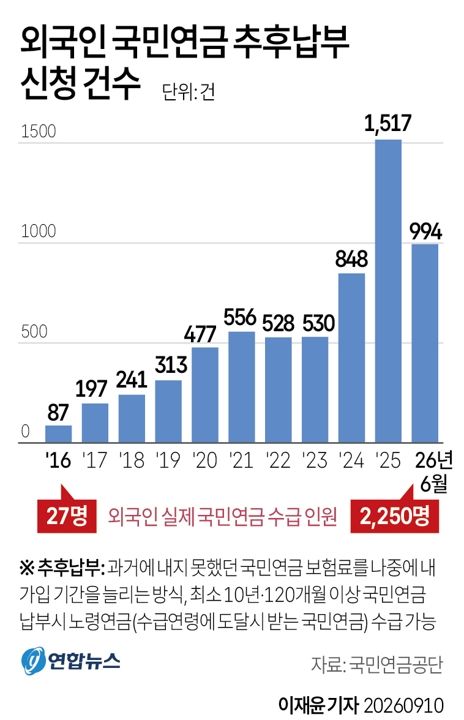
The particularly notable point is that the concentration of applications among foreign subscribers has grown even more pronounced. The number of applications by foreign nationals rose steadily from 87 in 2016 to 241 in 2018 and 477 in 2020. It then jumped to 848 in 2024 and 1,517 in 2025, while another 994 applications had already been filed in the first half of this year.
The number of people who actually began receiving pensions also increased sharply. Only 27 foreign nationals in 2016 had completed exactly 10 years of contributions through retroactive payments and become eligible to receive old-age pension benefits every month for life. By June this year, the figure had surged 83.3-fold to 2,250. This suggests that foreign nationals with short contribution periods in Korea have used retroactive payments to meet the minimum contribution period and secure eligibility for old-age pension benefits.
Measures Underway to Prevent Side Effects... Government and National Assembly Begin Preparing Countermeasures
As applications for retroactive payments have begun rising again among both Korean and foreign nationals, the government and the National Assembly of the Republic of Korea have begun preparing measures to prevent abuse. The Ministry of Health and Welfare (MOHW) and the NPS plan to first revise the screening criteria for foreign nationals. Under the new approach, only months in which applicants actually stayed in Korea for at least 15 days will count as periods of residence, based on records of entry into and departure from the country.
The government also plans to block retroactive payments entirely for periods when applicants did not live in Korea. In addition, under the principle of reciprocity, Korea will allow retroactive payments only for nationals of countries that permit Korean nationals living there to make such payments. This principle will be introduced through amendments to relevant laws and regulations.
Legislative efforts are also emerging. Kim Mi-ae of the People Power Party has proposed a bill that would restrict retroactive payments by foreign nationals under the principle of reciprocity. Even where reciprocity is recognized, applicants would be required to have paid National Pension contributions in practice for at least 12 months before applying for retroactive payments.
Beyond these measures, pension authorities are also preparing fundamental reforms that would apply to both Korean and foreign nationals. Key proposals include allowing retroactive payments only in proportion to the period for which actual contributions were paid, or substantially reducing the current maximum retroactive-payment period of 119 months.
The government plans to draft specific amendments to the law soon, based on the findings of a commissioned study. The aim is to prevent people from making short-term contributions and then paying a lump sum to qualify for pensions, while ensuring fairness with subscribers who have faithfully paid contributions over many years.
[email protected] Kim Hee-sun Reporter