"Saturday Wedding in Wangsimni: Looking for Someone to Fill the Empty Seats"—Prospective Couples’ Group Chat Promotes a “Mutual Wedding-Guest Exchange” [What Do You Think?]
- Input
- 2026-09-10 19:00:00
- Updated
- 2026-09-10 19:00:00
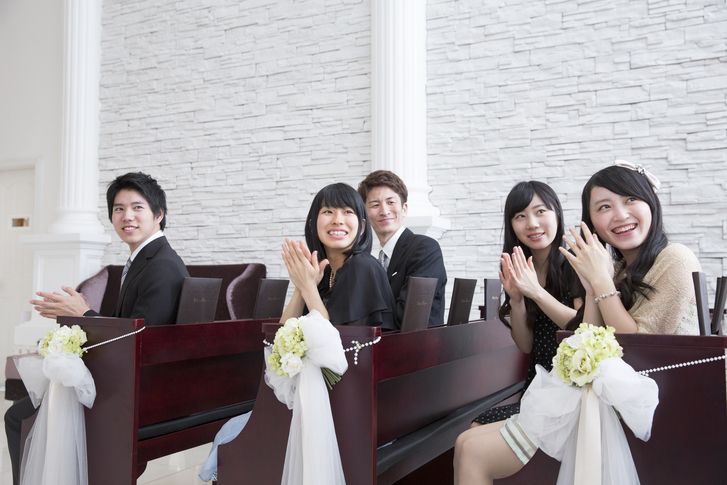
[Financial News] "I’m getting married in Wangsimni, Seoul, on the 28th. I’m looking for people who can fill the empty seats."
The post recently appeared in a KakaoTalk open chatroom for couples preparing to get married. With wedding costs soaring and guest lists shrinking, young people facing similar concerns are attending one another’s weddings to fill seats. This practice, known as a “mutual wedding-guest exchange,” is emerging as a new wedding custom.
Prospective Couples’ Community Swaps Mutual Attendance Instead of Paid “Wedding Guest” Services
Yonhap News Agency reported on the 10th that posts recruiting participants for mutual wedding-guest exchanges have been appearing one after another in communities for prospective couples and open chatrooms. In group chats with hundreds of members, participants share their wedding dates, venues and required numbers of guests, then coordinate schedules one-on-one. They agree in advance on detailed rules, including whether meals will be provided, the dress code and whether participants will pose as friends, co-workers or relatives at the venue.
The practice of attending each other’s weddings in turn is called “mutual attendance exchange” among participants. They attend the ceremonies naturally, as if they were actual acquaintances, offer congratulations and even join group photo sessions. Unlike traditional paid “wedding guest” services, which hire people for 20,000–50,000 won per day, this arrangement involves no separate service fee or wedding gift. Instead, participants exchange their attendance.
The search for such exchanges is driven by soaring wedding costs and the high barriers to booking wedding venues. According to Chamgagyeok, the Korea Consumer Agency’s price information portal, the median minimum guaranteed number of guests at wedding venues nationwide stood at 200 as of July. The median meal price was 60,000 won per person nationwide and 80,000 won in Seoul, while the median venue rental fee in Seoul reached 6.3 million won. Because couples are required to pay for meals for 200 people regardless of the actual number of guests, having too few guests can result in a substantial financial loss.
The reality that makes it difficult to mobilize a large network also plays a role. The average age at first marriage has risen to 33.9 for men and 31.6 for women, while frequent job changes and moves have made people more hesitant to call on a large circle of acquaintances. To prevent no-shows on the day of the ceremony, participants have developed their own trust rules, such as requiring a small deposit in advance or permanently removing people who fail to attend without notice from the community.
Joo (33), who used the service, told the media, "I was worried that there would appear to be too few guests during the photo session, but prospective couples in similar situations gathered and sincerely supported us, which gave me great strength. It also cost less than hiring paid guests, and the emotional bond was stronger."
Invitation Gatherings Also Cost a Lot... Preference for Clear “Give-and-Take” Relationships
Experts analyze the phenomenon as a combination of the financial burden in an era of high prices and the younger generation’s practical approach to forming relationships.
Lee Eun-hee, an emeritus professor in the Department of Consumer Studies at Inha University, explained, "The incidental costs of inviting guests, including invitation gatherings, are also considerable. Exchanging attendance is a highly practical alternative that reduces unnecessary spending."
Lee Su-jin, a research fellow at the Trend Korea Consumer Trend Analysis Center, also noted, "Young people prefer relationships with a clear purpose and give-and-take. This is a new form of relationship-building based on equivalence, in which each person exchanges the help they need on an equal basis."
[email protected] Moon Young-jin Reporter