"Ex officio investigation into unfair procurement even without a report... Rewards doubled"
- Input
- 2026-09-10 11:26:26
- Updated
- 2026-09-10 11:26:26
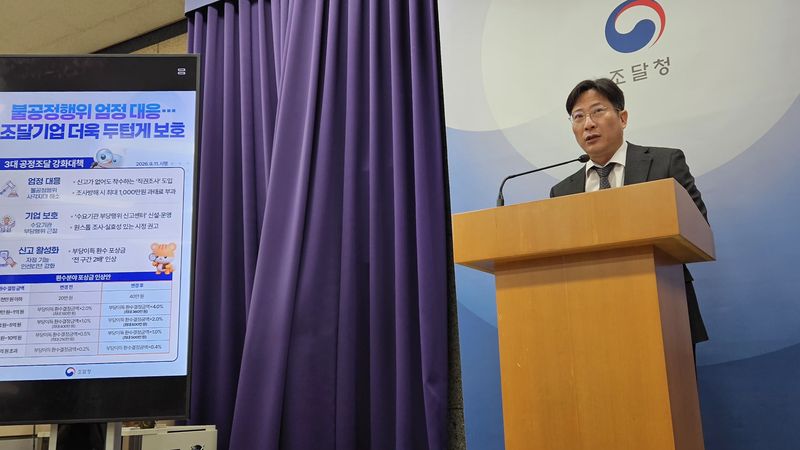
The Public Procurement Service announced that it has revised related subordinate regulations in accordance with the enforcement of the 'Procurement Business Act' amended last March and will begin full-scale implementation of the 'Fair Procurement Enhancement Plan,' which is centered on these details, starting on the 11th. This plan will be driven by three main pillars: strict response to unfair practices, substantial protection of procurement companies, and strengthened incentives for whistleblowers.
A fine of up to 10 million won for obstructing an investigation
Previously, public procurement investigations faced limitations as they relied on tip-offs and reports from victimized companies. This created blind spots where illegal activities were concealed when companies avoided reporting due to fear of repercussions. Accordingly, the Public Procurement Service has decided to introduce an "ex officio investigation" system, allowing it to directly initiate investigations without a formal report if there is clear evidence of unfairness, such as media reports, delivery inspection and quality check results, or a history of repeated violations. If a company refuses to comply with an investigating official's request for data submission or refuses, obstructs, or evades on-site investigations, a progressively increasing fine of up to 10 million won will be imposed, depending on the frequency and severity of the violations.
Establishment of Unfair Practices Reporting Center and Disclosure of Cases
Mechanisms have also been established to protect procurement companies from unfair practices by procuring agencies (public institutions, local governments, etc.) that exploit their superior position. A dedicated "Procuring Agency Unfair Practices Reporting Center" will be operated to address "abuse of power" behaviors, such as shifting costs that were not present at the time of bidding or demanding goods not included in the contract free of charge. The Public Procurement Service plans to prevent recurrence by issuing corrective demands and recommendations for institutional improvements to agencies where unfair practices are confirmed, and by publicly disclosing such cases on a quarterly basis.
From post-detection to 'preemptive prevention'
To encourage reporting of unfair procurement practices, rewards for reporting recovery will be doubled across all brackets. The reward for recovering 10 million won or less will increase from the existing 200,000 won to 400,000 won, and the payment ratios for each determined amount bracket will be raised, which is expected to further strengthen the market's self-correcting function against unfair practices.
The Public Procurement Service's introduction of ex officio investigations is interpreted as a determination to shift the paradigm of the public procurement supervision system from the existing "post-detection" approach to one centered on "preemptive prevention." The public procurement market, worth 200 trillion won annually, has been plagued by persistent irregular practices, such as broker involvement, name lending, and the disguised delivery of Chinese finished products as domestic goods.
Baek Seung-bo, Administrator of the Public Procurement Service, stated, "Illegal practices and unfair customs in public procurement ultimately become a burden on honest companies that compete diligently," adding, "We will build an advanced fair procurement ecosystem where principles prevail over illegal methods and fair competition prevails over unfair practices."
[email protected] Kim Won-jun Reporter