'Entire Water-Related Disaster Process Prediction': KICT Develops Domestic Simulation Model
- Input
- 2026-09-10 10:45:19
- Updated
- 2026-09-10 10:45:19
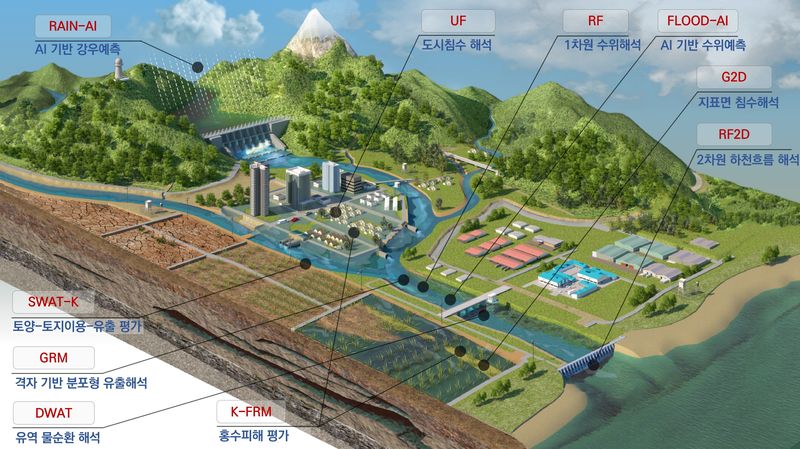
Until now, models developed overseas have primarily been used to analyze water-related disasters in Korea. These foreign models had limitations, including difficulty adequately reflecting the characteristics, climate, and topographical conditions of Korean rivers, as well as the costs of adopting and maintaining the technology. In particular, a vicious cycle has persisted in which the technological gap widened as expertise accumulated in Korea through water-related disaster analysis was instead used to improve the performance of foreign models.
To overcome these limitations, the research team at KICT's Water Resources and River Research Division significantly advanced its proprietary simulation model, which had previously remained at the academic research level, to a level suitable for practical use. The team also completed the WaterKICT model chain, an integrated model that organically connects the entire process of water-related disaster occurrence.
This simulation model is recognized for its technological capabilities and excellence both domestically and internationally. It has been listed as a recommended model by the World Meteorological Organization (WMO), a specialized agency of the United Nations (UN), and has been reflected in government policies, including preliminary feasibility study guidelines and river design standards. It is also being actively used in various research and practical fields requiring water-related disaster prediction and analysis, including the National Flood Forecasting System.
The research team expects that developing the WaterKICT model chain will reduce reliance on foreign models and establish a foundation for technological self-reliance in domestic water-related disaster analysis and prediction. In particular, it is expected to improve the accuracy of water-related disaster predictions and the efficiency of analysis, while providing a scientific basis for responding to disasters that recur every year.
Park Sun-kyu, president of KICT, said, "The WaterKICT model chain is a meaningful example of localization whose excellence has been recognized both domestically and internationally," adding, "This achievement will contribute to protecting the public from water-related disasters and advancing water resources management technology to the next level."
[email protected] Yeon Ji-an Reporter