KT, Asan Medical Center to Build an 'AI Hospital'—From Diagnosis to Patient Management with AI
- Input
- 2026-09-10 10:47:25
- Updated
- 2026-09-10 10:47:25
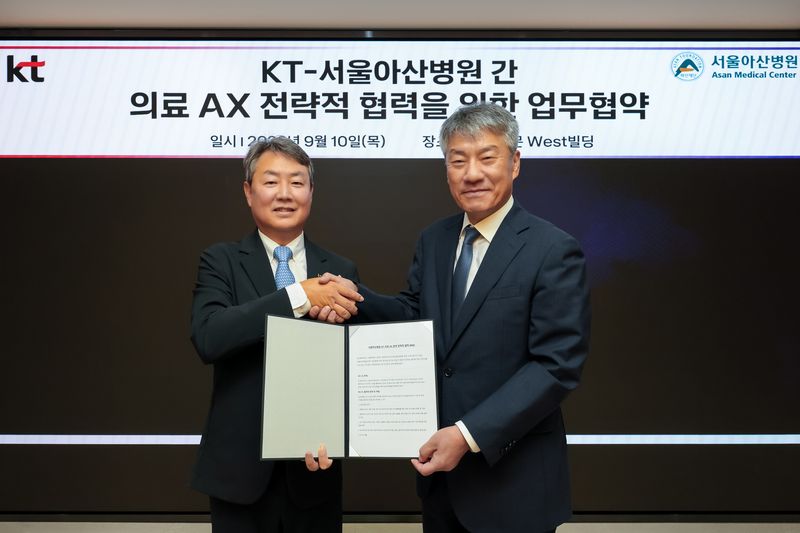
[Financial News] KT and Asan Medical Center are moving to build an 'AI hospital' that incorporates artificial intelligence (AI) into actual clinical settings, including diagnosis and patient management.
KT announced on the 10th that it had signed a memorandum of understanding (MOU) with Asan Medical Center for the construction of an AI hospital and the development of AI medical services for clinical application.
In line with the government's basic AI healthcare strategy, KT plans to identify and implement AI transformation (AX) models for medical settings, including a next-generation hospital information system. Its goal is to develop Asan Medical Center into a leading future healthcare hub for applying and validating medical AI technologies.
Drawing on its AI, cloud, data infrastructure, and AX platform capabilities, KT will support the development of service models and technology validation. It will also participate in planning and developing AI medical services for clinical application. Asan Medical Center will identify needs in clinical care, treatment, and research, while providing clinical consultation and efficacy evaluations during the development, demonstration, and validation of AI services. The two institutions plan to form a working-level consultative body later this month, pursue specific projects, and explore ways to apply and expand medical AI technologies in clinical settings.
Once the AI hospital is implemented, AI will support medical-image interpretation when patients visit the hospital and automatically collect and analyze health records scattered across multiple systems. Medical staff are expected to use this information to make faster diagnoses, while patients may experience shorter waiting times and improved quality of care.
The two institutions plan to gradually expand AI services whose clinical efficacy has been validated into medical settings. They will also pursue cooperation to address various challenges in the field, including AX-based clinical decision support and improvements to the patient experience.
Kim Bong-gyun, executive vice president and head of KT's Enterprise Division, said, "We will accelerate innovation in medical settings based on our AX platform capabilities and lead the development of future medical AI."
[email protected] Choi Hye-rim Reporter