Oh Se-hoon Makes Bold Move for 'G3 Seoul' with 86 Trillion Won Investment... Launches 5 Visions and 100 Tasks
- Input
- 2026-09-10 10:00:00
- Updated
- 2026-09-10 10:00:00
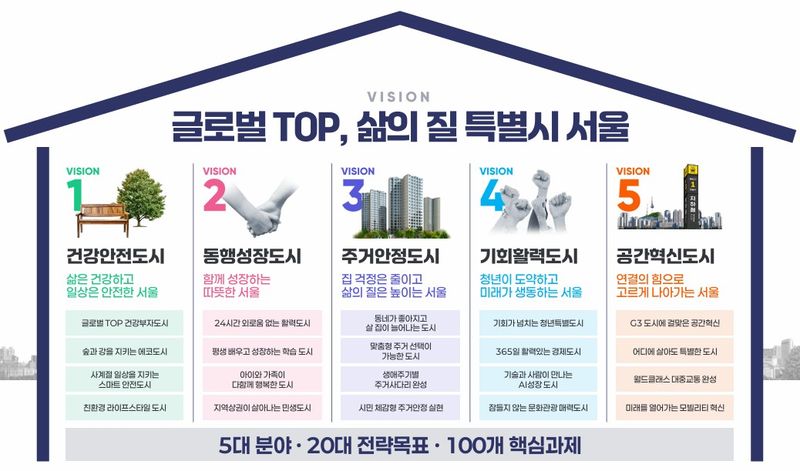
[Financial News] Seoul Mayor Oh Se-hoon is launching the "G3 Seoul Plan" in earnest, investing 86 trillion won by 2030 to elevate Seoul into a city with competitiveness and quality of life comparable to the world's top three cities. The plan envisions moving beyond mere external growth to raise the living conditions citizens experience—such as jobs, housing, health, and safety—to a world-class level. The Seoul Metropolitan Government announced on the 10th that it has finalized the G3 Seoul Plan, the top-tier strategy of the 9th popularly elected administration. It has established Health & Safety, Shared Growth, Housing Stability, Opportunity & Vitality, and Spatial Innovation as Seoul's five major future visions and will pursue 20 strategic goals and 100 key tasks to realize them.
First, to create a healthy and safe city, we will establish a '10-minute fitness zone (exercise + station access)' in front of your home. We will expand the number of Seoul Fitness on the Go centers from the current 20 to 100 and spread Fun Stations, utilizing unused subway spaces, to all autonomous districts. We will also create a health and vitality eco-platform throughout Seoul that connects forests, parks, and waterfront spaces.
In the field of the "City of Shared Growth," efforts will be made to address loneliness and disparities in education and care. Through "Seoul Without Loneliness 2.0," Seoul Mind Convenience Stores will be expanded to all autonomous districts, and programs will be operated to allow single-person households and others to share meals and interact. In the education sector, Seoul Learn will be expanded into offline coaching centers, and the eligibility criteria will be relaxed from 80% or less of the standard median income to 100% or less.
The focus of the Housing Stability City initiative is on expanding housing supply. Through 'Rapid Integrated Planning 2.0,' the plan aims to start construction on 310,000 units by 2031, applying a standard processing timeline to 85,000 units in key strategic redevelopment zones where construction can begin by 2028. Moa Housing manages 146 project sites in stages with the goal of starting construction on 40,000 units by 2031. Public housing will also be supplied in total, including 23,000 newly constructed public rental units and 70,000 purchased rental units. The Seoul-style public housing program 'Baro Nae Jip' will supply 6,500 units, and housing support tailored to the life cycle of young people, newlyweds, and the elderly will be expanded.
Key tasks for the Opportunity Vitality City include supporting youth, securing global talent, and revitalizing the night economy. The 'Youth AI Ladder' will be introduced to provide AI access passes and free basic education to 500,000 young people regardless of income, and 74,000 units of youth housing, 'The Dream House Plus,' will be supplied. The 'G3 Talent City, Seoul' initiative will also be promoted to support everything from attracting foreign master's and doctoral-level talent to housing and settlement.
It is also setting out to create a '24-hour vibrant economic city' where economic and cultural activities continue even at night. Nighttime stay-type content will be expanded at locations such as the Han River, Namsan, and Dongdaemun Design Plaza (DDP), and the Dalbit Night Market, which is being piloted in five locations this year, will be expanded to all autonomous districts in the future.
To create a spatial innovation city, we will promote the multi-nucleation of the city and mobility innovation. Sangam-dong-Susaek, Gasan-Guro District, Chang-dong-Sanggye, and Godeok-Gangil will be developed as four major urban centers, and 350 "pedestrian daily life centers" will be established within residential areas. Aiming to become the world's leading autonomous city, the number of autonomous buses will be increased from the current 16 to 500 by 2030. The number of autonomous taxis will also be expanded from the current 19 in the Gangnam District area to 50 in the Gangnam District and Sangam-dong areas by 2027. Furthermore, starting in the second half of 2026, Level 4 robotaxi demonstrations will commence to verify their safety and commercialization potential.
The Seoul Metropolitan Government plans to sequentially invest a total of 86.1 trillion won to implement these 100 key tasks, including 53.7 trillion won in city funds, 9.2 trillion won in state funds, and 23.2 trillion won in other sources such as the private sector. The city intends to finalize implementation plans for each task by the end of the year and continuously monitor progress to translate the plans into actual results.
Seoul Mayor Oh Se-hoon emphasized, "Becoming a 'Global Top 3' city is not merely about raising our global ranking, but a strategy to transform Seoul's competitiveness into a better life for every single citizen." He added, "I will prioritize the five future visions and 100 key tasks in city administration and see them through to the end to prove them through results, not just declarations." He continued, "Over the next four years, I will make Seoul a top global city that people around the world want to visit and citizens want to live in for a lifetime, as well as a 'Special City for Quality of Life.'"
[email protected] Seongchorong Reporter