South Chungcheong Province (Chungnam) Attracts 1.5303 Trillion Won in Investment from 27 Companies Across 8 Cities and Counties
- Input
- 2026-09-10 16:10:00
- Updated
- 2026-09-10 16:10:00
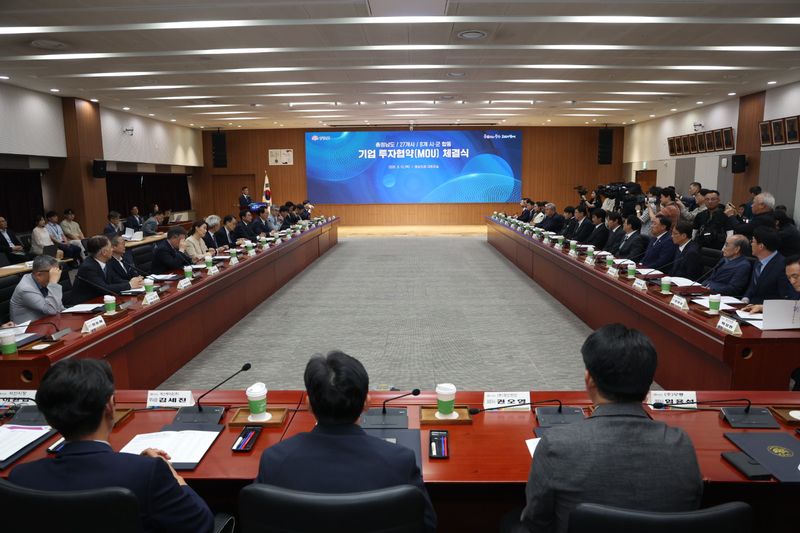
South Chungcheong Province (Chungnam) announced on the 10th that it signed a joint investment agreement with 8 cities and counties and 27 companies at the main conference room of the provincial government building. The signing ceremony was attended by Governor Park Soo-hyun, the heads and deputy heads of the 8 cities and counties, and representatives of the 27 companies.
Under the agreement, 27 companies plan to invest a total of 1.5303 trillion won to build, expand, or relocate production facilities on 568,672 square meters of land, including industrial complexes in eight cities and counties. The provincial government anticipates that if these companies execute their investments as planned, 1,811 new jobs will be created. Led by AI data centers, this investment encompasses not only Chungnam's key industries—such as semiconductors, displays, secondary batteries, automobiles, and aerospace—but also the entire spectrum of future high-tech industries.
Investment in Cheonan and Asan Continues in Auto Parts and Materials Industries
In Cheonan, automotive electronics manufacturer Company A is investing 113.5 billion won to relocate its Ansan factory to an individual site in Pungse-myeon, while SAMYOUNG PURE CHEMICALS CO., LTD., a manufacturer of ultra-high-purity hydrogen peroxide, is investing 98.9 billion won to expand its factory in the 5th General Industrial Complex. Organic light-emitting diode (OLED) material manufacturer DUK SAN NEOLUX CO., LTD. is investing 66.8 billion won to build a new factory in the Technopark General Industrial Complex, and primary battery manufacturer KD Coros Battery is also investing 36.5 billion won to expand its production facilities in the Seonggeo General Industrial Complex.
In Asan, KS Autosys is investing 35 billion won to build a new dry vacuum pump factory for semiconductors in Sinchang-myeon, and Company B, a manufacturer of automotive gaskets, is spending 16 billion won to relocate its Ansan factory to the Yeomchi General Industrial Complex. INCBIO, a cosmetics raw material supplier, is also investing 15 billion won to expand its factory within the same industrial complex.
Seosan to become a hub for secondary batteries and aerospace materials
In Seosan, SK On is investing 58.7 billion won to convert part of its existing electric vehicle battery line into production facilities for lithium iron phosphate (LFP) batteries for energy storage systems (ESS). At the Seosan Auto Valley General Industrial Complex, HVM CO., LTD., a manufacturer of advanced metals for aerospace, is investing 116.5 billion won to expand its factory, while automotive wire manufacturer Kyungshin Electric Wire (63.5 billion won) and transmission parts manufacturer MOORYONG CORPORATION LTD. (28.7 billion won) are also expanding their production facilities. At the Seosan Indus Valley General Industrial Complex, Woosung Metal is investing 30 billion won to expand its production plants for cast parts and lithium carbonate.
Relay investment also in Nonsan, Dangjin, Geumsan County, Seocheon County, and Hongseong County
In Nonsan, secondary battery manufacturer Routejade (27.1 billion won), food manufacturer Y&B Food (15 billion won), and transformer manufacturer gaonhae CO.,LTD. (6.6 billion won) are each expanding their factories. In the Dangjin Seokmun National Industrial Complex, iron phosphate manufacturer Youngjin (52.4 billion won), semiconductor thin film deposition material manufacturer LK CHEM Co., Ltd. (33 billion won), and black mass manufacturer EVACYCLE (30 billion won) are investing, and in the Bugok district of the Asan National Industrial Complex, packaging film manufacturer JK Advanced Materials and drawn steel pipe manufacturer Global Dream Steel are each establishing new factories.
In Geumsan County, Top Meat and Daehan Red Ginseng are each investing 10 billion won to build factories, while Aton Industry, a urea solution manufacturer, and Standards & Companies, a certification service provider, are newly moving into the Janghang National Ecological Industrial Complex in Seocheon County. Notably, Optimus CDC has decided to invest 600 billion won to establish a new AI data center in the Naepo Urban Advanced Industrial Complex in Hongseong County, marking the largest scale among the investments attracted this time.
South Chungcheong Province (Chungnam) estimated that the construction process, including site preparation and equipment purchase by these companies, would generate economic effects of 1.92 trillion won in production, 832.1 billion won in added value, and 10,247 jobs.
Recently, local governments have been intensifying their competition to attract high-tech industries, bolstered by the implementation of the Special Act on Semiconductors and policies to foster national strategic technologies. Amidst deepening concentration in the capital region, non-metropolitan municipalities are stepping up efforts to attract companies by offering tax breaks and support for the development of industrial complexes. In this context, South Chungcheong Province (Chungnam)'s successful attraction of a large number of AI data centers and companies specializing in secondary batteries and semiconductor materials is considered a significant achievement in terms of balanced regional development.
At the signing ceremony, Governor Park Soo-hyun stated, "I express my gratitude to each company that decided to make bold investments, believing in the potential of Chungnam despite difficult economic conditions." He added, "Through today's agreement, a total of 1.5303 trillion won in investment will be made within the province, creating 1,811 new jobs." He further remarked, "I look forward to leveraging the industrial strengths of the eight cities and counties and strengthening inter-industry linkages to revitalize the local economy and accelerate balanced growth in Chungnam."
South Chungcheong Province (Chungnam) plans to focus on follow-up management to ensure that investments by signatory companies lead to actual construction and implementation, while concentrating administrative efforts on attracting large-scale blue-chip companies centered on future advanced industries such as artificial intelligence and semiconductors.
[email protected] Kim Won-jun Reporter