The Federation of Korean Industries (FKI): "Future Vehicles and Small Modular Reactors (SMRs) Should Be Included in the Domestic Production Tax Credit"
- Input
- 2026-09-10 09:30:09
- Updated
- 2026-09-10 09:30:09
[Financial News] Suggestions have been raised to include future vehicles, biopharmaceuticals and vaccines, and Small Modular Reactors (SMRs) in the 'Domestic Production Tax Credit,' which supports the expansion of the domestic production base. Additionally, it has been pointed out that the plan to exclude large corporations from the Integrated Employment Tax Credit needs to be reconsidered in order to address the youth unemployment issue.
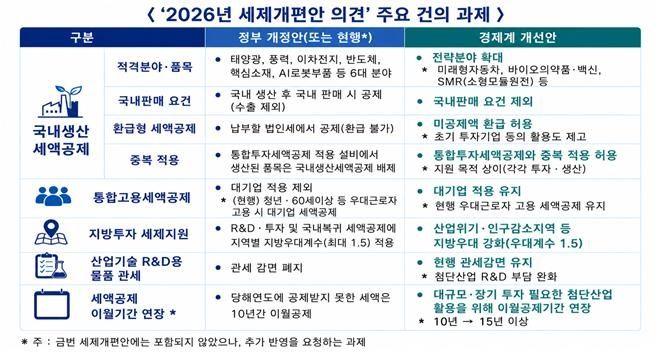
The Federation of Korean Industries (FKI) announced on the 10th that it had submitted an opinion paper to the National Assembly containing suggestions for improvement and supplementation regarding the government's '2026 Tax Reform Plan.' The opinion paper includes a total of 51 tasks across 10 laws, incorporating opinions from major domestic companies to enhance the effectiveness of tax support aimed at promoting domestic production, investment, and employment.
In particular, FKI proposed five major improvement tasks, including: improving eligibility and requirements for the Domestic Production Tax Credit; maintaining the application of the Integrated Employment Tax Credit for large corporations; expanding tax support for regions facing industrial crises or population decline; maintaining tariff reductions for goods used for industrial technology research and development (R&D); and extending the carryover period for tax credits for R&D and investment.
First, FKI proposed that the Domestic Production Tax Credit support be expanded to include future vehicles, biopharmaceuticals and vaccines, and SMRs, in addition to the six major fields of solar, wind, secondary batteries, semiconductors, core materials, and AI robot components. They also suggested that finished robot products, Liquid Hydrogen, a key means for the widespread adoption of hydrogen vehicles, and Sustainable Aviation Fuel (SAF), an eco-friendly fuel, should be additionally considered as eligible for support.
In addition, it was emphasized that while the government has excluded export volumes from the Domestic Production Tax Credit, it must support export volumes as well, as is done in the U.S. and Japan, to increase the utilization of the Domestic Production Tax Credit.
It also included a proposal to provide tax benefits, such as the Integrated Investment Tax Credit for industrial crisis areas and the application of the highest local preferential coefficient of 1.5 among Domestic Production Tax Credits for population-declining areas, in order to induce new investment in industrial crisis areas and maintain production bases in population-declining areas.
In addition, there is an opinion that tariff reductions on research and development goods need to be maintained to secure R&D competitiveness in advanced industries.
This is due to concerns that the abolition of tariff reductions could increase the burden of R&D costs and worsen cost competitiveness, as advanced industries such as future vehicles and autonomous driving frequently utilize R&D components, pilot parts, and overseas prototypes for pre-mass-production performance evaluation and quality verification.
FKI proposed extending the carry-forward period for tax credits, such as those for investment and R&D, as a task that needs to be additionally reflected in the government's tax reform plan. Current tax laws allow tax credits that could not be claimed because there was no or too little corporate tax to be paid in the relevant year to be carried forward for up to 10 years.
However, since high-tech industries such as semiconductors and biotechnology take a long time to generate profits after large-scale upfront investments, companies may not be able to fully utilize tax credits within 10 years if initial deficits persist. Therefore, there is a need to extend the tax credit carryforward period to at least 15 years to allow companies to fully take advantage of tax credit benefits.
Sangho Rhee, Head of the Economic Division at FKI, stated, "It is necessary to rationally improve and supplement the eligibility criteria and requirements during the regular session of the National Assembly so that companies can actually utilize tax benefits to increase production, investment, and employment."
[email protected] Park So-hyun Reporter