"Why don't figure skaters get dizzy even when spinning?"... Dizziness improves by 90% with vestibular rehabilitation [Weekend Health]
- Input
- 2026-09-10 10:49:41
- Updated
- 2026-09-10 10:49:41
[Financial News] The fact that figure skaters can spin rapidly without getting dizzy is not due to innate talent, but the result of repeated training. Likewise, dizziness in the elderly can be significantly improved by boosting the brain's adaptability through exercise.
Kim Min-beom, a professor of otolaryngology at Catholic Kwandong University International St. Mary's Hospital and a special director of the Korean Otological Society, emphasized on the 10th, "If dizziness or gait abnormalities persist for more than three months, early diagnosis to confirm the need for treatment through balance function tests is the priority." He added, "Subsequently, the speed of recovery can be accelerated by combining rehabilitation treatment through active training with improvements in the living environment," stating, "Dizziness is not the fate of aging, but a condition that can be overcome through training."
Dizziness leads to falls and isolation
It has been found that one in three elderly people has experienced dizziness severe enough to interfere with daily life within the past year. The incidence increases with age, with some studies showing that it reaches 35–40% in those aged 70 and older. Experts emphasize that this should be viewed not merely as a phenomenon of aging, but as a health problem requiring active treatment.
When dizziness occurs, the posture becomes unstable, significantly increasing the risk of falls. In particular, if a femoral fracture occurs, not only are treatment costs amounting to tens of millions of won per person, but the need for caregivers or family members also results in substantial socioeconomic losses.
Dizziness poses no physical danger. When symptoms arise, the fear of falling leads to reduced activity levels, which in turn results in decreased muscle strength and perpetuates a vicious cycle. It has also been reported that reduced activity leads to isolation and a tendency for cognitive function, particularly spatial awareness, to decline.
This is related to the aging of the balance system. Humans maintain balance by integrating information from the eyes, ears, muscles, and joints in the brain; among these, the equilibrium function handled by the ears is narrowly referred to as the 'vestibular function.' As the functions of these sensory sensors decline together due to aging, recovery becomes slower, and dizziness inevitably persists for a longer period.
According to recent studies, if symptoms persist for more than three months, such as difficulty standing upright or walking, dizziness when moving the head, and the world appearing to shake while walking, one should suspect 'Age-Related Vestibular Loss' and undergo testing. This condition is reported to occur in 5 to 10 percent of the elderly population.
"Exercise over medicine"... Nearly 90% improvement with vestibular rehabilitation
As a treatment method, 'vestibular rehabilitation therapy' through exercise is recommended over medication. While medication helps reduce symptoms such as dizziness or vomiting, long-term use can actually hinder recovery and lead to drug dependence. On the other hand, exercise therapy is a method that enhances the brain's adaptability to maintain balance by utilizing other senses, such as the eyes or joints, even if ear function is somewhat impaired.
Vestibular rehabilitation therapy is prescribed individually for each patient and involves performing standing exercises, seated head-turning exercises, and walking exercises three times a day for 30 minutes each.
Treatment is broadly divided into four categories: 'adaptation training,' which involves identifying and repeating movements that are difficult to perform or cause dizziness; 'substitution training,' which helps maintain balance using the eyes or joints when auditory function is impaired; 'habituation training,' which involves gradually increasing the intensity when severe dizziness is felt in specific postures; and 'posture and gait training,' which involves walking while moving the head or shifting the gaze.
A comparison of dizziness scales before and after treatment in patients with Age-Related Vestibular Loss was reported to have shown statistically significant improvement in about 90% of cases.
The prescribed exercises vary depending on the pattern of symptoms. If vision becomes blurry and dizziness occurs when moving the head to look at objects, 'gaze stabilization exercises' are prescribed; if symptoms worsen when moving the head in a specific direction or changing posture, habituation exercises for that posture are prescribed. In cases where walking is difficult due to severe staggering while standing or walking, training is conducted to stabilize the posture first before starting to walk.
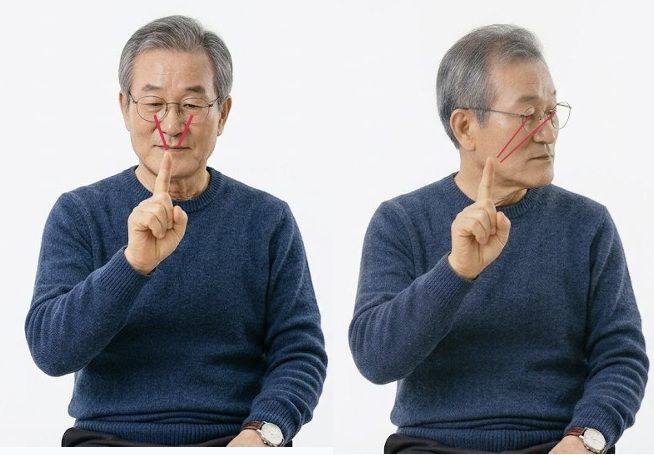
There are also training methods that can be done at home. A representative example is the 'gaze stabilization exercise,' which involves fixing a finger 30 cm in front of your eyes and turning your head from side to side while staring at the finger. As you gradually increase the speed of head rotation, the intensity of the exercise also increases. Once you become familiar with this movement, you can increase the difficulty by moving your finger along with the movement or turning your head while walking. In addition, it is important to reduce the risk of falls by maintaining a bright and familiar environment at home.
[email protected] Jeong Myeong-jin, Medical Specialist Reporter