"Surge in construction activity at Iran's 'Pickaxe Mountain,' where Trump has hinted at striking a nuclear facility"
- Input
- 2026-09-10 06:30:22
- Updated
- 2026-09-10 06:30:22
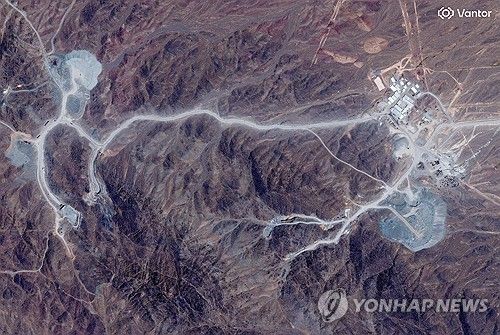
[Financial News] An analysis by a U.S. think tank indicates that construction activity has surged this year at Pickaxe Mountain, a suspected underground nuclear facility in Iran. Pickaxe Mountain is the site where U.S. President Donald Trump has mentioned the possibility of an attack on several occasions.
According to an analysis report posted on the website today by Joseph Rogers, deputy director of the Nuclear Issues Project at the Center for Strategic and International Studies (CSIS), road construction activity has been detected at Pickaxe Mountain more frequently than ever this year.
CSIS assessed that there has been a distinct surge in construction activity consistent with work to raise and reinforce entrances to the underground facilities, pave internal road networks, reinforce areas around the entrances, and level and remove excavated soil.
Frequent road construction activity detected
The analysis was based on various images of Pickaxe Mountain and the nearby Natanz nuclear facility dating back to 2020. CSIS said it used six years of Synthetic Aperture Radar (SAR) change-detection data, Sentinel-2 optical change-detection data, Airbus Very High Resolution (VHR) imagery from July 9, 2026, and Satellogic imagery from August 9.
The report stated, "Clear traces of three stages of activity were identified at five major points of interest and the roads connected to them, suggesting a transition from excavation to internal construction and external reinforcement."
It added, "The ongoing construction activity, the lack of an enhanced internal security posture, and the absence of vehicles and equipment unrelated to construction suggest that, even if the purpose is enrichment, this underground facility does not yet have the capability to conduct uranium enrichment."
It said that the Israeli intelligence services' claim that Iran had moved centrifuges for enriching uranium, a material used in nuclear weapons, to Pickaxe Mountain could neither be refuted nor substantiated.
The report noted that Iran may be constructing a centrifuge assembly facility at Pickaxe Mountain and may also be housing a uranium enrichment facility, with the aim of enriching approximately 440 kilograms of 60%-enriched uranium to weapons-grade material.
Difficult to strike, underscoring the importance of diplomatic efforts
Another possibility, it said, is that Iran could move additional nuclear weapons-related research and activities to Pickaxe Mountain.
It added, "Although publicly available data alone is insufficient to fully determine what is happening at Pickaxe Mountain, it is suspicious that Iran is constructing a facility just 2 kilometers from Natanz."
Pickaxe Mountain has long been suspected of housing an Iranian nuclear facility. Iran announced in 2020 that it would begin constructing an underground centrifuge assembly facility near Natanz and has since refused inspections by the International Atomic Energy Agency (IAEA).
President Donald Trump said on July 21 that he would "strike Pickaxe Mountain very hard" soon, and on the 4th he also said, "If something is going on there, we can strike soon."
However, CSIS pointed out that it would be difficult to destroy the underground facilities at Pickaxe Mountain with the Massive Ordnance Penetrator (MOP) bombs currently possessed by the United States.
The report stated, "Pickaxe Mountain is a deeply buried granite fortress that would be difficult to destroy even with the U.S.'s most powerful non-nuclear munitions, such as the GBU-57 bunker buster," adding, "Although a military attack could weaken or temporarily disable it, sustained bombing of Iran's nuclear infrastructure is not viable, demonstrating the need for a verifiable diplomatic solution."
In this regard, CNN reported, "The military is working to develop a 'next-generation penetrator bomb' capable of replacing the current MOP and striking more deeply buried targets," adding, "A contract to develop a prototype was signed last September, and the Air Force solicited proposals from the defense industry for the new weapon last June."
[email protected] Lee Seok-woo, International Specialist Reporter