'Big Spenders' in Their 60s Leave, 20s Arrive... "Signal of a Generational Shift in the Auto Market"
- Input
- 2026-09-14 06:59:00
- Updated
- 2026-09-14 06:59:00
■ Forecast of growing demand from the elderly reversed in one year
This result directly contradicts previous forecasts. In a report titled "Changes in Demographic and Social Structure and the Domestic Automobile Market," released last March, the Korea Automotive Technology Institute (KATECH) analyzed that demand from the elderly, whose population is growing rapidly, was expected to increase.
Lim Hyun-jin, a senior researcher at KATECH who authored the report, predicted, "As elderly drivers experience changes in income and physical function, demand is expected to increase for vehicles that are easy to drive and practical," adding, "The influence of the elderly in the future automobile market will grow." In fact, the number of registered vehicles owned by people in their 60s increased from 2.71 million in 2015 to 4.2 million in 2020 and 4.85 million in 2024, while the number for people in their 70s also rose from 800,000 to 1.44 million during the same period.
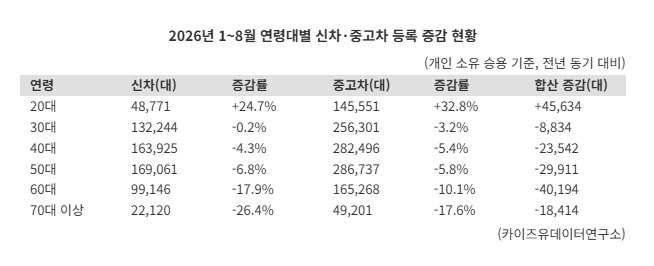
However, this year the trend moved in the opposite direction. New-car registrations among people in their 60s fell 17.9% to 99,146, while registrations among those aged 70 and over dropped 26.4% to 22,120. The decline was much steeper than among people in their 50s (-6.8%) or 40s (-4.3%). The share of new-car registrations by people in their 60s rose from 10.7% in 2017 to 17.9% last year, then fell to 15.6% this year, while their share of used-car transactions declined for the first time after rising for eight consecutive years.
A decline in new-car registrations is usually interpreted as a shift to used cars because of the price burden, but the pattern is different this time. Used-car transactions fell 10.1% among people in their 60s and 17.6% among those aged 70 and over. Demand did not simply shift to used cars; it left the market altogether. Of the 40,081-unit decline in private passenger car registrations from January to August, people aged 60 and over accounted for 29,611, or 73.9%. That was more than the combined decline among people in their 30s, 40s, and 50s.
■ Increase only among people in their 20s... "A generation with high accessibility to electric vehicles"
By contrast, the trend among people in their 20s was the exact opposite. New-car registrations surged 24.7% to 48,771, while used-car transactions jumped 32.8% to 145,551. The combined total reached 194,322, up 30.7%, making this the only age group to show an upward trend. Their share of new-car registrations rebounded to 7.7% this year, up 1.9 percentage points from last year's 10-year low of 5.8%, while their share of used-car transactions also reached a 10-year high of 12.3%.The key vehicle type driving the increase in demand among people in their 20s was the electric vehicle. Of the 9,666-unit increase in new-car registrations among people in their 20s, electric vehicles accounted for 6,678, or 69.1%, and hybrids for 2,960, or 30.6%. By contrast, gasoline-vehicle registrations stood at 23,775, roughly unchanged from the previous year.
Electric-vehicle registrations increased across all age groups. Registrations rose by 20,207 among people in their 30s, 24,355 among those in their 40s, and 16,005 among those in their 50s. Nevertheless, total new-car registrations fell by 282 among people in their 30s, by 7,451 among those in their 40s, and by 12,403 among those in their 50s. This was due to a roughly 21–25% decline in gasoline-vehicle registrations in those age groups. While people in other age groups replaced internal-combustion-engine vehicles with EVs, people in their 20s effectively added EVs without reducing their internal-combustion-engine vehicles.
Cheol Jo, a senior research fellow at the Korea Institute for Industrial Economics & Trade (KIET), explained, "People who have driven internal-combustion-engine vehicles find it difficult to switch to EVs, whereas young people entering the market are simply adapting to something new, making EVs easier for them to approach."
By vehicle class, midsize cars increased by 6,239, accounting for 64.5% of the increase among people in their 20s. The increase in light cars was only 414. Demand among people in their 20s therefore shifted toward midsize electric vehicles rather than low-cost compact cars.
However, the rebound among people in their 20s did not offset the exodus of older consumers. The two markets saw an increase of 45,634 vehicles among people in their 20s, fewer than the 58,608 vehicles lost by those aged 60 and over. From January to August this year, private passenger car registrations totaled 635,267, down 5.9% from the same period last year, while used-car transactions totaled 1,185,554, down 2.9%. The overall market appears to be shrinking as its core consumer base changes.
[email protected] Kim Dong-chan Reporter