After France Visit, Lee Says "My Term Is Clearly Limited by the Constitution," Directly Quelling Reelection Amendment Controversy
- Input
- 2026-09-10 03:00:00
- Updated
- 2026-09-10 03:00:00
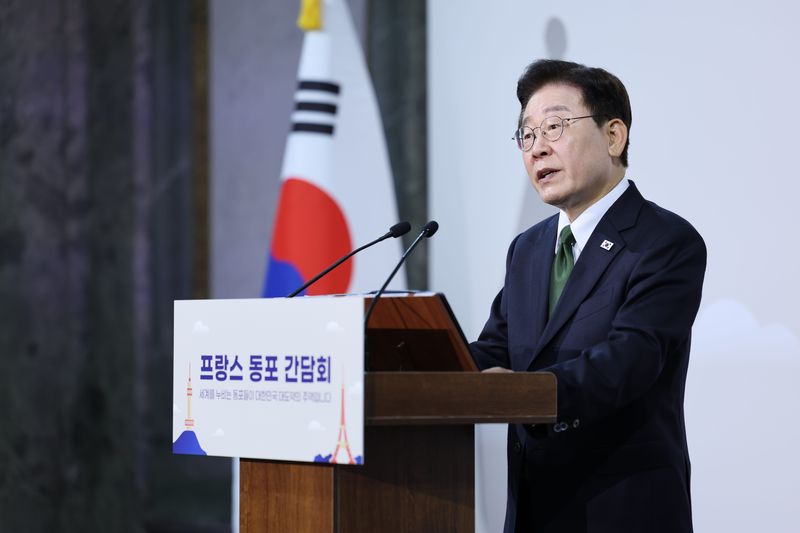
At a luncheon meeting with Korean residents in Paris, Lee explained why he had accelerated summit diplomacy from the beginning of his presidency and addressed the issue of his term. He said, "In fact, meetings between leaders and summit diplomacy provide good opportunities for trade, investment and the security environment of the Republic of Korea, which is known as an open trading nation," adding, "In any case, because my term is clearly limited by the Constitution, we have to start quickly to benefit from those effects." He continued, "Even if we establish very good relations in the latter part of my term, their use will inevitably be limited by then."
Although the remarks came while he was explaining his summit diplomacy schedule, this was the first time Lee had delivered a direct message regarding a constitutional amendment allowing reelection.
Lee met with Yaël Braun-Pivet, president of the French National Assembly, and asked for parliamentary support for economic and defense-industry cooperation between the two countries. He then held a luncheon meeting with Korean residents in France, listening to their difficulties in living and establishing themselves there. He concluded his schedule by meeting Mathias Cormann, secretary-general of the Organisation for Economic Co-operation and Development (OECD), before boarding Air Force One at Paris Orly Airport for the flight home.
At the summit with President Emmanuel Macron the previous day, the two leaders agreed to continue close coordination to ensure stability and freedom of navigation in the Strait of Hormuz and to restore global supply chains swiftly. Cheong Wa Dae, however, clarified that no specific troop deployment plan had been discussed at the summit and that South Korea's practical contribution remains under review.
In defense and security, the two sides signed an amendment protocol to the Agreement on the Protection of Classified Military Information and agreed to pursue the early conclusion of a mutual logistics support agreement. In the economic and industrial sectors, they set a goal of increasing bilateral trade to $20 billion by 2030. During the visit, the two countries adopted a total of 16 agreements, including memorandums of understanding, covering areas from the military and aviation to AI, semiconductors, quantum technology, nuclear power, space and biotechnology.
In the nuclear sector, the two countries agreed to launch a new high-level civilian nuclear dialogue. Through a cooperation protocol between Korea Hydro & Nuclear Power (KHNP) and Orano, they will seek to diversify the uranium enrichment supply chain and cooperate on the development of safety technologies for next-generation reactors. In AI, semiconductors and quantum technology, they will expand mutual market access for startups from both countries and joint research and development (R&D) between companies and research institutions. Samsung Electronics also joined French AI startup Mistral AI as a strategic investor in conjunction with the state visit.
Before the Paris schedule, the two leaders co-chaired the Lumière Summit in Saint-Paul-de-Vence in southern France and agreed to pursue the Lumière Partnership, under which each country will invest €500 million in the film and video industries over five years starting in 2027.
Lee also faces a number of domestic issues that must be addressed after his return. In particular, controversies surrounding Kim Seung-won, the nominee for justice minister, and Yong Hye-in, the nominee for minister of gender equality and family, are continuing amid confirmation hearings. Against this backdrop, Lee appears to have moved directly to prevent the reelection amendment issue, which the opposition has been attacking, from spreading further.
Lee must also decide how South Korea will contribute regarding the Strait of Hormuz. Since the government has not finalized a specific approach, including troop deployment, discussions are expected to continue after his return through relevant ministries and the National Security Council (NSC). After broadening diplomatic, security and industrial cooperation in France, Lee will once again face domestic and international issues at home, including personnel controversies, public sentiment over real estate and follow-up discussions on the Strait of Hormuz.
[email protected] Seong Seok-woo Reporter