Chung Dong-young: "U.S.-North Korea Talks Are a Window of Opportunity; We Must Open the Way to a Peace Regime on the Korean Peninsula"
- Input
- 2026-09-09 17:11:45
- Updated
- 2026-09-09 17:11:45
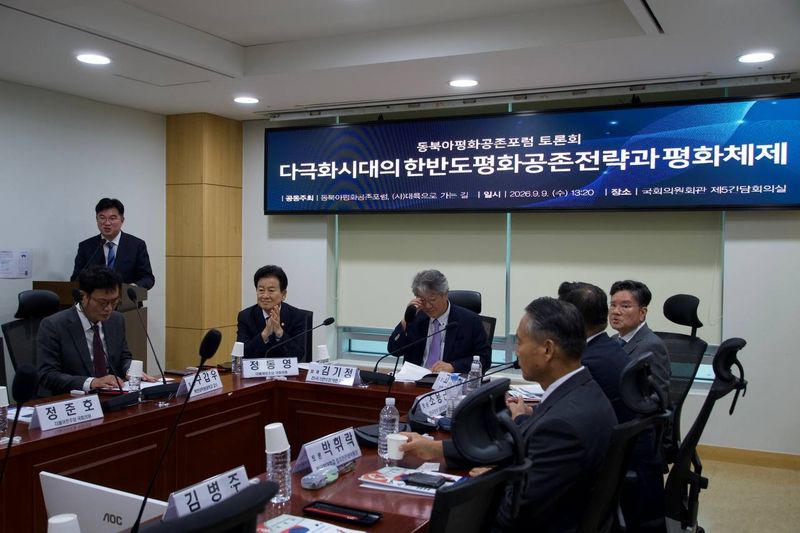
[Financial News] Democratic Party of Korea lawmaker Chung Dong-young’s lawmakers’ research group, the Northeast Asia Peaceful Coexistence Forum, held a discussion on the ninth in Meeting Room 5 of the National Assembly Members' Office Building under the theme “Strategies for Peaceful Coexistence and a Peace Regime on the Korean Peninsula in an Era of Multipolarity.”
The discussion was attended by Chung, Democratic Party of Korea lawmaker Jeong Jun-ho, who serves as the forum’s lead research member, and Park Jeong.
Chung pledged, “For us, who have experienced war, building a peace regime on the Korean Peninsula where war is unnecessary is our foremost task.” He added, “U.S. President Donald Trump’s expression of his desire to talk with Chairman Kim Jong Un will be the first and last window of opportunity for the Lee Jae-myung administration to establish a peace regime on the Korean Peninsula. Let us make sure to open this window of opportunity, build a peace regime, and bring peace to full bloom on the Korean Peninsula.”
Chung also emphasized the significance of transforming the armistice regime into a peace regime, saying, “Establishing a peace regime on the Korean Peninsula is also an absolute prerequisite for realizing the three mega-projects that will determine the future success or failure of the South Korean economy.”
Kim Ki-jung, former president of the Institute for National Security Strategy, who delivered the keynote presentation, said, “If peaceful coexistence is a concept concerning the form of relations, a peace regime is an institutional mechanism for realizing that form.” He added, “Its core is transforming the Armistice Agreement into a peace agreement.”
He also stated, “A peace regime on the Korean Peninsula must combine inter-Korean agreements, international guarantees, and multiple peace agreements. Its essential framework will consist of a multilateral agreement among North Korea, South Korea, the United States, and China, along with a bilateral North Korea–U.S. peace agreement.”
Koo Kab-woo, a professor at the University of North Korean Studies who participated in the discussion, said denuclearization should be redefined as a subordinate agenda item in negotiations on a peace regime amid a new imperialist era marked by U.S.-China rivalry and the absence of a global hegemon. He said the issue should be approached through a phased path of halting the advancement of North Korea’s nuclear capabilities, imposing controls, and pursuing disarmament.
He also stressed the need to pursue a peace declaration, rather than merely declaring an end to the war, to prevent the Armistice Agreement from being undermined. He proposed activating flexible negotiating frameworks, including six-party multilateral talks and a four-party peace declaration. Specific tasks he suggested included declaring a suspension of South Korea-U.S. joint military exercises, dispatching special envoys to persuade China and the United States, and establishing a preparatory committee for a peace agreement.
Cho Yong-geun, a former director of North Korea policy at the Ministry of National Defense, explained that the risk of accidental armed clashes and escalation has increased as North Korea fortifies the Korean Demilitarized Zone (DMZ) and reinforces its forward-deployed firepower. He stressed that, to ease tensions between the two Koreas, South Korea should effectively demilitarize its side of the DMZ, declare the Military Demarcation Line (MDL) a peace zone, and consider the proactive restoration of provisions in the September 19 Military Agreement, including the ground buffer zone. He also said the two Koreas should restore their military hotline while pursuing strategic communication with China and Russia to secure leverage for crisis management.
Park Hwi-rak, a former dean of Kookmin University Graduate School of Politics and Leadership who participated in the discussion, pointed out that peace cannot be established through unilateral declarations or hope alone. He said the reality that North Korea continues to pursue an offensive strategy toward South Korea and strengthen its nuclear forces must be faced squarely. In particular, he warned that, given North Korea’s explicit designation of “territorial completion” as the mission of its nuclear forces and its continued development of substantive nuclear capabilities, it would be dangerous to accept nuclear arms control instead of denuclearization or to emphasize engagement while overlooking North Korea’s responsibility.
Koh Yu-hwan, former president of the Korea Institute for National Unification (KINU), chaired the discussion. He concluded by saying that raising the issue of a peace regime only now, after failing to bring it to the forefront under previous democratic administrations, makes it difficult to catch up with North Korea’s changed policy line. He called for a peace-regime plan based on a practical, new response paradigm that soberly recognizes the security reality of the two hostile states defined by North Korea and corresponds to that reality.
[email protected] Kim Kyung-soo Reporter