Jeju National University Registers 239 International Students on Campus, Provides On-Site Fingerprinting Support
- Input
- 2026-09-09 17:01:12
- Updated
- 2026-09-09 17:01:12
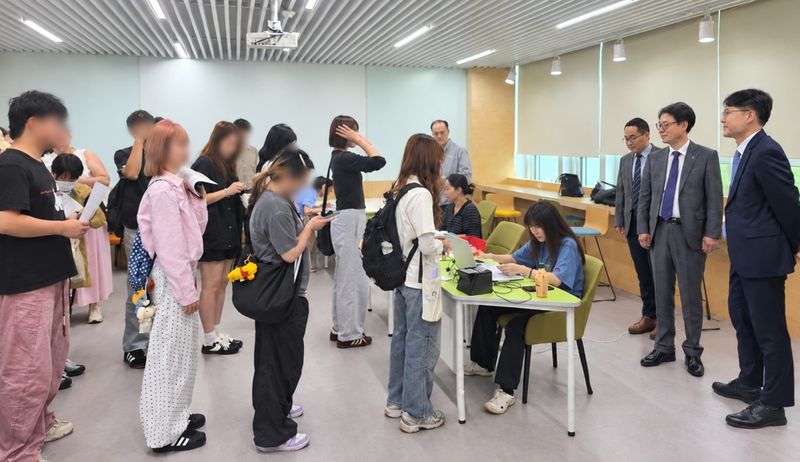
【Financial News Jeju = Jung Yong-bok】 A total of 239 newly enrolled international students at Jeju National University completed procedures for foreigner registration, including fingerprint registration, on campus instead of visiting an immigration office in person. As the number of international students has risen to 733 from 42 countries, the university and immigration authorities are strengthening support systems to reduce the administrative burden during the early stages of arrival and help students settle in smoothly.
According to Jeju National University on the 9th, the university and the Jeju Immigration Office operated a mobile immigration service for 239 new international students and language trainees over two days, from the 7th to the 8th.
Officials from the Jeju Immigration Office visited the university to register students’ fingerprints and guide them through the administrative procedures required for foreigner registration. The students completed the relevant procedures on campus without having to visit the immigration office separately.
Foreigner registration is a basic administrative procedure required for international students staying in Korea for an extended period. Under the Immigration Control Act, foreigners who intend to stay in Korea for more than 90 days from the date of entry must register as foreigners within 90 days of entering the country.
The registration process includes verifying the student’s place of stay and status of stay, as well as registering identifying information such as fingerprints. For new international students unfamiliar with Korea’s administrative system and language, this can be an added burden at the beginning of the semester, when they must also prepare for classes.
The mobile immigration service was introduced to ease these difficulties. Jeju National University and the Jeju Immigration Office have operated the university-visit service annually since 2020.
The service also comes amid a rise in the number of international students at Jeju National University.
As of September 1 this year, Jeju National University had 733 international students from 42 countries, including graduate students. The figure has increased by 157 from 576 in 2023, a rise over three years. The number of undergraduates, language trainees and exchange students grew 32.9%, from 359 last year to 477 this year.
As the university expands its recruitment of international students, the importance of support for their stay and daily lives after admission is also growing. Beyond increasing enrollment, establishing a support system that covers initial administrative procedures, Korean-language education, and academic and daily-life adjustment has become another challenge in the university’s internationalization efforts.
Jeju National University is expanding its recruitment of international students through Learncation, a regular student-exchange program; the Global Korea Scholarship (GKS) R&D track; and Korean-language courses. This year, it recruited 37 students through the GKS R&D track, while enrollment in its Korean-language program rose from 187 in the fall semester last year to 217 this year.
Yang Deok-soon, president of Jeju National University, and Ha Yong-guk, head of the Jeju Immigration Office, also visited the mobile immigration service site. They reviewed its operation and discussed ways to help international students settle in securely and strengthen cooperation between the two institutions.
Wonseob Song, director of international affairs at Jeju National University, said, "We will reduce the burden on international students caused by unfamiliar administrative procedures during the early stages of their arrival so that they can focus on their studies with stability. We will continue to expand practical cooperation with relevant organizations."
Ha Yong-guk said, "We will expand field-oriented services to ease the administrative burden on international students who are busy preparing for their studies at the beginning of the semester."
[email protected] Jung Yong-bok Reporter