Jeju National University (JNU), 733 International Students... Up 27% in 3 Years Driven by Exchange and R&D
- Input
- 2026-09-09 16:49:23
- Updated
- 2026-09-09 16:49:23
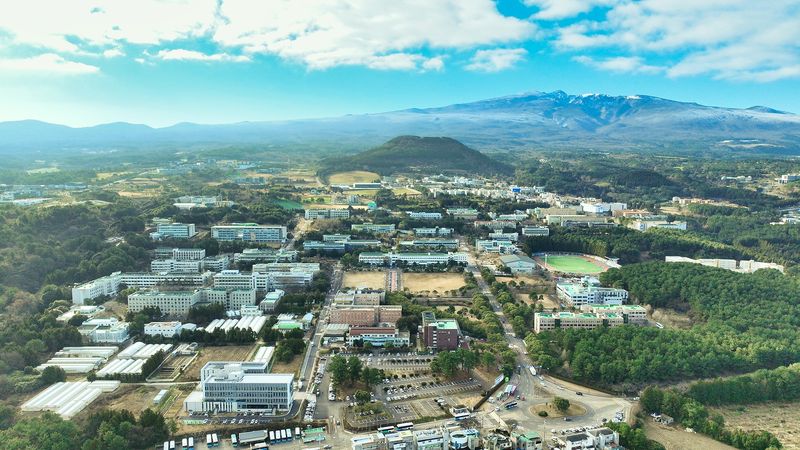
[Financial News Jeju = Reporter Jeong Yong-bok] The number of international students at Jeju National University (JNU) has increased to 733, showing a distinct upward trend since 2023. The total number of international students, including undergraduates, language trainees, and exchange students, reached 477, a 32.9% increase from last year. This growth was driven by the expansion of exchange students and the attraction of government-sponsored research and development (R&D) talent.
According to Jeju National University (JNU) on the 9th, as of September 1st of this year, there are 733 international students from 42 countries, including graduate students. This is an increase of 137 students, or 23.0%, compared to 596 as of October 1st of last year.
Compared to 576 people in 2023, it increased by 157 people, or 27.3%. The overall scale recovered to the same level as 733 people in 2021.
There are 256 graduate students, including 144 master's students, 88 doctoral students, and 24 students in the integrated master's and doctoral program. This is an increase of 19 from 237 last year.
The nationalities of foreign students have also expanded to 42 countries. China accounted for the largest share with 349 students, or 47.6% of the total, followed by Pakistan with 79 and Vietnam with 63. Mongolia and Sri Lanka each had 34 students, while India had 31.
Although the range of nationalities has broadened, the structure still shows that Chinese students account for nearly half. Students from China, Pakistan, and Vietnam alone make up 67.0% of the total.
One of the driving forces behind the growth is the number of exchange students. JNU’s Office of International Affairs expanded its "runcation" program, which previously focused on short-term experiential activities, into a regular exchange program where students study in Jeju for a full semester, and strengthened recruitment efforts targeting sister and partner universities. The number of exchange students, which was previously around 20 per semester, has increased to approximately 100 this year.
The attraction of research talent for advanced and new industries has also expanded. JNU attracted 37 research talents this year by utilizing the R&D track of the GKS, a government-sponsored scholarship program for foreign students.
This is the result of the Office of International Affairs and departments within the College of Engineering, such as the Department of Computer Engineering, Electronic Engineering, and the Department of Mechatronics Engineering, working together to attract international talent. The strategy aims not only to increase the number of foreign students but also to link this to the internationalization of the university's research fields.
Korean language courses are also being utilized as a channel for the influx of international students. The number of students enrolled in the Korean language course increased by 30, or 16.0%, from 187 in the fall semester of 2025 to 217 in the fall semester of this year.
JNU is also strengthening its system to connect Korean language trainees who wish to obtain a degree to undergraduate and graduate programs. This approach diversifies the pathways for the influx of international students by linking language training, exchange programs, government-sponsored scholarships, and degree programs.
The recent increase in international students aligns with the Glocal University Project promoted by JNU. JNU is pursuing the 'K-Runcation Platform,' a core educational model that enables domestic and international youth and researchers to learn and interact in Jeju.
The challenge ahead is to effectively translate the increase in the number of international students into degree attainment, research achievements, and community exchange. JNU plans to expand the recruitment and support of international students by linking its overseas university network with Korean language education, GKS R&D, and regular exchange programs.
[email protected] Jeong Yong-bok Reporter