[Exclusive] Construction-Cost Verifications Total KRW 23 Trillion, Yet No Post-Verification Monitoring or Legal Accountability
- Input
- 2026-09-10 05:30:00
- Updated
- 2026-09-10 05:30:00

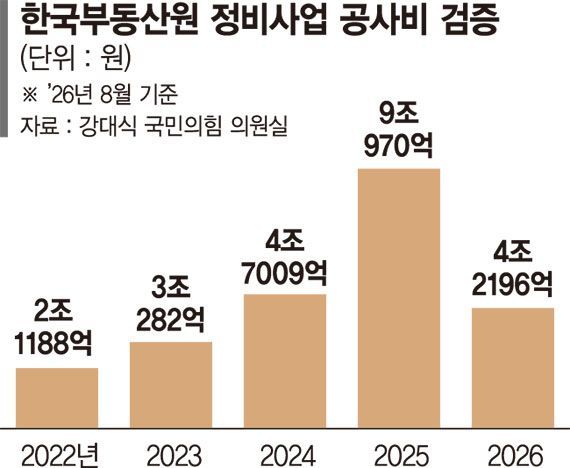
The figure rose from KRW 2.1188 trillion in 2022 to KRW 3.0282 trillion in 2023, KRW 4.7009 trillion in 2024, and KRW 9.097 trillion in 2025. With more than four months still remaining this year, the total is expected to increase further.
The number of completed verifications also increased during this period. After remaining relatively flat at 32 cases in 2022, 30 in 2023, and 36 in 2024, the number jumped to 52 in 2025 and reached 29 cases this year.
Although the verification volume has exceeded KRW 23 trillion, there are no cases in which KREB checked whether the results were reflected in actual contracts. Because no post-verification monitoring procedures have been established, it is difficult to determine how projects that underwent verification ultimately adjusted their construction costs. This has prompted criticism that the system’s original purpose—protecting association members’ rights—has not been fully realized.
■Fees continue to accumulate... KRW 18 billion over five yearsKREB explained, "We do not possess the relevant data because there are no separate rules requiring the submission and management of construction-contract results after verification." However, industry observers say the lack of rules alone is not a sufficient explanation. Since construction-cost verification is mandatory under current law when certain requirements are met, they argue that related regulations should have been established when the system was introduced.
Korea Land and Housing Corporation (LH), which operates under the Ministry of Land, Infrastructure and Transport (MOLIT), also conducts construction-cost verifications. However, most requests are directed to KREB. Verification-fee revenue has increased every year, surpassing KRW 18 billion over the past five years, including KRW 6.5 billion last year. KREB also received more than KRW 3.2 billion through August this year.
Lawmaker Kang said, "If, five years after the system was introduced, not a single case has been checked to determine how much of the more than KRW 23 trillion in verified construction costs was actually reflected, then the system has effectively become meaningless. KREB should not merely accumulate verification records; it must also track and manage how much of its recommendations to reduce costs are reflected in actual contracts."
A KREB official responded, "We are aware of these problems internally as well. An amendment containing related provisions, including post-verification monitoring, is currently awaiting consideration by the plenary session, so we hope it will pass quickly."
Under current law, a project must undergo construction-cost verification by KREB if any one of the following applies: at least 20% of landowners or association members request it; construction costs rise by at least 10% or 5%, depending on when the contractor was selected; or construction costs increase by at least 3% after verification is completed.
The second case is the most complicated. According to KREB’s construction-cost verification application system, a project that selected its contractor before receiving project implementation approval becomes subject to verification if construction costs rise by at least 10% from the amount at the time of selection. A project that selected its contractor after receiving approval must undergo verification when costs rise by at least 5%. For example, if a project’s construction costs total KRW 1 trillion, it becomes subject to verification when costs reach at least KRW 1.1 trillion if the contractor was selected before approval, or KRW 1.05 trillion if the contractor was selected afterward.
The problem is that verification is mandatory under current law, while implementing its results is only a recommendation. Even if KREB recommends lowering construction costs, there is no legal basis for sanctioning an association that decides to raise costs through a general meeting vote. As of today, KREB’s website states, "There are no separate penalties for failing to carry out construction-cost verification for redevelopment and reconstruction projects," and, "A contract does not have to be concluded exactly in accordance with the results of the construction-cost verification."
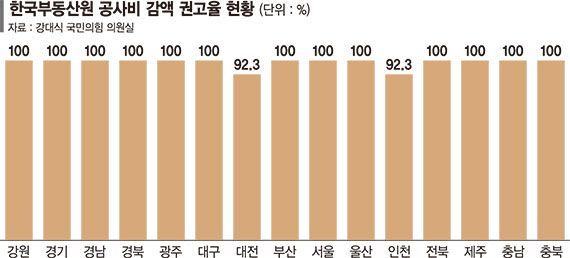
■99% receive recommendations to reduce costs, but implementation is not trackedMost projects that apply for verification receive recommendations to reduce construction costs. Of the 179 projects KREB verified over the past five years, 177 were notified of such recommendations, excluding one project in Incheon and one in Daejeon. That amounts to 98.9%. However, no publicly available tally shows whether the recommendations actually led to lower contract amounts.
A construction-industry representative involved in negotiations over construction-cost increases said, "Construction costs are determined through communication between the association and the contractor. I do not think anyone believes that receiving verification from KREB means they must follow its results. On construction sites, it is effectively a system that makes little difference whether it exists or not." The industry also explained that, although more than six years have passed since the system was introduced, many people still do not know that KREB conducts the verifications or that associations are responsible for applying for them.
Calls to overhaul the system are coming from both sides. Some argue that it should be abolished because association members bear the cost of verification even though recommendations to reduce costs are not binding. Others say the results should be given binding force to improve the system’s effectiveness. A real-estate-industry representative said, "It is difficult to understand why costs are automatically imposed when certain requirements are met, while no action is taken when the requirements are not followed. If I were a construction company, would there be any reason to comply?"
There is also debate over the effectiveness of the provision in current law stating that construction-cost verification must be conducted when an additional increase occurs after verification. With no clear post-verification monitoring procedure for determining whether costs have increased, critics question how such additional increases can be identified.
Kim Jin-su, a professor in the Department of Urban and Regional Planning at the Graduate School of Public Administration at Konkuk University, said, "Construction costs often reflect contractors’ claims to a considerable extent, and consultation with the association is essential. Since the system has no legal binding force, its effectiveness is greatly limited."
[email protected] Kwon Jun-ho Reporter