China Launches Regular Northern Sea Route Service Amid U.S. Pressure; First Joint China-Russia Sea-Ice Survey Conducted in Arctic Ocean
- Input
- 2026-09-09 17:09:58
- Updated
- 2026-09-09 17:09:58
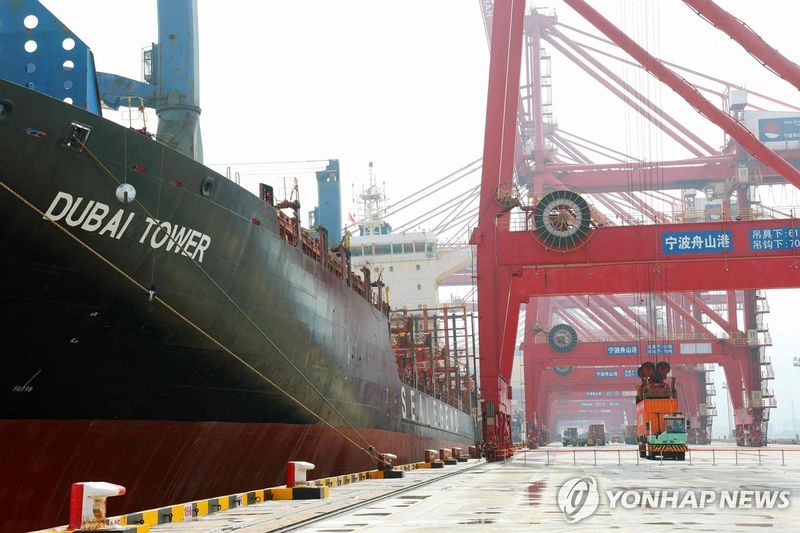
[Financial News] China and Russia are strengthening their ties as they conduct their first joint sea-ice survey in the Arctic Ocean. China is also preparing for the arrival in Europe of the first regular cargo ship to travel through the Northern Sea Route.
The New York Times (NYT) reported on the 8th, local time, that China’s decision to seriously pursue development of the Northern Sea Route despite its high costs is an attempt to achieve a long-term "geopolitical victory." The route is economically unattractive and carries high risks because it can be used for only about two months during the summer. Nevertheless, it represents a long-term geopolitical calculation.
Operating regular services along the Northern Sea Route, which offers little profitability, is intended as a geopolitical calculation even if it results in economic losses.
China’s First Regular Cargo Ship to Cross the Northern Sea Route to Arrive in Europe on the 9th
The three-week voyage of the Dubai Tower, a container ship operated by the Chinese shipping company Sea Legend, will conclude on the 9th. The ship departed from China in the middle of last month and is traveling across the Arctic Ocean to the United Kingdom for the first time. Ahead of its arrival, Arctic experts have focused on China’s decision to begin using the Northeast Passage, one of the routes within the Northern Sea Route, as a shortcut instead of the established routes through the Suez Canal or around the Cape of Good Hope.
Sea Legend noted that the voyage can be shortened by about two weeks because the distance is at least several thousand miles shorter. Another logistical advantage is that climate change has melted polar ice, making the route more accessible than before. The Northern Sea Route can also avoid conflict zones in the Middle East.
However, the NYT and others pointed out that China is accepting greater risks that outweigh these advantages.
Analysts say China’s entry into regular service along the Northern Sea Route is driven more by geopolitical calculations than by economic viability.
The route is navigable for two months, in August and September, while it is available for only a few days in July and October. Cargo ships may also require icebreaker escorts during their voyages. Specially designed vessels are necessary, and insurance premiums are high because of the increased risks.
A Geopolitical Calculation with Little Economic Viability
Many observers have pointed out that operating regular services would be difficult, dangerous and costly. Vidya Mani, an associate professor at the University of Virginia and a global supply-chain expert, criticized China’s use of the Northern Sea Route, saying it is "not commercially viable."
Dexter Roberts, a senior fellow at the Atlantic Council, said, "China is the only non-Arctic country actually doing this," adding, "China is an expert at pursuing projects that initially appear to have no commercial value."
He added that China’s moves "eventually become geopolitical victories."
Russia is considered one of the countries that would benefit directly if trade through the Arctic increases.
As Russia is already using the Northeast Passage to strengthen its ties with China, analysts say the Dubai Tower’s voyage will further deepen relations between the two countries.
Although the number of container ships that passed through the Northeast Passage last year was reportedly the highest on record, the total was only 13. By contrast, more than 1,800 container ships used the Suez Canal during the same year.
Because most of the Northeast Passage runs along Russia’s northern coast, shipping companies using the route must pay the Russian government fees related to passage. Western companies therefore have little choice but to be wary of using it.
China and Russia Begin Joint Sea-Ice Surveys, Expanding Their Influence in the Arctic Ocean
China and Russia have recently further strengthened cooperation in sea-ice research by conducting their first joint field survey in the Arctic.
China Central Television (CCTV), the state broadcaster, reported on the 5th that researchers from the Russian Arctic and Antarctic Research Institute conducted a joint sea-ice survey aboard Xuelong 2, the research icebreaker used for China’s 16th Arctic Ocean scientific expedition.
The cooperation appears to be a follow-up measure to a joint statement issued by the two countries in August 2024 on developing the Northern Sea Route.
Amid these developments, calls are growing in the United States and other Western countries to counter China’s influence in the Arctic. China describes itself as a "near-Arctic state," while Russia is an Arctic country.
U.S. President Donald Trump has also cited the Arctic Ocean threat posed by China and Russia as part of the rationale for his ambition to annex Greenland.
[email protected] International Affairs Specialist Lee Seok-woo Reporter