Jeju Targets Six Institutions in Second Public-Sector Relocation Drive... Campaign to Attract KRA and KAC Gains Momentum
- Input
- 2026-09-09 16:29:36
- Updated
- 2026-09-09 16:29:36
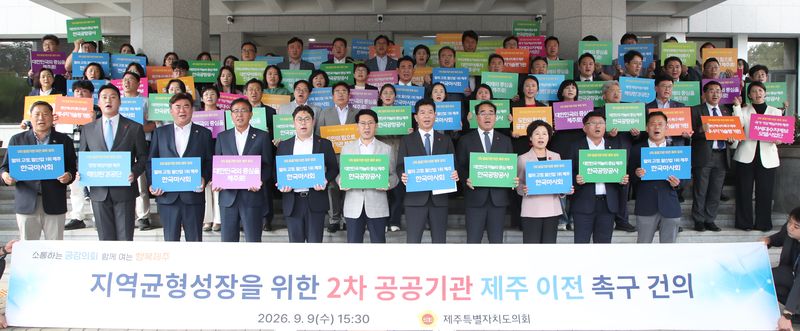
【Financial News Jeju = Jung Yong-bok】 As the government considers relocating approximately 350 public institutions from the Seoul metropolitan area to other regions in a second phase, Jeju has entered the competition to attract six institutions, including the Korea Racing Authority (KRA) and Korea Airports Corporation (KAC). Jeju Province and the Jeju Special Self-Governing Provincial Council have each launched dedicated organizations and public appeals, beginning a tailored campaign to connect the institutions’ functions with Jeju’s industries.
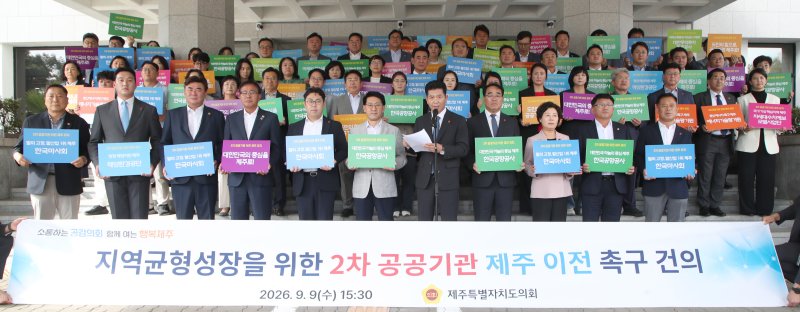
According to the Jeju Special Self-Governing Provincial Council on the 9th, Chairman Song Young-hoon, provincial council members and council staff announced a proposal that afternoon in front of the council building calling for the relocation of second-phase public institutions to Jeju to promote balanced regional growth.
The six institutions highlighted by the Jeju Special Self-Governing Provincial Council are the Korea Racing Authority (KRA), Korea Airports Corporation (KAC), Korea Marine Environment Management Corporation, Korea Institute of Energy Technology Evaluation and Planning (KETEP), Korea Trade-Investment Promotion Agency (KOTRA), and the Next-Generation Numerical Weather Prediction Model Development Project Group.
A day earlier, on the 8th, Jeju Province held a meeting of its task force for attracting public institutions, chaired by Deputy Governor for Administrative Affairs Park Chun-soo. It selected five key institutions it hopes to attract: KRA, KAC, KETEP, the Korea Marine Environment Management Corporation and KOTRA.
With the provincial council adding the Next-Generation Numerical Weather Prediction Model Development Project Group, the number of institutions publicly targeted by Jeju has risen to six. However, the government has not yet finalized which institutions will be relocated or where they will be assigned.
Jeju Province plans to designate a department in charge of each institution, submit attraction proposals to the relevant central ministries, and contact the institutions’ executives, employees and labor unions directly. The lead department will regularly compile the results of visits and meetings, while major developments will be reported to the governor every week.
The campaign is not primarily about demanding “Jeju’s share.” Because the government is placing emphasis on clustering related institutions around existing innovation cities and functionally connecting them with regional industries and universities in the second phase, Jeju must demonstrate why each institution needs to relocate there.
The most direct link for KRA is Jeju’s horse and tourism industries. Jeju has concentrated infrastructure for the horse industry, including facilities for breeding and training racehorses, providing a basis for connecting the authority’s functions with local industries.
Jeju is approaching KAC through Jeju International Airport and the aviation industry. The region’s status as home to a major tourism airport, along with future air mobility and tourism and logistics functions, can be incorporated into the case for relocation.
KETEP can be linked to Jeju’s demonstration base for the energy transition, including wind and solar power and its distributed-energy specialized zone. The Korea Marine Environment Management Corporation can be connected to marine-environment management in island regions and emerging marine industries, while KOTRA can be tied to the international free city’s functions related to companies’ overseas expansion and investment attraction.
The Next-Generation Numerical Weather Prediction Model Development Project Group, proposed additionally by the provincial council, can be linked to Jeju’s direct exposure to weather disasters such as typhoons and torrential rains. The central argument is to connect the island with artificial intelligence-based weather and climate prediction research.
The government’s schedule is also intensifying competition among regions. It is broadly reviewing approximately 350 public institutions located in the Seoul metropolitan area, aiming to establish a second-phase relocation plan in the fourth quarter of this year and begin relocating leading institutions in 2027.
The government has also proposed revisiting the criteria for determining which institutions need to remain in the Seoul metropolitan area, which were applied during the first relocation. To shorten the time required to construct new offices, leading institutions may first relocate by leasing existing buildings.
Jeju’s existing Jeju Innovation City could provide a foundation for attracting institutions. At the same time, the province must address the shortcomings of the first relocation, particularly the extent to which relocated institutions failed to become sufficiently rooted in the local economy and industries.
Jeju Province explained during a report to the provincial council in July that it had submitted to the government reasons for attracting 31 institutions and measures to support settlement in preparation for the second-phase relocation. After narrowing its key targets to five, its strategy shifted from securing a broad pool of candidates to making a focused selection.
With the provincial council also identifying six institutions specifically, the key question now is how consistently the provincial administration, council, industries and universities can develop the case for attracting each institution.
The province is also working to build public support. Jeju Province plans to continue a province-wide signature campaign and on-site publicity, while issuing joint appeals with the relevant industries, universities and organizations associated with each institution.
The regional economic impact of the second-phase relocation will not be determined by the number of institutions alone. Meaningful balanced growth will occur only if the relocated institutions’ functions are connected to the projects and research of Jeju companies, research institutes and universities, and lead to hiring local talent and creating jobs for young people.
Song Young-hoon, chairman of the Jeju Special Self-Governing Provincial Council, said, “The second-phase relocation of public institutions is a national task aimed at easing the Seoul-centered system and expanding the foundations for regional growth.” He added that Jeju would continue its campaign to ensure that the key institutions it has proposed are included among the relocation targets.
[email protected] Jung Yong-bok Reporter