Jeju Province Ranks First Nationwide in Employment, Yet 1,742 Positions Remain Unfilled... AI to Address the ‘Job Mismatch’
- Input
- 2026-09-09 16:11:16
- Updated
- 2026-09-09 16:11:16
【Financial News Jeju—Jung Yong-bok】 Jeju Province’s employment rate reached 71.9% in August, the highest in the country, but companies continue to struggle to fill vacancies.
According to the 2026 Jeju Regional Workforce Development Basic Plan, released on HRD4U by the Ministry of Employment and Labor on the 9th, 93,278 people worked at businesses with five or more regular employees in Jeju Province at the end of 2024. The figure covers 50 industries surveyed under the medium-category classification of the Korea Standard Industrial Classification.
These businesses had 21,965 job openings in 2024, of which 1,742 remained unfilled. The unfilled rate was 7.9%, 1.3 percentage points higher than the national rate of 6.6%.
The trends in the country as a whole and in Jeju Province diverged. The national unfilled rate fell for two consecutive years, from 8.9% in 2022 to 7.1% in 2023 and 6.6% in 2024. Jeju Province’s rate declined from 9.5% to 7.8% over the same period, before rising again to 7.9% in 2024.
Unfilled positions refer to jobs for which companies recruited but failed to secure the workers they wanted. This does not necessarily mean that no job seekers were available. Such vacancies can also arise when the duties, skill levels, wages, working hours or other conditions required by companies do not match job seekers’ preferences.
The number of workers leaving was also high relative to the number being hired. The surveyed businesses had 19,546 departures in 2024, resulting in a turnover rate of 21.0%. That was 5.1 percentage points higher than the national average of 15.9%. Jeju Province’s turnover rate rose by 9.0 percentage points in just two years, from 12.0% in 2022 to 14.6% in 2023.
The hiring rate was also high at 22.7%, exceeding the national rate of 17.0% by 5.7 percentage points. In the report, the hiring rate is defined as annual hires divided by the current workforce. The simultaneous high levels of hiring and departures indicate that workforce inflows and outflows are more active among businesses in Jeju Province than nationwide.
The labor shortage was concentrated in Jeju Province’s livelihood and service sectors. Of the 1,742 unfilled positions, 350 were in social welfare services, accounting for 20.1%. Lodging followed with 238 positions, restaurants and bars with 233, and land transport and pipeline transport with 206.
The four industries accounted for 1,027 unfilled positions, or 59.0% of the total. Social welfare and lodging, restaurant and bar businesses already have substantial hiring demand, creating a dual problem: they need many workers but cannot secure the necessary staff in time.
By contrast, Jeju Province’s overall employment indicators were the strongest in the country. According to the 2026 August Employment Trends released that day by the Ministry of Data and Statistics, Jeju Province’s employment rate was 71.9%, the highest among the country’s cities and provinces. It was 8.6 percentage points above the national average of 63.3%.
Jeju Province had 415,000 employed people, an increase of 12,000 from the same month last year. The employment rate rose 2.1 percentage points from 69.8% a year earlier, also marking the largest increase among the cities and provinces.
The employment rate for people aged 15 to 64, the comparison standard used by the Organisation for Economic Co-operation and Development (OECD), was also high at 76.5%, 6.1 percentage points above the national figure of 70.4%. The unemployment rate fell by 0.5 percentage points from the same month last year to 0.8%. It was less than half the national unemployment rate of 2.0%.
The reason high employment and low unemployment do not immediately resolve companies’ hiring difficulties is that the two statistics measure different populations. The Economically Active Population Survey examines households to assess labor supply, including employment and unemployment, while the business workforce demand survey examines how successfully companies have secured the workers they need.
Even when many people are already working and the employment rate is high, specific industries and occupations may still struggle to find the workers they need.
Conditions varied by industry. Although the total number of employed people in Jeju Province increased in August, employment in wholesale and retail, lodging, and food services fell by 7,000 from the same month last year. In contrast, business, personal and public services grew by 8,000, construction by 7,000, and agriculture, forestry and fisheries by 4,000.
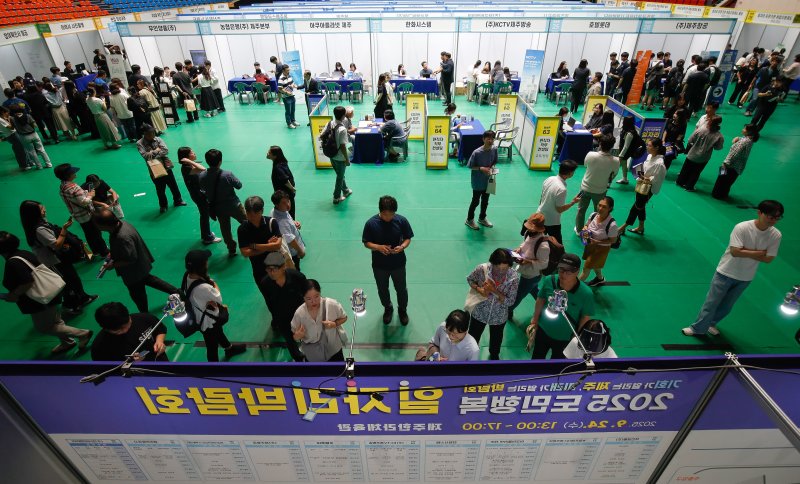
Jeju Island has decided to change how it connects companies with job seekers. The 2026 Residents’ Happiness Jeju Island Job Fair will be held from 1 to 5 p.m. on October 29 at Halla Gymnasium in Jeju Province. Advance registration will open at 10 a.m. on the 15th.
This year’s fair will introduce AI-based job matching. The system will compare job seekers’ preferred occupations and duties, work experience, certifications, preferred work location, employment type and salary with companies’ publicly posted job openings, then recommend suitable positions. AI mock interview programs will also be available online and at the event venue.
At last year’s Residents’ Happiness Job Fair at Halla Gymnasium, 2,332 people attended and 321 took part in actual interviews. Forty companies, including Hanwha Systems, Korea BMI and the Jeju Free International City Development Center (JDC), conducted on-site interviews and employment consultations.
The success of AI job matching will depend on how effectively it leads to actual interviews, hiring and long-term employment. Unless the structural factors behind unfilled positions—including wages, working hours, skill levels, housing and working conditions—are improved as well, the labor shortage may persist.
Jeju Province’s employment policy is also shifting its focus. Rather than simply increasing the number of employed people, it is moving toward connecting the workers companies need with the businesses that need them and helping those hires remain in the region for the long term.
[email protected] Jung Yong-bok Reporter