"If TADA Had Succeeded"... Korea Startup Forum Looks Back on 10 Years: "Regulations Must Change Now"
- Input
- 2026-09-09 16:40:20
- Updated
- 2026-09-09 16:40:20
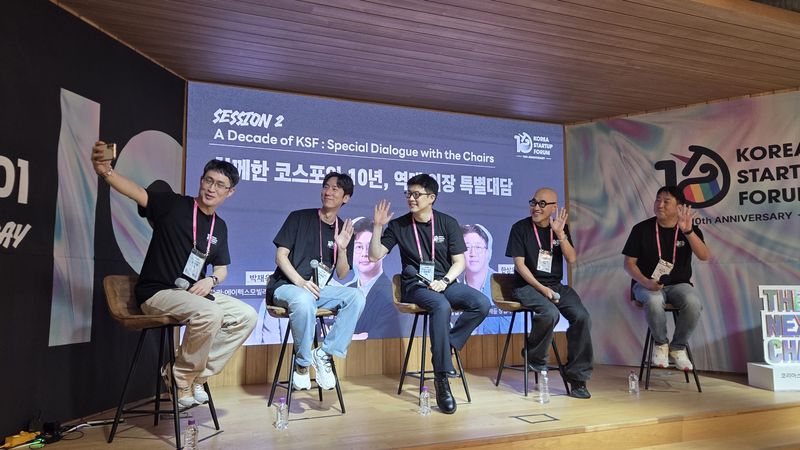
Kim Bong-jin, the inaugural chairman of the Korea Startup Forum (CEO of Grandeclip and founder of Woowa Brothers), emphasized this at the 'Next Chapter' Media Day event commemorating the 10th anniversary of the Korea Startup Forum's launch, held at TIPSTOWN S6 in Gangnam-gu, Seoul, on the 9th.
Former Chairman Kim is a leading first-generation Korean startup entrepreneur who founded Woowa Brothers, the operator of Baedal Minjok. Looking back on the past 10 years since the Korea Startup Forum was launched in 2016, he pointed out that the regulatory environment surrounding startups is still hindering innovation.
The Korea Startup Forum was launched by founders who recognized the need to respond to regulations following the 'Callbus issue' and other developments. About 3,000 startups and innovative companies currently participate. According to the Korea Startup Forum, its member companies have created approximately 56,000 jobs and attracted a cumulative total of about 29 trillion won in investment over the past 10 years.
Former Chairman Kim pointed out, "It is true that the pace of innovation in Korea has slowed considerably compared with the United States and China," adding, "I regret that if TADA had succeeded, innovative industries such as autonomous driving might have reached us more quickly."
Jaeuk Park, CEO of SOCAR and APEX Mobility Inc. and 3rd chairman; Jae Won Kim, CEO of Elice Group and current chairman; and Sangwoo Han, CEO of WIZDOME and 4th chairman, who attended the event, also emphasized the need for regulatory reform.
CEO Park particularly emphasized the need to shift to 'negative regulation' to develop the startup ecosystem. Negative regulation refers to a regulatory approach under which everything is permitted unless explicitly prohibited by law. TADA, the rental-car-based ride-hailing service operated by CEO Park, grew into an innovative mobility service but came into conflict with the existing taxi industry and suspended its core service, Tada Basic, after relevant laws were amended in 2020.
CEO Park emphasized, "The reason so much innovation occurs in the United States and elsewhere ultimately lies in negative regulation," adding, "The approach of freely trying everything not explicitly prohibited by law and then creating laws or regulations later for the innovations that emerge from the process is the source of innovation."
It was also suggested that deregulation of new industries, expanded early-stage public-sector purchasing, and a revitalized investment-exit market are necessary for startup growth in the era of artificial intelligence (AI).
Jae Won Kim, CEO of Elice Group and current chairman of the Korea Startup Forum, said, "National competitiveness in the AI era depends on how quickly new technologies can reach the market and grow," and assessed that "the answer to becoming an AI powerhouse is becoming a startup powerhouse."
He emphasized that the next 10 years must create a structure that enables startups to grow further. The five key directions for the next decade presented by the Korea Startup Forum are market, regulatory innovation, expansion, growth, and legacy. The plan is to move beyond subsidy-centered support and create a market in which the government and public sector become the first customers of innovative companies, while improving systems so that new industries are not blocked by existing regulations.
The plan also calls for strengthening the virtuous cycle of capital through investment, exits, and reinvestment, and creating an environment in which talented people choose startups and share in the fruits of growth through compensation systems such as restricted stock units (RSUs). Building a 'Pay It Forward' ecosystem, in which the experience, capital, and entrepreneurial spirit of senior founders are passed on to younger entrepreneurs, was also presented as a key task.
[email protected] Lee Ju-mi Reporter