Treated Like Objects Despite National Dedication... Who Takes Responsibility for Service Animals After Retirement?
- Input
- 2026-09-09 16:37:56
- Updated
- 2026-09-09 16:37:56
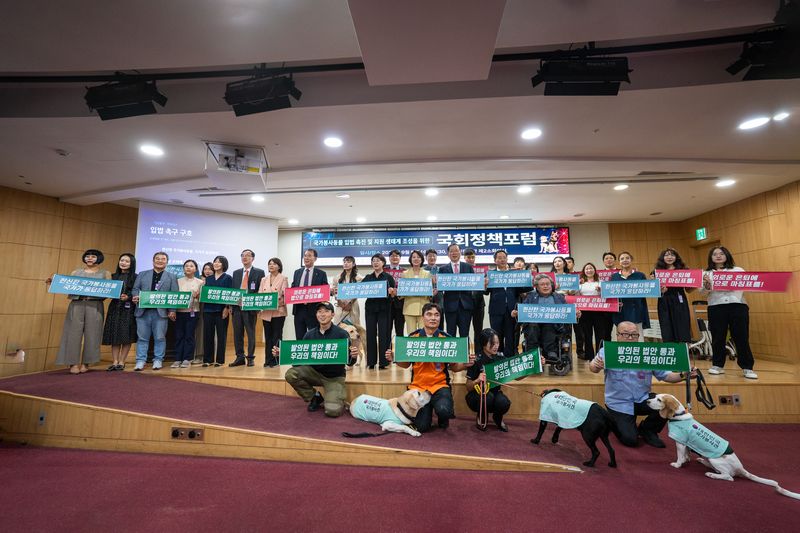
At the 'National Assembly Policy Forum for Promoting Legislation for Service Animals and Establishing a Support Ecosystem,' held on the 9th at the National Assembly Members' Office Building in Yeouido, Seoul, participants discussed ways to improve the treatment of retired service animals and establish a support system. The forum was co-hosted by 15 lawmakers from both ruling and opposition parties, including Rep. Cho Seung-hwan of the People Power Party, and organized by the Sustainable Development Research Institute 'Machimpyo.'
Rep. Cho Seung-hwan of the People Power Party, who delivered the opening remarks, stated, "Institutional support, such as medical assistance and the alleviation of adoption burdens, is necessary even after retirement," adding, "We must create a support system where the state and society take joint responsibility."
Rep. Kim Ye-ji of the People Power Party pointed out, "Animals are still legally considered property," adding that "a fundamental solution is difficult unless their legal status is improved." She further stated that she would look into ensuring that relevant support measures are reflected in the enforcement decree and budget.
The related amendment to the Animal Protection Act passed the standing committee on the 2nd when the National Assembly’s Agriculture, Food, Rural Affairs, and Fisheries Committee approved a committee alternative resulting from a consolidated review of related bills. The amendment includes provisions for administrative and financial support by the state and local governments, as well as the basis for the establishment and operation of support centers for retired volunteer animals. Further procedures remain, including review by the Legislation and Judiciary Committee and a vote in the plenary session.
Lee Young, Chairperson of the Board of Directors of Machimpyo, who delivered the keynote speech, emphasized, "Passing the law is not the end; we must establish a budget and implementing regulations." She also suggested that support centers should not function as mere residential facilities, but rather play a role in connecting individuals to adoption through treatment and socialization training.
Park Byeong-bae, representative of the Korea Special Detection Dog Center, who gave the presentation, stated, "What drove the service animals' performance was the bond," and emphasized the need for a management system that ensures emotional care continues even after retirement.
Yeon Seong-chan, President of the National Association of University Animal Hospital Directors, emphasized the need for government support, stating that there are limitations to private medical assistance. He also proposed the establishment of a facility tentatively named the "National Animal Veterans Hospital" in the long term, encompassing treatment, rehabilitation, and long-term care.
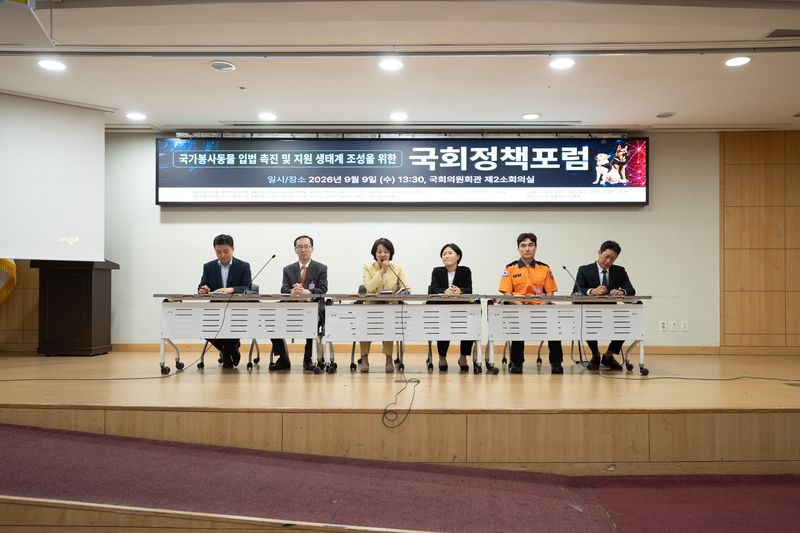
Lee Yeon-sook, a division head at the Ministry of Agriculture, Food and Rural Affairs, stated, "The enactment of the law is not the end, but the beginning," and announced plans to push for the preparation of subordinate regulations and the securing of a budget. The government is operating a platform that integrates adoption information for volunteer animals across ministries and is running adoption support programs. Additionally, it has included the Retired Volunteer Animal Support Center as a national agenda item and is consulting with local governments and relevant agencies regarding its establishment. Discussions are also underway with veterinary colleges regarding the designation of public animal hospitals to provide medical support for volunteer animals.
Kim Cheol-hyeon, a handler at the National Fire Agency who adopted 'Toback,' a rescue dog that was dispatched to the scene about 235 times, including the major earthquake in Türkiye, and rescued 14 people, called for an improvement in social perception regarding retired service animals. Handler Kim stated, "People are scared of it just by looking at it because it is a big dog, but when I explain that it is a dog that served the nation, their eyes change," adding that there is a need for markings and promotion to identify it as a national service animal.
Opinions were also raised that the support center should serve as a space connecting rehabilitation and adoption, rather than merely a shelter. Park Hyun-jong, Director of the Banryeomaru Center, suggested that the center should be established in an accessible location to allow citizens and retired volunteer animals to interact and facilitate adoption. Chairman Yeon emphasized that relying solely on private donations leads to a lack of sustainability, stating, "The government must take the lead and secure the budget." The Ministry of Agriculture, Food and Rural Affairs stated that it is necessary to consider utilizing existing medical infrastructure, such as animal hospitals and veterinary colleges, in addition to establishing a separate dedicated hospital.
Meanwhile, on this day, the National Association of University Animal Hospital Directors and companies also signed an agreement to support handlers who have adopted retired volunteer animals with medical expenses, food, and supplies.
[email protected] Choi Seung-han Reporter