95% of the 14 Trillion Won School Meal Market Is Contracted Through Sole-Source Contracts... Secured Another 310 Billion Won Immediately After the 'Legal Violation' Label Was Removed
- Input
- 2026-09-09 15:32:26
- Updated
- 2026-09-09 15:32:26
[Financial News] With more than 95% of the school meal market, worth over 14 trillion won over the past five years, contracted through sole-source contracts, it has been revealed that suppliers subject to administrative sanctions for violations of the Food Sanitation Act, origin-labeling violations, or sanctions as disqualified business operators secured contracts worth approximately 310 billion won immediately after their sanctions ended. Critics say the practice of sole-source contracting, with its low barriers to entry and lack of competition, is facilitating the easy return of violating companies to the market.
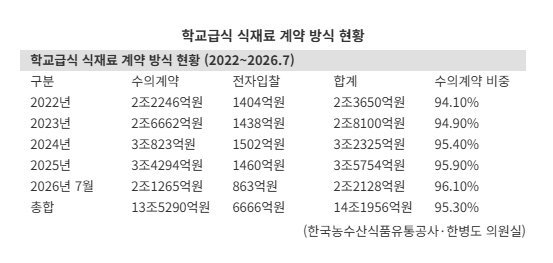
According to data from the parliamentary audit submitted by the Korea Agro-Fisheries & Food Trade Corporation (aT) to Han Byung-do of the Democratic Party of Korea, a member of the National Assembly Education Committee, on the 9th, 13.529 trillion won, or 95.3% of the total 14.1956 trillion won in school meal ingredient contracts from 2022 through July 2026, was contracted through sole-source contracts. Contracts concluded through electronic bidding amounted to 666.6 billion won, accounting for only 4.7% of the total.
The concentration of school meal contracts in sole-source contracting is intensifying. The proportion of sole-source contracts, which stood at 94.1% in 2022, rose every year to 94.9% in 2023, 95.4% in 2024, 95.9% in 2025, and 96.1% as of July 2026.
The problem is that, within this lax structure of sole-source contracting for public school meals, companies caught violating various laws are returning to schools without significant restrictions. During the same period, 186 of the 458 companies that received administrative sanctions for violating relevant laws—40.6%—signed new supply contracts with schools after their sanction periods ended. The total number of renewed contracts they signed after sanctions was 29,980, with a total contract value of 312.80763 billion won.
In fact, Company A, based in Gyeonggi Province, was fined for violating the Food Sanitation Act in 2022 and was barred from using the Public Food Service Integrated Platform (eaT) for 89 days, or approximately three months. As soon as the restriction was lifted, however, it signed 7,598 contracts and secured orders worth 91.55587 billion won. Eight of the top 10 companies that renewed their contracts had violated the Food Sanitation Act. The platform-use restrictions generally lasted 31 to 92 days, or one to three months, while the longest lasted only 202 days. In other words, companies can regain massive public procurement volumes simply by waiting out the sanction period.
Of the 527 administrative sanctions imposed over the past five years, violations of the Food Sanitation Act were the most common, accounting for 329 cases, or 62.4% of the total. They were followed by sanctions against disqualified business operators, with 163 cases, or 30.9%, and origin-labeling violations, with 35 cases, or 6.6%. However, among the sanctions for Food Sanitation Act violations, fines accounted for 192 cases, or 58.4% of all such violations. In addition, 44 companies received administrative sanctions two or more times over the five-year period, accounting for 9.6% of all sanctioned companies.
Since the revised School Meals Act took effect last August, violating companies may be barred from participating in bids and excluded from sole-source contracts for up to six months. However, critics say the current system alone cannot fundamentally prevent companies from re-entering the market after short-term sanctions expire.
Han Byung-do said, "School meals are an important part of the physical development and academic achievement of growing children," adding, "The Ministry of Education must strengthen accountability throughout the school meal process, from preliminary inspections to follow-up management, by managing administrative sanctions and violation histories in an integrated manner." During this year's parliamentary audit, Han plans to examine whether corrective actions have been verified after sanctions and call for improvements to information sharing among relevant agencies and the system for on-site re-inspections.
[email protected] Kim Man-gi Reporter