Three Organizations Lower Language Barriers and Receive UNESCO King Sejong Literacy Prize
- Input
- 2026-09-09 15:00:00
- Updated
- 2026-09-09 15:00:00
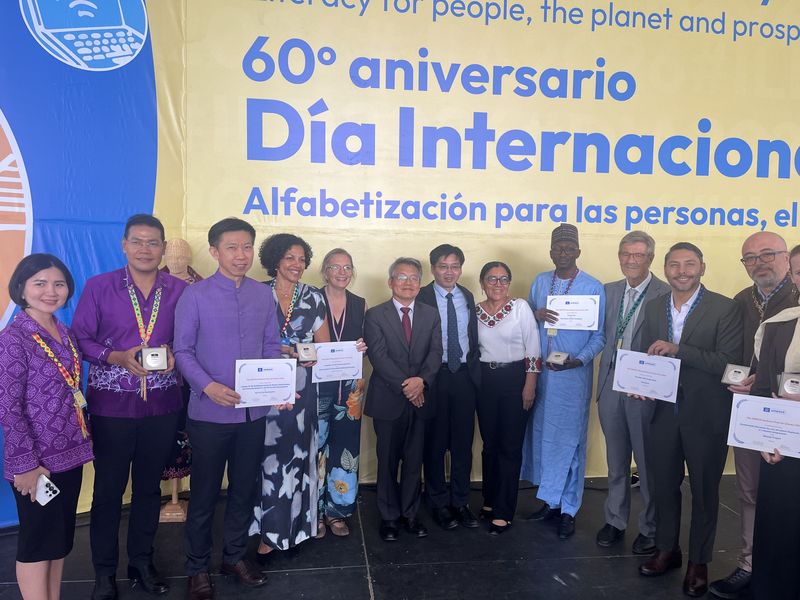
According to the Ministry of Culture, Sports and Tourism on the 9th, the winning organizations are BibloRed of Colombia, the Rutu Foundation for Intercultural Multilingual Education of the Netherlands, and the Waer Waters Charity Foundation of Nigeria.
The ceremony was held in San Juan Chamula, Mexico, on the 8th (local time), International Literacy Day. This year's competition received 132 applications from 72 countries, 35 more than last year.
BibloRed supported multilingual literacy education for marginalized groups and the preservation of mother tongues through its Escuelas LEO program, which uses the Bogotá public library network. It also provided Spanish-language education for deaf learners.
Through its Language-Friendly Schools program, the Rutu Foundation used students' diverse mother tongues as learning resources. It worked to respect linguistic diversity in schools and reduce educational disparities.
The Waer Waters Charity Foundation provided solar-powered learning spaces through its Basic Literacy Acceleration Project. It offered level-based instruction in indigenous languages, including Igbo and Ijaw, improving literacy among marginalized children and helping them return to formal education.
UNESCO explains that 40% of learners worldwide do not receive education in their mother tongue. The winning initiatives share the common feature of lowering barriers to educational participation by respecting learners' languages.
Meanwhile, the UNESCO King Sejong Literacy Prize was established in 1989 with support from the South Korean government to promote the spirit behind the creation of Hangul and contribute to the eradication of illiteracy. The awards began in 1990, and the prize money for each winning organization was raised this year from $20,000 to $30,000.
Myeong Su-hyeon, director of cultural policy at the Ministry of Culture, Sports and Tourism, said, "We will strengthen cooperation with UNESCO so that everyone around the world can communicate with society through the written word without being marginalized."
[email protected] Jang In-seo Reporter