Yun Ho-jung: "Discussions Underway to Revise Public Prosecution Office Plan... Legislative Notice Could Be Reissued if Necessary"
- Input
- 2026-09-09 14:32:32
- Updated
- 2026-09-09 14:32:32
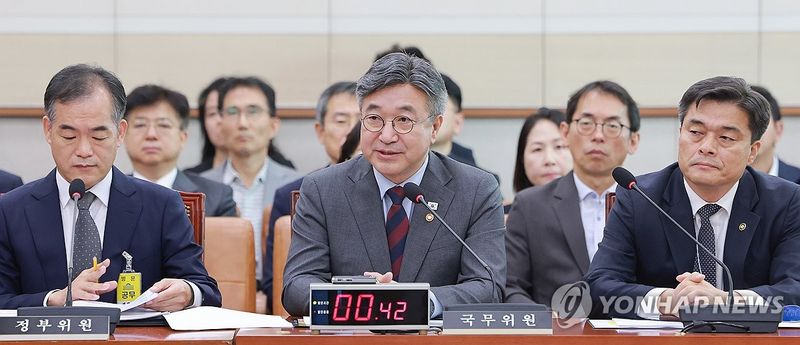
[Financial News] Yun Ho-jung, minister of the Ministry of the Interior and Safety (MOIS), said on the 9th regarding the controversial organizational plan for the Public Prosecution Office, "We are discussing a revised plan with the Ministry of Justice, and if necessary, we can issue the legislative notice again."
At a full meeting of the Legislation and Judiciary Committee of the National Assembly that day, Minister Yun explained that the schedule had been tight and that it had been difficult to reach sufficient agreement with the Ministry of Justice because there was a deadline for issuing the legislative notice on the Public Prosecution Office's organizational decree. He was responding to Democratic Party of Korea lawmaker Kim Yong-min, who argued that the Public Prosecution Office had expanded departments related to investigative direction without increasing trial prosecutors, despite having no investigative authority. Yun added, "We first issued the legislative notice and gathered opinions, and we are now discussing a revised plan. If necessary, we are also considering reissuing the legislative notice."
According to the organizational plan for the Public Prosecution Office announced by the Ministry of Justice on the 4th, the office will consist of a headquarters, six metropolitan prosecution offices, 18 regional prosecution offices and 42 branch offices. Its authorized personnel will total 8,412, including 2,292 prosecutors and 6,120 general staff. Although investigative functions will be removed from the Public Prosecution Office when it launches next month under the separation of investigation and indictment, the prosecutor quota will remain unchanged at 2,292, prompting calls from ruling-party lawmakers for a review.
The Democratic Party of Korea said that day it would examine whether the organizational plan for the Public Prosecution Office and the proposed revision to the enforcement decree of the Prosecutor Quota Act conform to the prosecution reform principle of separating investigation from indictment. DPK leader Kim Min-seok said, "At the National Assembly level, we need to examine whether there is any excessive behavior by vested interests seeking to preserve the organization."
The Ministry of Justice maintains that its plan abolishes investigative organizations and cuts 2,294 positions, or 21.4 percent, from the total workforce of 10,706. It explained that the plan eliminates the Crime Information Planning Office and investigative units handling intelligence-led and joint investigations, while reorganizing the structure around an organization responsible for cases transferred after referrals involving serious crimes.
Minister Yun also said there was no problem with the basic philosophy of prosecution reform regarding the controversy surrounding Kim Ji-hoon, the nominee to become the first head of the Serious Crime Investigation Agency.
In response to a question from Yoon Sang-hyun of the opposition People Power Party, who said that "Nominee Kim publicly opposed reducing the prosecution's investigative authority when he was head of the Criminal Affairs Department at the Supreme Prosecutors' Office," Minister Yun replied, "As far as I understand, there is no problem with his basic philosophy regarding current prosecution reform, and more broadly, the protection of human rights and the realization of social justice."
Kim Ji-hoon publicly opposed the abolition of the prosecution's supplementary investigative authority in 2022, when he was head of the Criminal Affairs Department at the Supreme Prosecutors' Office of the Republic of Korea. Minister Yun explained, "I have been informed that he was thoroughly vetted through the Nomination Committee for the Head of the Serious Crime Investigation Agency," adding that he understood Kim had expressed his position on supplementary investigative authority in his capacity at the time as the department head responsible for supplementary investigations.
Regarding criticism that preparations to secure personnel and equipment for the Serious Crime Investigation Agency, which will launch on October 2, were inadequate, Minister Yun said there would be no major problem with its launch. He stated, "We have decided to secure the essential equipment and essential systems," and added, "Our plan was first to secure personnel transferred from the prosecution service and then hire experienced personnel to fill any shortfall."
Regarding the need to reinforce police investigative personnel following the transfer of the prosecution service's unresolved cases, Yun said it would also be possible to assign personnel remaining at the Public Prosecution Office to the police or the Corruption Investigation Office for High-ranking Officials after the Serious Crime Investigation Agency's staffing quota had been filled.
[email protected] Lee Bo-mi Reporter