"Nepal’s Flood Rescue Operations Enter Final Phase"... Changes Inevitable for Korean Relief Team’s Search
- Input
- 2026-09-09 12:05:54
- Updated
- 2026-09-09 12:05:54
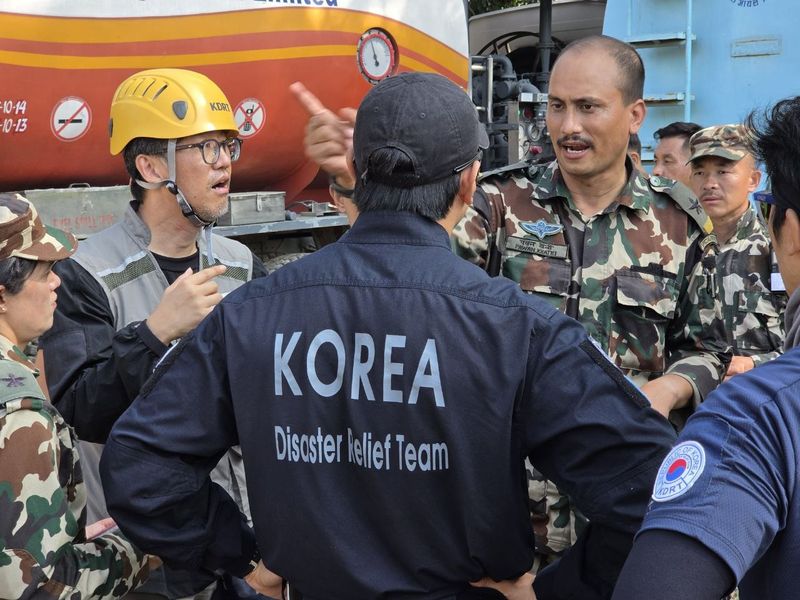
According to the Ministry of Foreign Affairs on the 9th, Nepalese military authorities have ended searches at major sites, including the tunnel of the Upper Trishuli (UT)-1 Hydropower Plant, where nine South Koreans are missing. The Korean relief team also said it would not conduct search operations that morning, taking into account Nepal’s transition to the final phase of search-and-rescue operations.
As the Nepalese Army entered the reconstruction and recovery phase, it sharply reduced the number of helicopters operating in the area. With the remaining helicopters prioritized for transporting relief and recovery supplies, the Korean relief team is expected to face difficulties proposing or coordinating additional aerial and mountain searches.
At the strong request of the missing people’s families, the Korean relief team obtained assistance from the Nepalese Army and carried out ground searches in dangerous areas and detailed drone searches until the end. However, it found no traces of the missing people because of rugged terrain, severed roads and other limitations. The Ministry of Foreign Affairs’ mobile-phone location tracking also failed to produce precise records, making it difficult to identify additional search routes.
The previous day, seven members of the Korean relief team traveled by helicopter with the Nepalese Army to areas where the missing South Koreans were concentrated, including the powerhouse, and conducted a ground search for the first time. They were unable to find the missing South Koreans.
The relief team traveled with the Nepalese Army aboard two helicopters to the Rasuwa area in north-central Bagmati Province. It then attempted searches in the mountainous areas around the powerhouse and Yellow Bridge of the Upper Trishuli (UT)-1 Hydropower Plant, as well as in the mountainous area around the main camp. The families of the missing people had repeatedly and strongly requested searches in these locations.
The team had initially planned to land in these areas and conduct ground searches. However, the Nepalese Army determined that landing was impossible because there were no safe landing sites. As a result, one helicopter landed near the powerhouse, while the other landed at a Nepalese Army base camp 6 kilometers from the powerhouse.
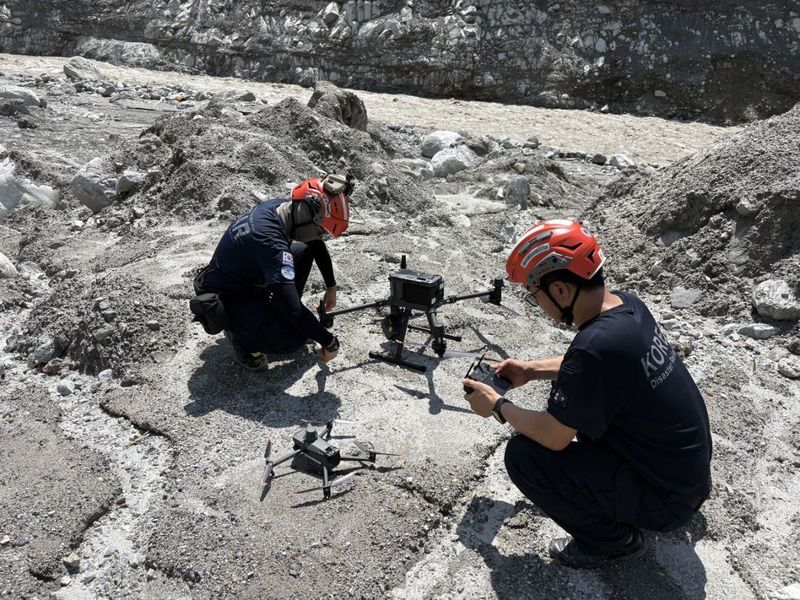
The team that landed near the powerhouse conducted an intensive drone search of the surrounding area after the Nepalese Army determined that the steep slopes left no area suitable for a ground search.
The other team conducted a ground search upstream along a temporary road in an attempt to find a possible evacuation point. It stopped where the road was cut off and then carried out a drone search for about one hour and 40 minutes. However, it found nothing unusual related to the missing people that day.
The KDRT relief team leader met with the families and conveyed the results of the searches described above.
Cho Hyun-moon, head of the National Fire Agency’s Rescue Headquarters, said, "I have 33 years of experience conducting search-and-rescue operations at numerous similar disaster sites, including the landslide caused by torrential rain along Naerincheon in Inje, Gangwon Province, in 2006. However, at the site in Nepal, I could not help but feel helpless in the face of the unique nature of a disaster that cannot be compared with those in Korea and the geographical limitations on access. I feel deeply regretful and sorry." Lee Kyu-ho, the KDRT relief team leader, said, "Realistically, I believe our members have done everything they could through ground searches within the bounds of safety."
[email protected] Kim Kyung-soo Reporter