[Exclusive] Business Community Urges National Assembly to Ease 52-Hour Workweek and Mandatory Large-Supermarket Closure Rules
- Input
- 2026-09-09 12:02:57
- Updated
- 2026-09-09 12:02:57
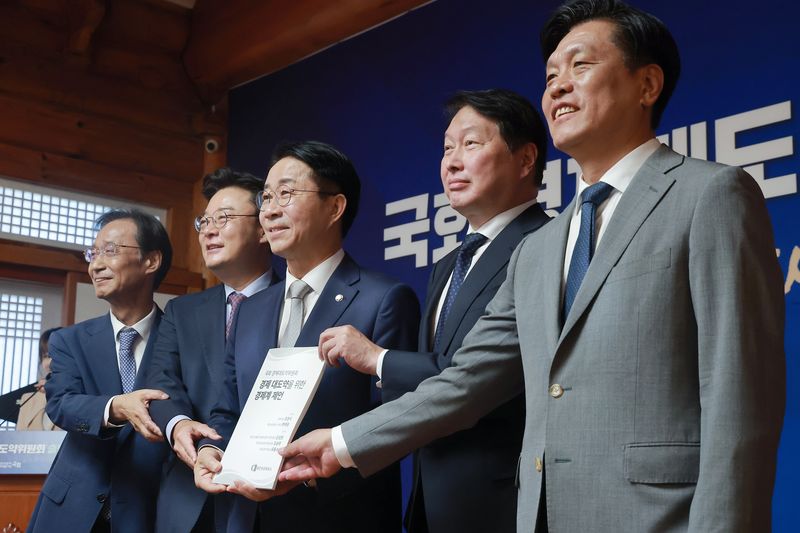
The National Assembly held the launch ceremony of the National Assembly Economic Great Leap Forward Committee at Sarangjae Hall that day. The ceremony was attended by co-chairs Cho Jeong-sik, speaker of the National Assembly, and Chey Tae-won, chairman of the Korea Chamber of Commerce and Industry, among others.
According to a key political figure who attended the ceremony, the business community was confirmed to have urged the National Assembly to allow exceptions to the 52-hour workweek and ease mandatory closure rules for large supermarkets.
Allowing exceptions to the 52-hour workweek for high-income workers, including those in research and development (R&D), has long been a priority for the business community. The argument is that restrictions on their working hours reduce corporate productivity and competitiveness in global markets. In particular, the business community’s demand was thwarted when the Democratic Party of Korea, which held the key position amid opposition from labor groups during the drafting of the Special Act on Semiconductor Support, passed the legislation without an exception to the 52-hour workweek.
More recently, whether to include an exception to the 52-hour workweek in the Mega Special District Act, which is intended to support the three mega-projects being ambitiously pursued by the Lee Jae Myung administration, has emerged as a key issue. The business community therefore raised the matter directly at the gathering with the National Assembly, seeking once again to secure an exception to the 52-hour workweek.
The business community also called for easing mandatory closure rules for large supermarkets. A ruling-party official said, “The request was to allow large supermarkets to open on weekends, at least in areas with large concentrations of foreign tourists, such as special tourism zones, even if the regulations are not eased across the board.” Large supermarkets are currently restricted from operating on two weekends each month.
[email protected] Kim Hyung-gu Reporter