6,282 Applicants to Science High Schools Nationwide... Highest in 11 Years
- Input
- 2026-09-09 11:52:40
- Updated
- 2026-09-09 11:52:40
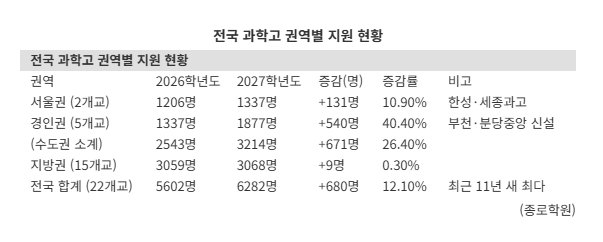
[Financial News] Applications for the 22 science high schools nationwide for the 2027 academic year received a total of 6,282 applications, marking the highest number of applicants in the past 11 years. The results, which closed on the 3rd, show an increase of 680 applicants compared to the previous year's 5,602, representing a 12.1% rise, with an average competition rate of 3.38 to 1.
On the 9th, Lim Seong Ho, CEO of Jongro Academy, analyzed, "Although there were significant concerns about top-tier students flocking to medical schools due to the expansion of medical school quotas and the introduction of the regional doctor system in provincial areas, the increase in demand for admission—despite the disadvantages students face when applying to medical schools upon entering science high schools—is proof that top students' preference for science and engineering fields remains solid." He added, "The number of applicants for the seven gifted schools nationwide, which closed earlier, also stood at 4,155, marking the highest figure in the last six years and supporting this trend."
The recent surge in applicants was largely influenced by the opening of Bucheon Science High School and Bundang Jungang Science High School in the Gyeonggi region. Although the two schools were recruiting 100 students each, 406 applicants flocked to Bucheon Science High School and 405 to Bundang Jungang Science High School, bringing the total number of applicants for the two schools alone to 811. Consequently, applicants in the Seoul area increased by 10.9% compared to the previous year, while those in the Gyeongin area rose by 40.4%, resulting in a 26.4% increase in total applicants for the metropolitan area. In contrast, applicants to 15 schools in provincial areas increased by only 0.3%, remaining at a level similar to the previous year.
However, the trend changes somewhat when excluding the two newly established schools. When comparing only the 20 existing schools, the number of applicants was 5,471, which is actually 131 fewer, or 2.3%, than the 5,602 applicants from the previous year. While the Seoul area maintained a natural growth trend, the number of applicants decreased at existing schools in the Gyeongin area, and remained flat in provincial areas. This means that a significant portion of the overall increase in applicants stemmed from the opening of the new schools.
Analysts suggest that this trend is not unrelated to the industrial environment characterized by the artificial intelligence boom and the semiconductor supercycle. According to The Export-Import Bank of Korea (KEXIM), semiconductor exports this year are projected to reach $188 billion, an 11% increase from the previous year and setting a new all-time high. Meanwhile, SK hynix ranked first in the global HBM market with a 58% market share in the first quarter of this year. The government is also stepping up efforts to foster talent in the semiconductor and science and engineering sectors, notably by announcing a semiconductor investment plan worth approximately 800 trillion won (combined) for Samsung Electronics Co., Ltd. and SK hynix last June.
The competition rate by school was highest at Gyeonggi Buk Science High School at 5.30 to 1, followed by Hansung Science High School at 4.47 to 1, Sejong Science High School at 4.44 to 1, Bucheon Science High School at 4.06 to 1, Bundang Jungang Science High School at 4.05 to 1, Daejeon Dongsin Science High School at 3.96 to 1, and Incheon Jinsan Science High School at 3.39 to 1.
The 22 science high schools nationwide will conduct school-specific interviews from November 13 to 28, and the final successful candidates will be announced sequentially between November 25 and December 2.
[email protected] Kim Man-gi Reporter