Discarded Police Uniforms Turned into Bags and New Clothes as Police and Climate Ministry Launch Circular-Use Initiative
- Input
- 2026-09-09 14:00:00
- Updated
- 2026-09-09 14:00:00
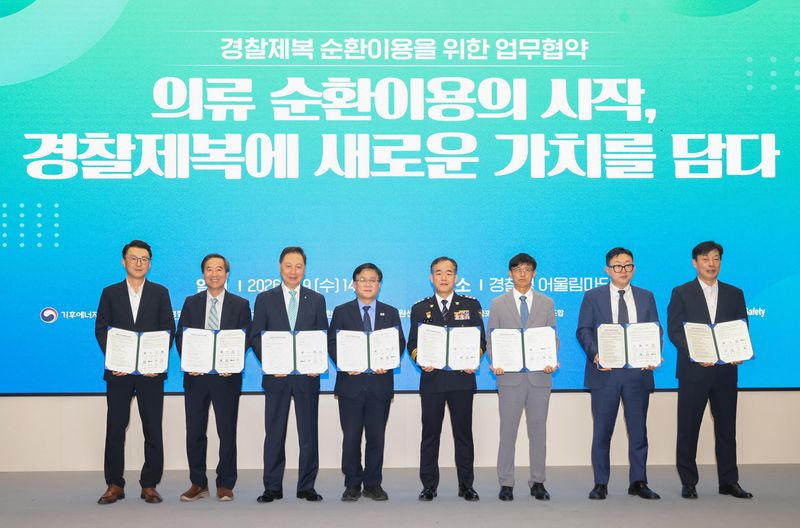
[Financial News] Discarded police uniforms, which have mostly been incinerated, will be repurposed into bags, wallets and recycled fibers. The government and police plan to establish a system covering the collection, preprocessing and recycling of police uniforms.
The Korean National Police Agency said on the 9th that it had signed an agreement on the circular use of police uniforms with the Ministry of Climate, Energy and Environment, Korea Environment Corporation (K-eco), and the Korea Circular Resources Distribution Support Center. The Korea Packaging Materials Recycling Business Mutual Aid Association, Korea Sustainable Textile and Apparel Alliance, BYN Black Yak and K2 Safety Korea will also participate in the agreement.
Clothing typically combines multiple materials, such as polyester and cotton, with accessories including zippers and buttons, making it difficult to recycle. The proportion of clothing recycled worldwide is estimated to be less than 1%.
Institutional uniforms, by contrast, are relatively uniform in material and can be collected in large quantities, making them more suitable for recycling than ordinary clothing. The police explained that police uniforms are made from high-quality, durable functional fibers, allowing them to be recycled not only through upcycling but also through mechanical and chemical processes.
According to the police, approximately 300 metric tons of discarded police uniforms have been incinerated each year. As the design of police uniforms is being revised this year for the first time in 10 years, a large volume of discarded uniforms is expected to be generated. Over the next two years, discarded uniforms for 130,000 employees of the headquarters and affiliated agencies are expected to arise, mainly consisting of outdoor jackets and vests.
Under the pilot project, police uniforms suitable for recycling or upcycling will be separated at police substations, police precinct units, police stations and the Korean National Police Agency nationwide. The uniforms will then be collected by provincial and metropolitan police agencies and sent to preprocessing companies. These companies will remove accessories such as zippers and buttons, separate the materials, and supply them to recycling companies.
Recycling methods are broadly divided into upcycling and mechanical or chemical recycling. Discarded police uniforms can be cut and sewn into bags, wallets and dolls. The resulting products will vary in color and design depending on the type of police uniform used.
Mechanical recycling involves shredding and cutting uniforms into short fibers resembling cotton, which can then be spun into yarn or used in construction materials and furniture. In chemical recycling, only the polyester in blended fibers is broken down at the molecular level and recombined into polyester chains. The resulting material can be used to replace virgin plastic.
K-eco will store separately collected police uniforms in storage warehouses when immediate transportation to companies is difficult, then supply them according to companies' requests. The Korea Circular Resources Distribution Support Center will coordinate the processing volume of preprocessing companies with demand from recycling companies and manage related statistics, including recycling and disposal volumes.
The Korea Packaging Materials Recycling Business Mutual Aid Association will identify clothing and manufacturing companies capable of using recycled yarn. The Korea Sustainable Textile and Apparel Alliance will participate in circulating the clothing sustainably instead of incinerating or exporting it. BYN Black Yak and K2 Safety Korea will use recycled yarn produced through chemical recycling to manufacture and distribute finished clothing products.
The Ministry of Climate, Energy and Environment will oversee the pilot project, including recognizing discarded police uniforms that meet certain requirements, such as environmental performance and economic viability, as circular resources. It also plans to identify users, including central and local governments, that can use products made from recycled police uniforms. Beginning with police uniforms, the government plans to expand the pilot recycling project to other institutional uniforms, including military uniforms, firefighters' uniforms and school uniforms.
Kim Seong-hwan, Minister of Climate, Energy and Environment, said, "This agreement is for the first public-sector pilot project on the circular use of clothing and marks the first step toward giving clothing a new life through upcycling and recycling. We will build a circular-economy society in which the clothing circular-use system that began with police uniforms spreads to various institutional uniforms and everyday clothing."
Kim Jongcheol, Acting Commissioner General of the Korean National Police Agency, emphasized, "It is meaningful that police uniforms symbolizing public safety will once again contribute to society in a new form. Through this agreement, the police organization will also actively participate in achieving carbon neutrality and promoting resource circulation."
[email protected] Kim Ye-ji Reporter