SK hynix’s Noh-Jung Kwak: "The Memory Competition Is Now a ‘Curved Road’—We Must Read Changes in the AI Ecosystem"
- Input
- 2026-09-09 14:35:15
- Updated
- 2026-09-09 14:35:15
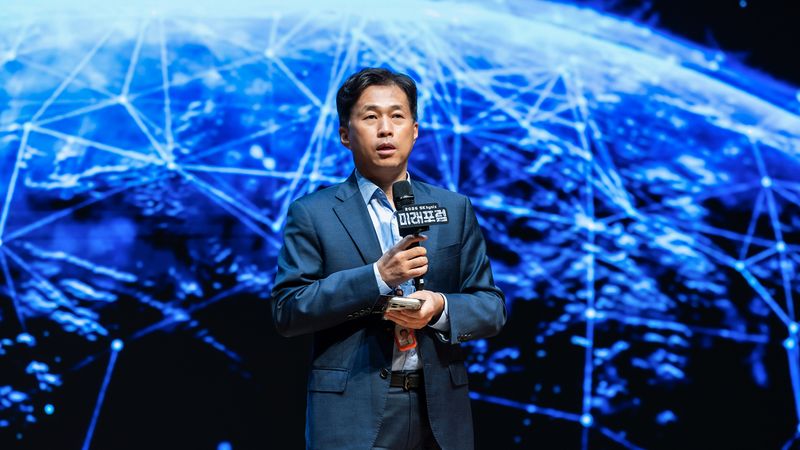
[Financial News] SK hynix President Noh-Jung Kwak said, "The memory market used to be a ‘straight road,’ where companies competed over who could run faster. Now, it is like driving on a ‘curved road’ that changes from moment to moment. It has become important not only to build internal capabilities, but also to understand the speed and direction of changes in the external environment and adapt flexibly."
At the 2026 SK hynix Future Forum, held on the 8th at the SUPEX Center on the company’s Icheon Campus under the theme "The Golden Time in the AI Era: AI Memory Solution Creators Are Changing the World," Kwak emphasized, "We need to shift our perspective ‘from the outside in,’ reconsidering from the viewpoints of customers and partners what we have taken for granted and seeking possibilities we have not previously seen amid changes in the AI ecosystem."
The Future Forum was organized to define the direction SK hynix should take in the rapidly changing AI era and to enhance employees’ insight. Following the company’s exploration of AI technologies in 2024 and its outlook on innovation across the AI value chain last year, this year’s forum examined an AI era in which work and the environment are changing and the boundaries between business and technology are breaking down. The focus was on determining what the company should do and defining the direction memory technology should take.
Following Kwak’s opening remarks, the event featured three presentations and a panel discussion. Participants included figures from domestic and international industries and professors from major universities. Key executives also attended, including Kim Kyung-hoon, vice president in charge of the Design Research Lab; Kim Hyung-soo, vice president in charge of DRAM design; Hoyoung Son, vice president in charge of Advanced PKG Development; Lim Eui-cheol, vice president in charge of Solution AT; and Joo Jae-wook, vice president in charge of Smart Mass Production Technology and AX Advance.
Experts from several global groups also took part as speakers, including Anthropic, the developer of the generative AI service Claude, offering their views on memory capabilities in the AI era. Tariq Shihipar, Claude’s product lead, explained how AI is changing work based on real-world usage data. "The more experienced people are, the better they perform because they know what to delegate and how to evaluate the results," he said, offering insights for the semiconductor industry alongside the adoption trends of global companies. He emphasized that the semiconductor industry could build “software factories” that use AI for tasks such as circuit simulation, power consumption measurement, and system optimization. He also stressed the importance of establishing systems that allow AI to verify its own results.
He further predicted that AI agents’ applications would expand across manufacturing once they are connected to hardware such as robots. As a result, AI would handle repetitive and verifiable tasks, while people would focus on higher-value roles, such as generating new ideas and making decisions based on their expertise, he said.
[email protected] Lim Soo-bin Reporter