"Borrowed 4 Trillion Won to Buy Homes"—August Mortgage Loans Jump, Interest Burden Grows With Rate Hikes
- Input
- 2026-09-09 12:00:00
- Updated
- 2026-09-09 12:00:00

On the 9th, Shin Jin-chang, secretary-general of the Financial Services Commission (FSC), chaired a joint household-debt review meeting attended by the Ministry of Economy and Finance, the Ministry of Land, Infrastructure and Transport (MOLIT), the Bank of Korea (BOK), the Financial Supervisory Service, the Korea Federation of Banks (KFB), the Korea Federation of Savings Banks (KFSB), the Credit Finance Association, and the five major banks.
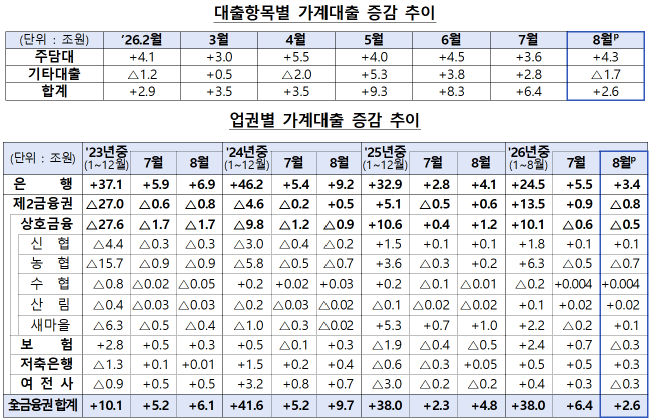
According to the FSC, household loans across the financial sector increased by 2.6 trillion won in August. Mortgage loans alone rose by 4.3 trillion won, including a 4 trillion won increase in the banking sector and a 300 billion won increase in the nonbanking sector.
A breakdown of the increase in bank mortgage loans in August shows that banks’ own lending rose by 2.9 trillion won. General mortgage loans increased by 2 trillion won, while group loans rose by 1.2 trillion won. Jeonse loans declined by 400 billion won. Policy mortgage products—including the Didimdol Loan and Buteumok Jeonse Loan—increased by 1.1 trillion won, while the Bogeumjari Loan decreased by 100 billion won.
Other loans, including credit loans, fell by 1.7 trillion won. This marked a shift to a decline from the previous month, when they had increased by 2.8 trillion won. The change resulted from a 500 billion won decrease in credit loans, which had risen by 2.1 trillion won in July amid a surge in debt-financed investing.
Household loans from nonbank financial institutions decreased by 800 billion won, reversing the 900 billion won increase recorded in the previous month. The decline in mutual finance institutions narrowed from 600 billion won to 500 billion won. Savings banks also saw their increase narrow from 500 billion won to 300 billion won. Insurers and specialized credit finance companies shifted to declines this month.
Shin said, "The 4.3 trillion won increase in mortgage loans in August resulted from a rise in housing transactions before the end of the temporary suspension of the higher capital gains tax, as well as expanded execution of balance-payment loans following an increase in move-in volumes in July and August." He added, "The impact of voluntary management measures by financial institutions caused other loans to shift to a decline for the first time in four months, narrowing the increase in household loans from the previous month."
Shin also stressed, "The upward trend in mortgage loans may continue due to seasonal demand for funds during the fall moving season, as well as the impact of separately managing group loans such as relocation, interim-payment, and balance-payment loans under the Aug. 13 measures. Please continue closely monitoring household loans."
Concerns have emerged that household debt could surge as the FSC’s revision of its household-loan quota management targets expands financial institutions’ lending capacity. Analysts have also warned that the heavy interest burden on households during a period of rising rates could lead to weaker consumption.
Shin said, "In line with the purpose of adjusting the aggregate target under the Aug. 13 measures, please continue making efforts to ensure that financial institutions meet their individual aggregate management targets while supplying, in a timely and uninterrupted manner, funds needed for policy support, including the promotion of housing supply, housing stability for young people, and relief for genuine homebuyers facing funding difficulties." He added, "As borrowers’ repayment burden is growing due to the Bank of Korea’s base-rate hikes and rising market interest rates, financial companies need to show careful consideration so that low-income and vulnerable groups do not suffer harm."
[email protected] Park Moon-soo Reporter