Jeju Begins Construction of KRW 35 Billion Smart Aquaculture Cluster to Demonstrate Aquaculture Using Less Seawater and Electricity
- Input
- 2026-09-09 10:21:47
- Updated
- 2026-09-09 10:21:47
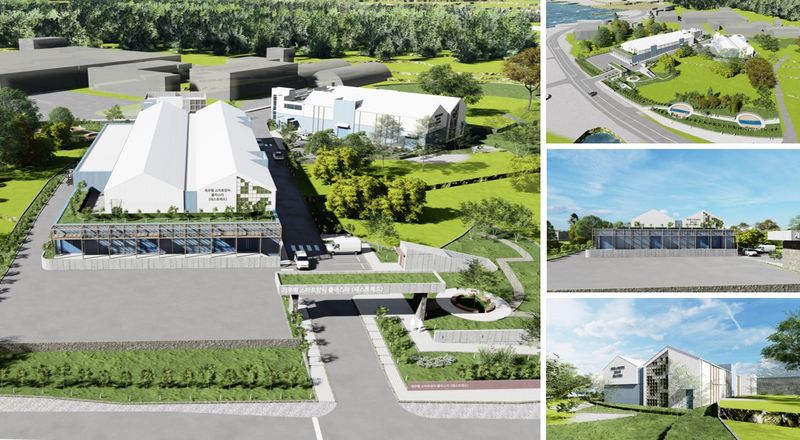
【Financial News Jeju = Reporter Yong-bok Jung】 Jeju is testing a transition in land-based aquaculture from a system that draws in large volumes of seawater to one that reduces seawater use and manages water quality and facilities with artificial intelligence (AI).
According to Jeju Special Self-Governing Province on the 9th, the Jeju Smart Aquaculture Cluster Development Project involves building demonstration facilities and supporting land in Haengwon-ri, Gujwa-eup, Jeju City. The total project cost is KRW 35 billion, with KRW 18.5 billion in national funding and KRW 16.5 billion in local funding.
Jeju Special Self-Governing Province began work on the aquaculture systems, electrical installations, and building and civil engineering projects in July. Construction will proceed sequentially by type of work, followed by completion in December 2027 and the start of pilot operations.
The project’s core technology is low-water-exchange aquaculture, which reduces seawater consumption. Many land-based aquaculture facilities in Jeju currently draw in fresh seawater more than 20 times a day. Because seawater must be continuously pumped in, electricity costs are a significant burden, and the facilities may also be affected by high water temperatures or changes in external water quality.
Jeju Special Self-Governing Province will test recirculating systems in stages by reducing the amount of new seawater supplied and filtering used water for reuse.
The demonstration facilities will be built on a 16,824-square-meter site, with a total floor area of 4,688 square meters. The aquaculture building, with 1,443 square meters of tank space, will contain facilities capable of controlling water temperature and quality.
The demonstration will consist of three stages based on the amount of new seawater supplied each day: a low-water-exchange flow-through system with 10 turnovers per day, a modified flow-through recirculating system with two turnovers per day, and an eco-friendly recirculating system with one turnover per day.
Here, “one turnover” means supplying new seawater equivalent to the tank capacity during a single day. Compared with facilities that currently use more than 20 turnovers, the system is designed to gradually reduce dependence on new seawater while assessing the aquaculture environment and productivity.
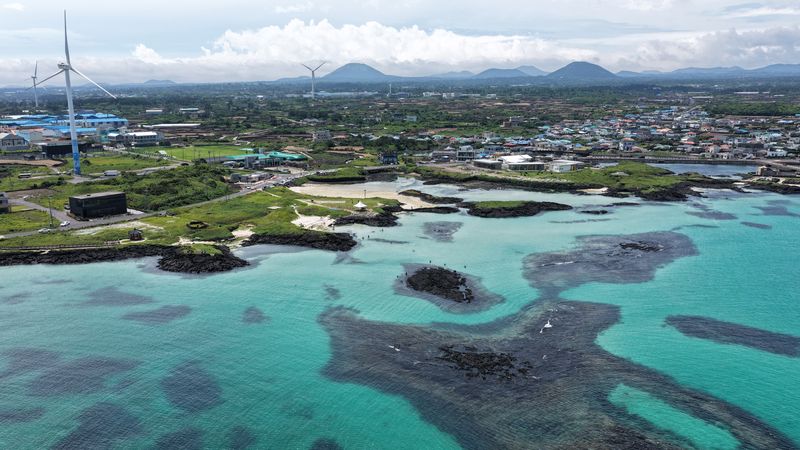
AI will also be incorporated into aquaculture facility management. Information and communications technology will be used to collect real-time data on water quality, equipment conditions and flow rates, which AI will analyze to enable integrated management and control of the facilities.
The project focuses on creating a foundation for replacing some management practices that have relied on operators’ experience and on-site inspections with data-based methods, allowing more systematic responses to abnormal water quality or equipment changes.
The high dependence of Jeju’s land-based aquaculture industry on seawater is one reason the Jeju Smart Aquaculture Cluster has drawn attention. Existing methods, which involve drawing and discharging large volumes of seawater, have created management burdens through pumping costs, water-temperature changes and disease control.
Once low-water-exchange and recirculating technologies are applied in the field, Jeju Special Self-Governing Province plans to first accumulate data on seawater use, rearing conditions and facility operations at the demonstration site. It will then consider models that can be expanded to actual aquaculture facilities. Specific rates of cost reduction or productivity improvement will have to be confirmed after the demonstration.
The Haengwon Land-Based Aquaculture Complex around the demonstration facilities will also be improved. A waterfront park and stone walls will be built on the supporting land. The project will also include office remodeling, exterior painting, improvements to the main road and stormwater manholes, upgrades to aging infrastructure such as settling tanks, and the installation of screening facilities around the pump room.
Jeju Special Self-Governing Province was selected for the MOF’s smart aquaculture cluster competition in 2022 and subsequently proceeded with approval of the master plan and detailed design. After completing related permits and approvals covering construction, landscape, environment, cultural heritage, public waters and groundwater, the project moved into full-scale construction this year.
The project will run for six years, from 2022 to 2027. The test bed will be built on nine lots, including Lot 81 in Haengwon-ri, Gujwa-eup, Jeju City. Of the four buildings, Building 1 will house low-water-exchange flow-through and modified flow-through recirculating facilities, while Building 2 will contain an eco-friendly recirculating aquaculture system as well as office and viewing areas. Pumping facilities will be installed in Building 3, and an elevated water tank in Building 4.
Kim Jong-su, director of Jeju’s Ocean and Fisheries Bureau, said, "We will carry out the construction safely and make the smart aquaculture cluster a key hub leading Jeju’s aquaculture industry toward an eco-friendly production system."
[email protected] Yong-bok Jung Reporter