Students Reporting School Violence Victimization More Than Triple in Six Years... Violence Has Become More Extreme, Including the “Yacha Rule”
- Input
- 2026-09-09 12:00:00
- Updated
- 2026-09-09 12:00:00
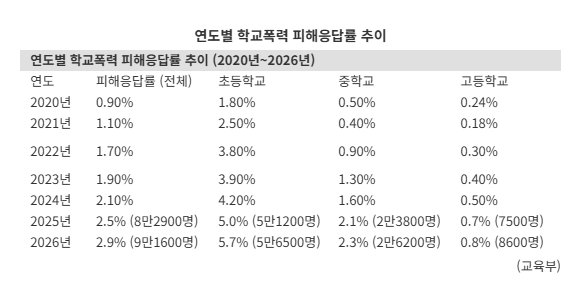
[Financial News] The proportion of students reporting school violence victimization rose from 0.9% in 2020 to 2.9% this year, more than tripling in six years. As the number of victims continues to grow, the Ministry of Education said it would also strengthen its response to more extreme forms of school violence, including the “Yacha Rule.”
According to the “2026 First Survey on School Violence” released by the Ministry of Education on the 9th, the victimization rate was 2.9%, up 0.4 percentage points from the previous year. The rate of students reporting that they had witnessed school violence also rose by 0.6 percentage points to 6.7%. In other words, about three out of every 100 students said they had experienced school violence, while roughly seven out of 100 said they had witnessed it. By contrast, the proportion of students who acknowledged perpetrating violence was 0.8%, less than one in 100 and down 0.3 percentage points from the previous year. This highlighted a gap between the indicators. Of the 91,600 students who reported being victims, elementary school students accounted for the largest share at 56,500.
The differences by school level were also clear. The elementary school victimization rate rose by 0.7 percentage points to 5.7%, while the perpetration rate fell by 0.8 percentage points to 1.6%, producing the widest divergence between the two indicators. Middle schools recorded a victimization rate of 2.3% and a perpetration rate of 0.7%. The corresponding figures for high schools were 0.8% and 0.1%, respectively.
An official from the Ministry of Education explained, "Given the self-reported nature of the survey, students may perceive the same behavior differently, which can lead to a gap between the reported victimization and perpetration rates." The official said victims often view behavior that began as a joke as school violence, while perpetrators frequently regard it as mere horseplay and fail to recognize that they committed violence. The official added, "The fact that elementary schools showed both the largest increase in reported victimization and the largest decrease in reported perpetration is also connected to this difference in perception."
By type of victimization, verbal abuse was the most common at 37.8%, followed by group bullying at 17.1%, physical violence at 15.7%, and cyberbullying at 7.0%. Compared with the previous year, verbal abuse fell by 1.2 percentage points and cyberbullying by 0.8 percentage points. Group bullying, however, rose by 0.7 percentage points, while physical violence increased by 1.1 percentage points.
Responding to more extreme forms of violence has also emerged as a key challenge. The Ministry of Education and the Korean National Police Agency issued a “Yacha Rule” alert in August. An official from the Ministry of Education said, "It is difficult to determine a specific increase in the Yacha Rule based solely on the standardized survey questions." The official nevertheless noted, "Serious cases have been reported in the field, including stronger students forcing weaker students to fight and then selling videos of the fights."
Changes were also evident in statistics on the handling of school violence cases. The number of cases reported to Offices of Education during the 2025 academic year fell to 56,880, but the proportion that proceeded to formal review rose to 51.7%. The share of cases determined not to constitute school violence after review also increased to 22.1%. An official from the Ministry of Education explained, "At meetings with schools and other stakeholders, many participants said that incidents beginning as jokes or conflicts often develop into school violence cases."
The Ministry of Education said it would strengthen preventive education designed to build practical response skills, including conflict management and defensive behavior, so that minor disputes do not escalate into school violence. Beginning in the second semester, it will operate Eoullim Plus Model Schools, which focus on practical activities, and expand the scope of the Relationship Restoration Deliberation Program introduced in March. It also plans to increase mobile prevention education for working parents with dual incomes in cooperation with the Korea Chamber of Commerce and Industry (KCCI). For serious and malicious violence, including the Yacha Rule, the ministry said it would work with provincial and metropolitan Offices of Education and the Korean National Police Agency to respond firmly under a zero-tolerance principle.
[email protected] Man-ki Kim Reporter