'Same Law, Different Schools': Regional Difference in Smartphone Regulations 3.6 Times
- Input
- 2026-09-09 10:08:18
- Updated
- 2026-09-09 10:08:18
[Financial News] Six months have passed since the law restricting the use and possession of smartphones on school grounds went into effect, but it has been found that there is extreme disparity in regulations, with the rate of forced confiscation varying by up to 3.6 times depending on the region where the school is located. One in six schools nationwide has still not even been able to revise its relevant school regulations, leading to continued confusion in the educational field.
With standards varying widely, conflicts between students and teachers attempting to evade enforcement are deepening on the ground. In some schools, there are even instances where students bring a "second phone" intended for submission upon arrival to circumvent regulations. It is pointed out that teachers are bearing a double burden of dealing with both enforcement and complaints, as disputes over responsibility for lost or damaged devices overlap with parental grievances regarding the severity of disciplinary actions.
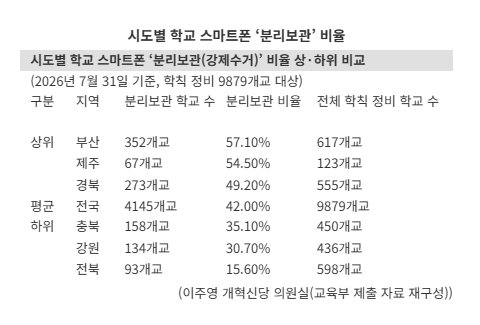
According to data submitted by the Ministry of Education to Rep. Lee Ju-young of the Reform Party, a member of the National Assembly Education Committee, on the 9th, only 9,879 out of 11,868 elementary, middle, and high schools nationwide—or 83.2%—had completed the revision of their school regulations. The remaining 1,989 schools, amounting to 16.8%, had not incorporated standards restricting the use of smart devices into their regulations even after the start of the new academic year.
Even among schools that established school regulations, the intensity of regulations varied significantly by region. For the 'separate storage type,' where devices are collected en masse upon arrival at school, the figures exceeded half in Busan (57.1%) and Jeju (54.5%). In contrast, Jeonbuk stood at 15.6%, Chungbuk at 35.1%, and Gangwon at 30.7%, resulting in a 3.6-fold gap between Busan, which had the highest separate storage rate, and Jeonbuk, which had the lowest.
The proportion of schools allowing students to possess mobile phones personally but restricting their use only during class was highest in Jeonbuk at 84.4%, followed by Gangwon at 69.3% and Chungbuk at 64.9%. On a national average, among schools that revised their school regulations, the personal possession type accounted for 57.6% and the separate storage type for 42.0%.
While the amendment to the Elementary and Secondary Education Act has established a legal basis for restricting the use and possession of smart devices within schools, the lack of unified standards and the leaving of detailed regulations to school discretion have effectively resulted in a pronounced disparity between regions.
Representative Lee Ju-young stated, "While I sympathize with the intent of the system restricting the possession of smart devices on school grounds—to protect students' right to learn—there are concerns that the issue of equity in the intensity of the regulations and confusion on the ground could further intensify conflicts between students, parents, and teachers." She added, "Through this parliamentary audit, I will examine the reasons for the delay in revising school regulations and review future plans in a direction that is acceptable to all, going beyond merely creating regulations to address students' right to learn, parents' safety concerns, and teachers' conditions for student guidance."
[email protected] Kim Man-gi Reporter