“Scalpel, please,” and the Robot Hands It Over... Humanoid Surgical Robot That Moves Like a Person to Be Unveiled on the 16th
- Input
- 2026-09-09 10:11:38
- Updated
- 2026-09-09 10:11:38
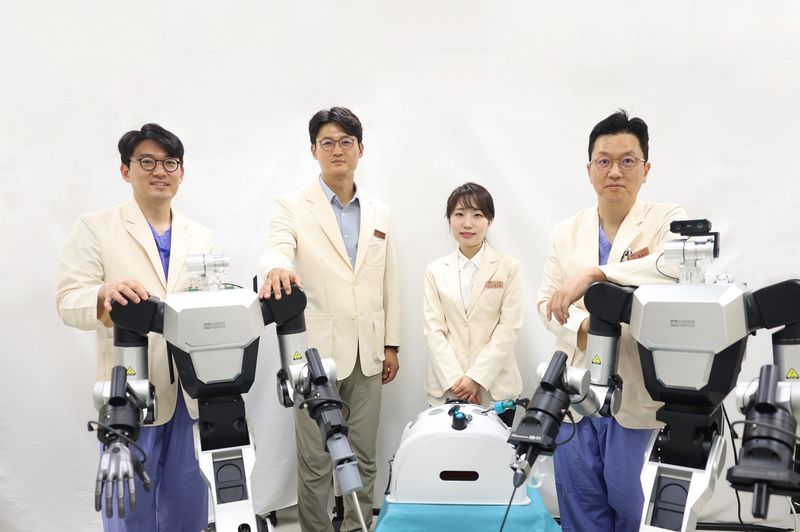
[Financial News] Two robots will be publicly demonstrated working alongside a human doctor as a team to perform surgery—a world first.
Samsung Seoul Hospital said it will demonstrate its humanoid surgical-assistance robot to the public on the 16th. The hospital was selected in 2025 as the lead institution for the Korean ARPA-H, a major national project, and is developing a “humanoid Physical AI-based surgical-assistance robot for creating an efficient surgical environment.”
Rainbow Robotics, Aidin Robotics, Ha Hae-ho, the Samsung Institute of Convergence Medicine, Seoul National University, the National Cancer Center, and Jeonbuk National University Hospital have formed the “ORchestra” consortium to jointly develop the humanoid surgical-assistance robot.
The project is currently validating the robot’s ability to deliver and retrieve instruments, manipulate an endoscope, retract tissue, understand voice commands, and stop and recover safely in a simulated surgical environment.
Commercialization will be pursued through repeated performance testing, simulated-environment and preclinical testing, usability evaluations by medical staff, establishment of a GMP quality system, clinical trials, and medical-device regulatory approval.
Samsung Seoul Hospital will unveil to the public for the first time the humanoid surgical-assistance robot it has developed over the past year. The demonstration will show step by step how the robot can divide responsibilities with medical staff, from repetitive support tasks in the operating room to precise movements involved in minimally invasive surgery.
Professor Jung Yong-gi said, “You will see a humanoid surgical-assistance robot that follows the commands and manipulations of medical staff, who retain decision-making and control authority throughout the entire surgical process.” He added, “You will be able to intuitively see how successfully it can assist people during surgery.”
Performing Surgery with a Robot That Moves Like a Person
In the first demonstration, Samsung Seoul Hospital will show the humanoid surgical-assistance robot directly holding surgical instruments. It will demonstrate a series of precise surgical procedures involving incision, dissection, and suturing of biological tissue.
Professor Jung explained, “The robot is not yet at the stage where it can assess a patient’s condition and perform surgery autonomously.” He added, “Instead, a skilled medical professional controls the robot’s two arms and surgical instruments in real time through a control device.”
The robot mirrors the operating surgeon’s movements as the surgeon works while looking at a monitor. It resembles the way the robot in the science-fiction film “Real Steel,” starring Hugh Jackman, follows and replicates a person’s movements.
Professor Jung said, “The humanoid surgical-assistance robot converts the movements of a person’s hands and arms into the robot’s coordinate system and implements them in the operating room.” He added, “This will allow people to see precision surgery in which the medical professional’s control inputs are expressed as small, individual movements.”
The second demonstration will show the humanoid surgical-assistance robot helping the operating surgeon by taking over tasks traditionally performed by people, including circulating surgical instruments, maintaining the endoscopic view, and retracting tissue.
The demonstration will show the robot performing a continuous sequence of tasks, as in an actual surgical procedure. In particular, it will publicly present a world-first scene in which two robots collaborate with a human doctor to perform surgery.
Robot No. 1 takes on the role of an operating-room nurse. It understands the operating surgeon’s voice request, identifies the requested surgical instrument, adjusts the handle’s orientation and handover position so the surgeon can grasp it safely, and passes it over. Once the instrument has been used, the robot takes it back, organizes it in the designated location, and updates the list of available instruments and the status of the next request.
Professor Jung explained, “The key is not simply handing over an instrument once and stopping there. It is completing the entire instrument-circulation process—‘request, delivery, use, retrieval, and organization’—as a person would during an actual operation.”
Robot No. 2 simultaneously performs the roles of a surgical assistant and nurse. It holds a laparoscopic endoscope in its left hand and adjusts the view so that the surgical site remains centered on the screen. Its right hand holds a surgical grasper, which it uses to retract biological tissue in the designated direction according to the operating surgeon’s instructions.
Professor Jung explained, “Because a single humanoid surgical-assistance robot handles both the endoscopic view and tissue retraction, it can coordinate these movements in tandem—adjusting the view of the surgical site while creating the space needed for the operation.”
At the end, participants in the demonstration will have an opportunity to operate the humanoid surgical-assistance robot themselves in a simulated open-surgery environment.
Countries Around the World Compete to Develop Humanoid Surgical-Assistance Robots
Research into introducing humanoid surgical-assistance robots into operating rooms remains globally at the early stages of demonstration and proof of concept. South Korea has also entered this early development race and is working to open up the market.
Development of humanoid surgical-assistance robots for operating rooms is broadly taking two directions. One focuses on transporting supplies and handling preparation tasks before and after surgery; the other focuses on participating in surgery and manipulating surgical instruments.
Foxconn, the world’s largest electronics contract manufacturer, drew attention at this year’s COMPUTEX event in Taiwan by introducing Nurabot, a robot capable of moving through hospital wards to deliver medication and supplies while also performing operating-room nursing tasks.
Humanoid surgical-assistance robots that perform surgery based on human manipulation have also moved closer to commercialization. Researchers at UC San Diego reported in Nature in July that a humanoid surgical-assistance robot performed surgery on a pig model using existing laparoscopic instruments under human remote control.
Professor Jung explained, “This means that humanoid surgical-assistance robots can use operating rooms designed for people and existing surgical instruments as they are, without the need to build separate operating rooms for them.” He added, “Once commercialized, they could be rapidly deployed in operating rooms without requiring separate environmental changes.”
Samsung Seoul Hospital said the demonstration focused less on having the humanoid surgical-assistance robot perform individual movements and more on having it understand the entire surgical process and connect the workflow like a person who understands and acts within that context.
The hospital said its approach differs from that of other countries, where surgical robots currently under development are moving toward performing specific movements like people or better than people. Samsung Seoul Hospital is instead implementing an operating-room system in which multiple humanoid surgical-assistance robots share the surgical context and work with people as a single team.
Professor Jung said, “If humanoid surgical-assistance robots can help people in environments where surgery is difficult for humans and in areas involving repetitive, demanding labor, they can create a surgical environment that is more beneficial for patients.” He added, “We expect them to enable more stable operations with limited medical personnel and help fill staffing gaps in nighttime, emergency, and essential-care settings, where it is difficult to secure skilled surgical assistants.”
Meanwhile, the humanoid surgical-assistance robot development project at Samsung Seoul Hospital is part of the “2025 Korean ARPA-H Project,” supported by the Ministry of Health and Welfare (MOHW) and the Korea Health Industry Development Institute’s K-Health MIRAE Initiative. It is a competitive government-funded research and development project with total funding of 13.835 billion won, running for 54 months from July 2025 through December 2029. The project will enter its second phase after a first-stage competition evaluation at the end of 2026.
[email protected] Medical Specialist Reporter Jung Myung-jin Reporter