Jeju Issues Reexamined Through International Students’ Eyes: 40 JNU Students Take Part in a Living-Lab Experiment
- Input
- 2026-09-09 09:51:35
- Updated
- 2026-09-09 09:51:35
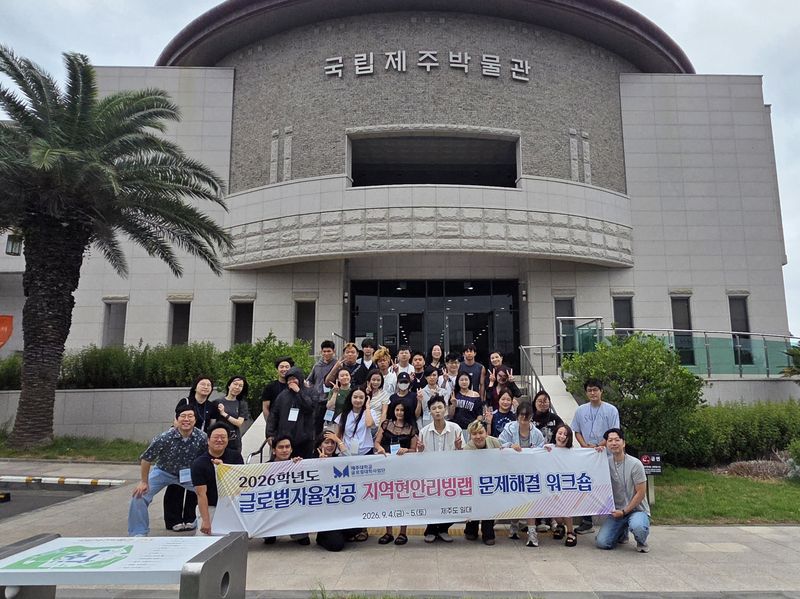
【Financial News Jeju = Reporter Jung Yong-bok】 Jeju National University (JNU) is expanding its living-lab education program, which directly involves domestic and international students in addressing local issues. About 40 students, including international students, visit sites across Jeju and explore problems and solutions from different cultural perspectives.
According to JNU on the 9th, its Global Interdisciplinary Studies program held the second Regional Issues Living-Lab Problem-Solving Workshop from the 4th to the 5th with support from the Glocal University Project Office.
About 40 people, including faculty members from Global Interdisciplinary Studies and domestic and international enrolled students, took part in the program.
A living lab is an approach in which local residents or users identify problems in real-life settings and work together to create solutions. Unlike classroom-based courses that address problems assigned in advance, the approach focuses on having students observe the field, define problems, and design alternatives through collaboration.
During this workshop, domestic students and international students also formed teams to examine various issues they encountered in Jeju and discuss possible solutions.
The participation of international students is particularly meaningful because it allows familiar local issues to be reconsidered through the eyes of people with different cultural and life experiences. The program incorporated the process itself into the educational experience: international students living in Jeju identified inconveniences and areas for improvement from the perspective of actual users, while working with domestic students to coordinate solutions.
Through the program, JNU plans to strengthen students’ problem-solving and collaboration skills while broadening their understanding of and experience participating in the local community.
The program is also aligned with Learncation, a core direction of JNU’s Glocal University Project. Learncation combines “learning” and “vacation” and refers to JNU’s regionally connected education model, which uses industrial, cultural, and everyday-life settings across Jeju as educational spaces where young people and researchers from Korea and abroad can learn and interact.
The living-lab program run by Global Interdisciplinary Studies follows the same direction by using Jeju itself as a learning space rather than limiting education to the university campus.
The initiative is also notable because it connects the challenges facing the region with education instead of limiting the role of a regional university to student instruction alone. In a place like Jeju, where tourism, migration, and the presence of international residents are active, the perspectives of students from different backgrounds can serve as a resource for viewing local issues in new ways.
JNU’s Global Interdisciplinary Studies program plans to continue expanding field-based education linked to the local community.
Lee Ga-young, head professor of Global Interdisciplinary Studies at JNU, said, "The process of international students viewing Jeju’s issues through different cultural backgrounds and perspectives and considering solutions is itself an important form of learning." She added, "We will expand educational programs that help students understand Jeju and grow together with the local community."
[email protected] Jung Yong-bok Reporter