Returns Achieved Too Quickly... Higher Fee Burden for Class A of Target-Date Conversion Funds
- Input
- 2026-09-09 12:00:00
- Updated
- 2026-09-09 12:00:00
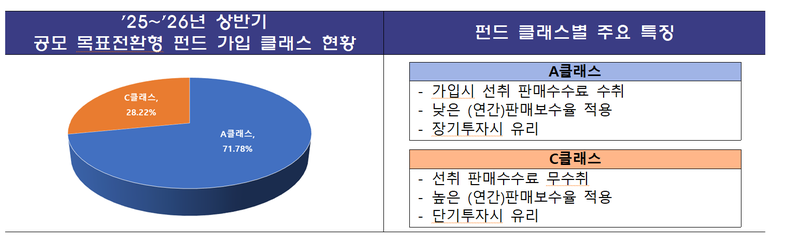
[Financial News] The average time taken by publicly offered target-date conversion funds that achieved their target returns in the first half of this year was just two months. However, seven out of 10 investors subscribed to products that charge upfront sales fees, which impose a heavier cost burden on short-term investments. The Financial Supervisory Service urged investors to choose a fund class based on their expected investment period.
According to the Financial Supervisory Service on the 10th, 71.8% of investors who subscribed to publicly offered target-date conversion funds from 2025 through the first half of 2026 chose Class A, which charges an upfront sales fee.
Target-date conversion funds raise money for a set period and invest it in risky assets such as stocks. Once a preset target return is reached, the funds automatically switch to safer assets such as bonds and are managed until maturity.
The average time taken by funds that achieved their target returns fell from 505 days in 2022 to 284 days in 2023, 249 days in 2024, and 105 days last year. In the first half of this year, it shortened further to 57 days. Funds that failed to achieve their target returns were excluded from these statistics.
The issue is that the cost burden of Class A can increase as the investment period shortens. Class A charges the sales fee upfront but has a lower annual distribution fee, making it advantageous for long-term investment. Class C, by contrast, has no upfront sales fee but carries a higher annual distribution fee, making it relatively more suitable for short-term investment.
The cumulative costs of the two classes generally become similar after two years. This means that choosing Class A may be disadvantageous in terms of cost if the target return is reached early or the fund is redeemed before maturity.
Demand for target-date conversion funds is growing rapidly. Assets raised by publicly offered target-date conversion funds increased from 100 billion won in 2022 to 200 billion won in 2023 and 1.4 trillion won in 2024. They surged to 5.2 trillion won last year, while another 3.2 trillion won was raised in the first half of this year.
The Financial Supervisory Service emphasized that the “target return” of a target-date conversion fund is not a guaranteed return. Depending on market conditions, it may take longer to reach the target or the target may not be reached at all. There is also a possibility of significant losses while the fund is invested in risky assets such as stocks.
Even if the target return is reached, the actual return may fall below the target. This is because it generally takes about five days to switch to safer assets after the target is reached. If asset prices fall amid sharp market fluctuations during this period, the return at the time of conversion may be significantly below the target return.
Starting on the 30th, the Financial Supervisory Service will apply the Standardized Key Fund Risk Disclosure to 10 types of funds, including target-date conversion funds. It plans to strengthen the information required in fund registration statements so investors can easily identify key product risks and instruct fund distributors to provide adequate explanations of fee burdens and other costs.
[email protected] Lee Jeong-hwa Reporter