What Was the Top Non-Covered Medical Expense at Hospitals in the Second Half of Last Year?
- Input
- 2026-09-09 12:00:00
- Updated
- 2026-09-09 12:00:00
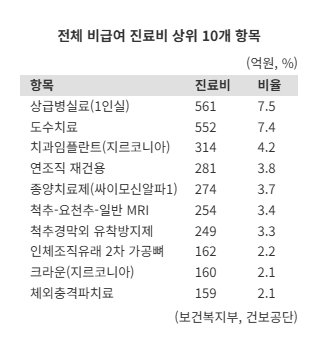
[Financial News] Premium room charges (single rooms) and manual therapy ranked among the highest non-covered medical expenses at hospitals.
The Ministry of Health and Welfare (MOHW) and the National Health Insurance Service (NHIS) analyzed the results of the “2025 Second-Half Non-Covered Medical Service Reporting System,” conducted among hospital-level medical institutions in the second half of 2025. The total non-covered medical expenses reported across 1,251 items amounted to KRW 749.9 billion. By type of institution, hospitals accounted for KRW 312.2 billion (41.6%), general hospitals for KRW 158.7 billion (21.2%), and tertiary general hospitals for KRW 108.4 billion (14.5%).
Compared with KRW 686.4 billion in the first half of last year (March data), non-covered medical expenses increased by KRW 63.5 billion. The increase was attributed to the number of reporting institutions rising by 98, from 4,000 to 4,098, as well as a KRW 11.38 million increase in average non-covered medical expenses per institution. The share of non-covered expenses in total medical expenses, including covered and non-covered services, also rose by approximately 0.2 percentage points from the first half. Total medical expenses at hospital-level institutions increased from approximately KRW 6.2686 trillion in March 2025 to approximately KRW 6.7280 trillion in September.
Of the KRW 749.9 billion in total non-covered medical expenses at hospitals, premium room charges (single rooms) accounted for the largest share at KRW 56.1 billion (7.5%). They were followed by manual therapy at KRW 55.2 billion (7.4%), dental implants (zirconia) at KRW 31.4 billion (4.2%), supplements for ligaments, tendons, muscles, and fascia (for soft-tissue reconstruction) at KRW 28.1 billion (3.8%), the tumor treatment thymosin alpha-1 at KRW 27.4 billion (3.7%), spine–lumbosacral–general MRI at KRW 25.4 billion (3.4%), spinal epidural adhesion-prevention agents at KRW 24.9 billion (3.3%), secondarily processed bone derived from human tissue at KRW 16.2 billion (2.2%), zirconia crowns at KRW 16.0 billion (2.1%), and extracorporeal shock wave therapy at KRW 15.9 billion (2.1%).
By medical field, medical services accounted for the largest share at KRW 657.7 billion (87.7%), followed by dental services at KRW 72.8 billion (9.7%) and Korean medicine services at KRW 19.4 billion (2.6%).
Within medical services, premium room charges (single rooms) accounted for the largest amount at KRW 56.1 billion (8.5%), followed by manual therapy at KRW 55.2 billion (8.4%) and soft-tissue reconstruction materials at KRW 28.1 billion (4.3%).
In dental services, the three leading items—dental implants (per tooth), crowns, and orthodontic treatment—accounted for 85.0% of total dental expenses. By implant material, zirconia accounted for the vast majority, followed by porcelain-fused-to-metal (PFM) and other materials. Zirconia also represented the largest share of crown materials, followed by PFM, gold, and other materials.
In Korean medicine services, herbal decoctions and traditional herbal preparations accounted for the largest amount at KRW 14.4 billion (73.9%), followed by pharmacopuncture–acupoints at KRW 4.5 billion (23.1%) and Korean medicine physical therapy at KRW 130 million (0.7%).
Among the items with the highest expenses, treatment materials for soft-tissue reconstruction and spinal epidural adhesion-prevention agents recorded significant increases. Non-covered items related to cancer patients, including the immune-enhancing agent thymosin alpha-1, also rose substantially, particularly at long-term care hospitals and Korean medicine hospitals.
Since July, MOHW has applied manual therapy, one of the largest non-covered medical expense items in the medical field, as managed coverage by establishing reimbursement rates and treatment standards. For extracorporeal shock wave therapy, it established a foundation for managing the number and intervals of non-covered treatments and their indications through voluntary corrective measures by the medical community.
MOHW plans to continue monitoring the status of managed coverage and non-covered services and strengthen the non-covered service management system by expanding the items subject to managed coverage.
Yoo Ju-heon, director general of the Health Insurance Policy Bureau, said, "We will strengthen oversight through continuous monitoring of excessive non-covered services that burden the public with medical expenses beyond their medical necessity. We will also work to protect the public's right to know by expanding the provision of non-covered service information using reported data."
The non-covered medical service reporting system requires medical institutions to report details of non-covered services to assess their status and guarantee the public's right to know about such services and their right to choose medical care. It has been in operation since September 2023. The status of non-covered services is surveyed twice a year: nationwide among all medical institutions for first-half data (March treatment records), and additionally among hospital-level medical institutions for second-half data (September treatment records). The number of items covered by the 2025 report expanded to 1,251, an increase of 183 from the 1,068 items in 2024.
[email protected] Medical Specialist Reporter Yoo Ju-heon Reporter