Tung Chee-hwa, Hong Kong’s First Chief Executive After Handover to China, Dies at 89
- Input
- 2026-09-09 09:25:39
- Updated
- 2026-09-09 09:25:39
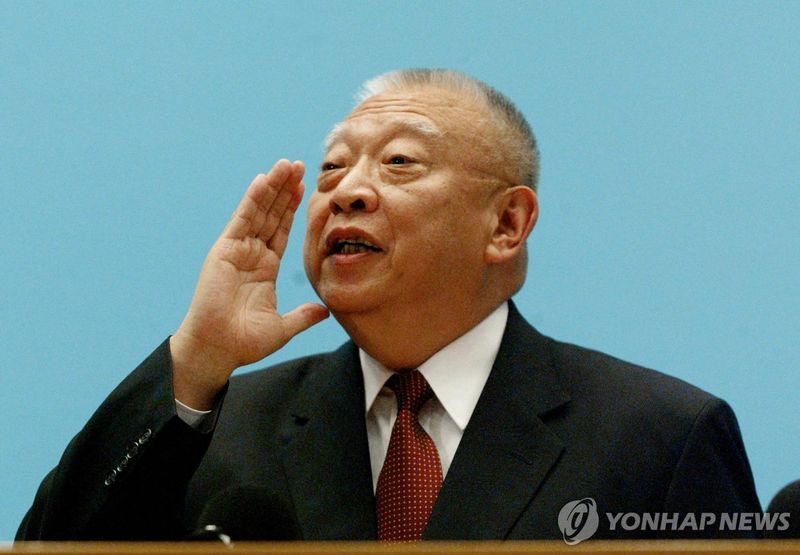
[Financial News] Tung Chee-hwa, Hong Kong’s first Chief Executive after the territory was returned to China in 1997 and a former vice chairman of the Chinese People’s Political Consultative Conference (CPPCC), died on the 8th local time. He was 89.
According to AFP and other outlets on the 9th, the office of Tung, Hong Kong’s first Chief Executive, said in a statement that he had passed away peacefully surrounded by his family. The statement emphasized, "Mr. Tung served the country and the Hong Kong Special Administrative Region with unwavering dedication throughout his life," adding, "His contributions, marked by integrity, compassion and dignity, will be remembered for a long time."
Born in 1937 into a prominent shipping family in Shanghai, China, he served as Hong Kong’s Chief Executive from 1997 to 2005. His family moved to Hong Kong in 1947. He was involved in political organizations in both mainland China and Hong Kong, and won the election for Hong Kong’s first Chief Executive in December 1996, beginning his five-year term on July 1, 1997. After his first term ended, he secured a second term without facing a competing candidate.
His eight-year tenure was a turbulent period marked by policy failures and concerns over intervention from mainland China.
Early in his administration, the Asian financial crisis, record-high unemployment and the collapse of Hong Kong’s property market dealt a severe blow to many ordinary residents.
In July 2003, his political career reached a critical juncture when 500,000 Hong Kong residents took to the streets to oppose the government’s proposed National Security Act, formally the national security bill under Article 23 of the Basic Law of Hong Kong.
Although the bill was eventually withdrawn, protest marches continued to be held annually in Hong Kong on July 1, the anniversary of the handover, until 2020.
In 2004, Hong Kong residents again staged large-scale demonstrations demanding democracy, and Tung faced the worst crisis of his tenure that December.
Hu Jintao, then China’s president, publicly rebuked Tung and his cabinet over their poor performance.
Tung eventually stepped down in 2005, citing health reasons, two years before the end of his second term.
After leaving office, he served as a vice chairman of the CPPCC, China’s top political advisory body. Two years later, in 2023, he stepped down from the vice chairmanship as the CPPCC leadership was replaced.
He studied naval architecture and marine engineering at the University of Liverpool in 1960 and, after working in the United States, returned to Hong Kong in 1969 to join the family business. As the former head of the shipping company Oriental Overseas, he also served in 1985 on a committee that supported the drafting of the Basic Law of Hong Kong. The Basic Law of Hong Kong is a constitutional-level law governing Hong Kong after its return to China.
[email protected] International Affairs Specialist Lee Seok-woo Reporter