DRTECH’s Dynamic Detector ‘EXPEED’ Posts 116% Average Annual Growth
- Input
- 2026-09-09 08:46:04
- Updated
- 2026-09-09 08:46:04
[Financial News] DRTECH’s EXPEED series of dynamic detectors is being widely adopted as an extraoral 3D imaging sensor in dental CBCT (Cone Beam Computed Tomography) equipment.
As the world has recently entered a super-aged society and digital dentistry has spread, dental care is rapidly becoming digitized worldwide. Accordingly, dental diagnostic imaging equipment is increasingly incorporating advanced artificial intelligence (AI) solutions and software functions, driving steady growth in EXPEED sales.
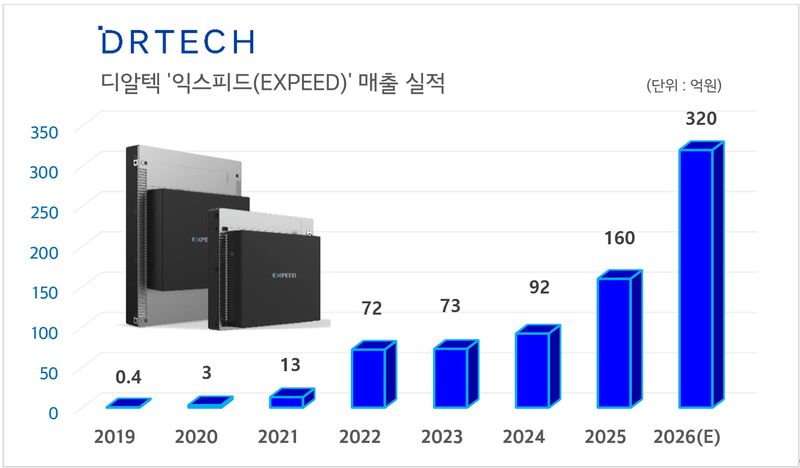
DRTECH said on the 9th that sales of the EXPEED series grew at an average annual rate of 116% from 2020 through last year. Sales rose 47-fold, from 300 million won in 2020 to 16 billion won last year.
Sales of the EXPEED series have continued to grow this year. DRTECH’s first-half EXPEED sales totaled 14.7 billion won, up 88% from the same period a year earlier. The growth rate is even higher when including the dynamic detector used in EXTRON, the surgical C-arm equipment that DRTECH developed in-house and currently sells.
In 2019, DRTECH unveiled the world’s first EXPEED series of dynamic X-ray detectors based on indium gallium zinc oxide (IGZO) TFTs. Compared with conventional amorphous silicon (a-Si), IGZO offers higher electron mobility and lower leakage current.
IGZO TFTs enable rapid image-signal processing, with electron mobility more than 10 times higher than that of a-Si TFTs. This helps reduce noise in low-dose environments and produce high-quality images.
Leveraging this technology, the EXPEED series was selected for the Ministry of SMEs and Startups’ Hidden 100 Champion in Materials, Components and Equipment program. DRTECH has also made a full-scale entry into the dynamic-detector market, previously dominated by competitors from Japan, the United States and France, and has continued to secure new wins.
A DRTECH representative said, “The volume of EXPEED series supplies is increasing significantly as we have secured not only domestic customers but also leading global dental diagnostic-system companies as customers. We also began supplying a leading European dental X-ray company this year.”
In the dynamic-detector market, complementary metal-oxide-semiconductor (CMOS)-based detectors are also considered a major competing technology. CMOS-based detectors are digital X-ray image sensors manufactured using a single-crystal silicon wafer semiconductor process. Active transistor circuits are installed within each pixel to amplify and process optical signals.
In particular, DRTECH’s IGZO TFT-based dynamic detectors are attracting attention as an alternative that can offer both price competitiveness and supply stability amid recent increases in CMOS semiconductor prices and supply uncertainty.
A DRTECH representative said, “Global company A abandoned its CMOS-based detectors and replaced them with IGZO TFT-based detectors, after which it recently increased its order volume. Other dental diagnostic-system companies are showing similar movements, so demand for IGZO TFT-based detectors is expected to rise significantly.”
Meanwhile, DRTECH has invested more than 100 billion won in research and development (R&D) and facilities over the past four years to expand its business into diagnostic imaging systems. By absorbing all one-off costs last year, including expenses related to meeting product requirements from major overseas customers, the company laid the foundation for improving profitability this year.
As a result, DRTECH posted first-half sales of 68.9 billion won this year, up 17% from the same period a year earlier. It also recorded an operating profit of 1.3 billion won during the period, turning profitable from a 2.6 billion won operating loss a year earlier. A DRTECH representative added, “With the momentum from the first half continuing into the second half, we will make this year a turning point for achieving both quantitative and qualitative growth.”
[email protected] Kang Kyung-rae Reporter