Police Launches ‘Public Participation and Field Engagement’ Reform Task Force... Citizens to Evaluate Police Measures
- Input
- 2026-09-09 11:00:00
- Updated
- 2026-09-09 11:00:00
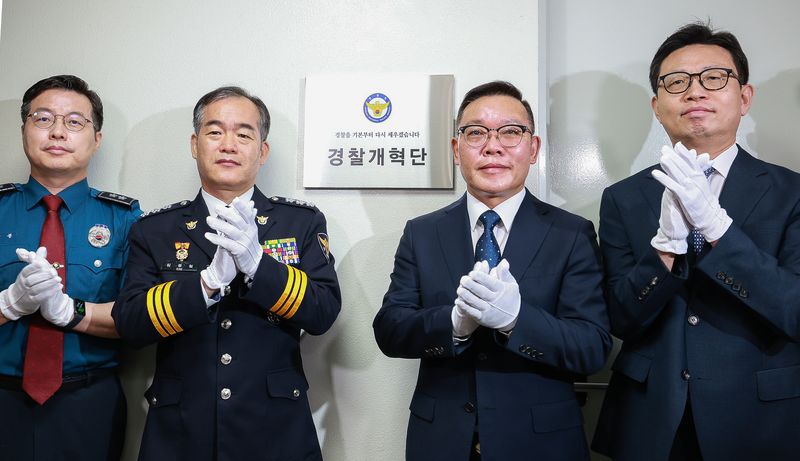
[Financial News] Police are pursuing reform by directly reflecting the views of the public and officers working in the field. They will introduce a ‘Citizen Jury for Police Policies’ system, under which citizens will directly evaluate major police measures, and hold ‘Public Listening Sessions’ across the country to hear from the public.
The Korean National Police Agency officially launched the ‘Public Participation and Field Engagement Police Reform Task Force’ on the 9th and held a ceremony unveiling its sign, where it announced the task force’s operating plans.
The task force will be headed concurrently by the chief of the Autonomous Police Planning Division, taking into account the links among reform initiatives. It will consist of two teams: the Reform Planning Team and the Institutional Improvement Team. After the regular personnel reshuffle in the second half of the year, one superintendent-level team leader, three senior superintendent-level officers and additional working-level staff will be assigned.
Police will pursue a tentatively named ‘100 Days of Police Reform with the Public.’ The initiative aims to move beyond the past practice of police independently devising reform measures and instead pursue reforms centered on public participation. To that end, they will hold nationwide Public Listening Sessions under the theme ‘The Path to Police Reform: Listening to the Public’ and collect opinions through an online channel as well.
The Public Listening Sessions will run from this month through November. In October and November, police will develop measures based on the opinions collected, turn them into specific reform tasks and quickly implement those that are ready for execution. In mid-December, they will hold a ‘100-Day Briefing’ to disclose the progress of the tasks and future plans.
Police will also establish a mechanism for the public to directly evaluate police policies. Under the tentatively named ‘Citizen Jury for Police Policies’ system, citizen jurors will compare and deliberate on various measures prepared by police when issues of significant public interest or concern arise, and assess their appropriateness.
The citizen jury will be operated by creating pools of personnel for each field based on recommendations from representative organizations, ensuring that the voices of diverse groups, including socially vulnerable people and victims, are reflected.
Police will also pursue measures enabling field officers to identify and address operational problems themselves. Through the tentatively named ‘Magnifying Glass Project,’ they will operate a channel for proposals to identify and improve operational blind spots where work may be handled through expedient or distorted methods, as well as inefficient factors. Rewards will be given for outstanding proposals.
They will also operate a tentatively named ‘The Field Officer Goes,’ a task force made up of field employees that directly visits the front lines to identify difficulties and problems. When the task force receives various issues from the field, it will work with the reform task force to develop improvement measures and share the results.
Police said they would avoid showy measures in the reform process and minimize unnecessary burdens and fatigue for field personnel. They will diagnose the organization, staffing and overall workload, reorganize work systems and inspect blind spots in management and supervision.
The task force will also divide responsibilities with existing internal reform bodies. If the National Office of Investigation Committee on Investigation Reform reviews ways to improve the investigation system and related tasks, the reform task force will receive updates on the discussions and support the implementation of future recommendations.
The reform task force is also supporting the development of institutional improvement measures and the implementation of related tasks by the Korean National Police Agency Task Force for Follow-up Measures on the Criminal Procedure Act, which is discussing the police investigation system, personnel and facilities in preparation for the revised Criminal Procedure Act taking effect on the 2nd of next month.
For external police reform bodies expected to be established and operated by the Prime Minister’s Office and the Democratic Party of Korea, the task force will provide materials, attend meetings when requested and offer practical support. It also plans to develop into concrete measures the tasks proposed and formulated by those bodies.
The reform task force will not establish a separate civilian advisory body. As an implementation organization within the Korean National Police Agency, it will communicate with internal and external reform bodies and support the implementation of reform tasks.
Acting Commissioner General Kim Jongcheol said, "We will complete police reform that earns the public’s trust and the field’s support, centered on the voices of the public and officers working in the field."
[email protected] Kim Yeji Reporter