‘K-AI Cities’ to Be Built in Wonju, Cheonan and Asan, Saemangeum, and Gwangju by 2030
- Input
- 2026-09-09 06:00:00
- Updated
- 2026-09-09 06:00:00
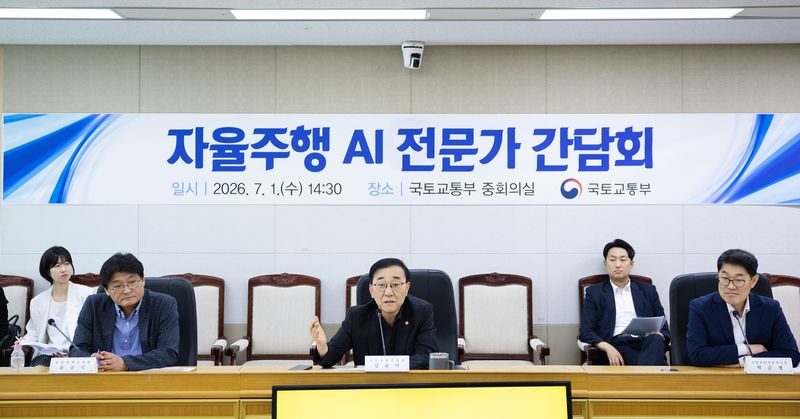
On the 9th, the Ministry of Land, Infrastructure and Transport (MOLIT) announced the K-AI City Implementation Strategy at the 2026 World Smart City Expo held at the Busan Exhibition and Convention Center (BEXCO). Its goal is to establish the relevant legal and institutional framework and business foundation by 2027, and to create AI-specialized pilot cities by 2030.
The implementation strategy consists of five key tasks: discovering AI innovation services; building AI City infrastructure; creating and operating AI-specialized pilot cities; expanding leading models; and establishing a legal and institutional foundation. The plan is to create people-centered cities where AI and robotics technologies can be freely tested, while developing export-oriented cities that bring together Korean technologies and industries.
The pilot cities will be divided into two types according to local conditions. In Wonju and Cheonan and Asan, which were selected through a public competition, the “testbed-type” model will be applied. Under this model, the public sector provides the infrastructure, while private companies develop and validate AI services.
The “model-city-type” approach will be introduced in Saemangeum and Gwangju, where companies and other organizations are expected to make proactive infrastructure investments. The approach involves designing spaces and infrastructure so that AI and robotics technologies can operate from the urban-planning stage.
The government will also develop “AI City + X services,” which apply AI to urban sectors. It will support the development of AI services in land and transport through a competition for private companies, and expand outstanding technologies as flagship K-AI City services. In the public sector, it will first develop and distribute services that citizens can use in their daily lives, such as AI for building administration and AI for urban planning.
Technology levels will be managed in five stages, from foundation building to autonomous cities. A technology roadmap will cover foundation building, spatial recognition, intelligent collaboration, robot control, and autonomous cities. The government will also pursue research and development into urban-operation technologies, including data standardization and refinement technologies and urban-agent platforms.
The infrastructure of an AI City will consist of an urban intelligence center as the “brain,” a data pipeline as the “neural network,” and physical AI and intelligent facilities as the “body.” Centered on the five major regions and three special regions, the government will upgrade existing urban-operation facilities into urban intelligence centers and ensure that data collection and analysis lead to services in the field.
The government will also expand “smart+ buildings,” which use buildings as physical AI platforms. It will establish guidelines containing installation standards for intelligent facilities capable of accommodating robots, autonomous vehicles, and other technologies.
The project-development approach will shift toward an industrial ecosystem in which local governments, companies, and universities jointly participate in everything from service development and commercialization to talent training. The government also plans to operate an “AI and Smart City Solutions Market” connecting organizations that need the services with technology companies.
Overseas expansion will be pursued through a “K-AI City platform” that combines urban infrastructure with AI services. The government will develop export models tailored to the needs of each country and expand them into urban-development projects. It also plans to reorganize the existing K-City Network project around AI Cities and increase the number of overseas cooperation centers.
To establish a legal foundation, the existing Smart Cities Act will be renamed the Artificial Intelligence and Smart Cities Act. The law will define concepts such as artificial intelligence cities and urban data, and include provisions for designating and supporting AI-specialized pilot cities as well as granting regulatory exemptions. Urban-operation regulations for data management, AI risk response, and securing public acceptance will also be introduced, along with planning-based regulatory sandboxes.
Kim Yun-duk said, "We will realize people-centered AI cities in which technology itself is not the goal, and ensure that everyone can experience in daily life the changes created as AI connects cities."
[email protected] Choi Ga-young Reporter