[Editorial] Per-Capita GNI Nears $40,000, but Without Everyday Benefits, It Is Just a Pie in the Sky
- Input
- 2026-09-08 18:55:10
- Updated
- 2026-09-08 18:55:10
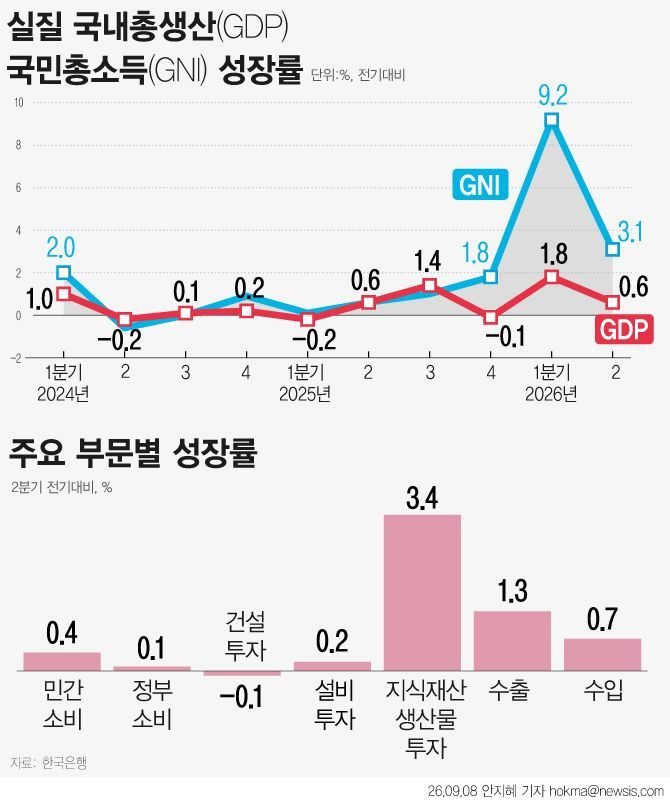
The “dream $40,000” could become a historic indicator that South Korea’s economy has crossed the threshold into the ranks of advanced economies. However, the government’s emphasis on per-capita GNI of $40,000 amounts to little more than a rosy indicator. Given its wide gap with the reality of the economy as experienced by the public, people may feel poverty amid plenty.
First, it is necessary to examine how strong performance in certain sectors, including semiconductors, has lifted the overall indicators. The increase in wealth concentrated in specific industries and large corporations appears to have driven the country’s overall economic report card. It would therefore be misleading to interpret the figures as proof that every household’s finances have improved.
The contrasting fortunes of different industries are also evident in these statistics. Manufacturing and information and communications technology (ICT) each grew by around the mid-1% range, while construction fell 1.9% amid weakness in civil engineering, and agriculture, forestry, and fisheries declined 7.2%. Even when economic indicators rise overall, the gains clearly tend to be concentrated among certain groups. It is also important to note that the income gap between employees in advanced industries and large corporations and those working for small and medium-sized enterprises is widening.
The most serious issue is that the channels through which the achievements of certain industries and companies flow into employment and domestic demand remain narrow and slow. Corporate income has increased because exports have performed exceptionally well, but the benefits must ultimately be distributed more broadly. Of course, higher corporate income can flow into household income through performance bonuses and dividends. It can also become government income through corporate taxes, earned-income taxes, and dividend-income taxes. However, it takes considerable time for this warmth to flow downward, and it is impossible to know how much of the benefits will actually be distributed. In particular, there is no guarantee that expanded semiconductor facility investment will immediately lead to domestic employment.
The macroeconomic environment is also deteriorating. On the 27th of last month, the BOK raised its benchmark interest rate from 2.75% to 3.00%. This was effectively a signal that the low-interest-rate trend had ended and that the economy was entering a period of rate hikes in earnest. During a high-interest-rate period, ordinary households face heavier interest burdens. Since the rate hike was implemented because of rising prices, it also means that lower-income people will face tighter household finances. Moreover, with household debt still at a high level, further rate increases will inevitably reduce spending capacity as repayment burdens rise even if incomes increase.
Greater efforts by the government and political circles are needed to make the era of $40,000 per-capita GNI tangible in people’s everyday lives. People’s livelihoods can improve only when long-standing issues such as stabilizing the real estate market and managing household debt are resolved. Rising income does not represent genuine prosperity if people remain burdened by real estate and debt and their actual spending capacity declines. In addition, turning the current gains created by the semiconductor boom into growth that the majority of the public can feel is the surest way to strengthen the sense that higher income has brought real benefits.