"Government and Companies Must Become One Team to Become Top 3 in AI"... Ha Jung-woo, Vice Chairman of the National AI Strategy Committee (Roundup)
- Input
- 2026-09-08 20:09:18
- Updated
- 2026-09-08 20:09:18
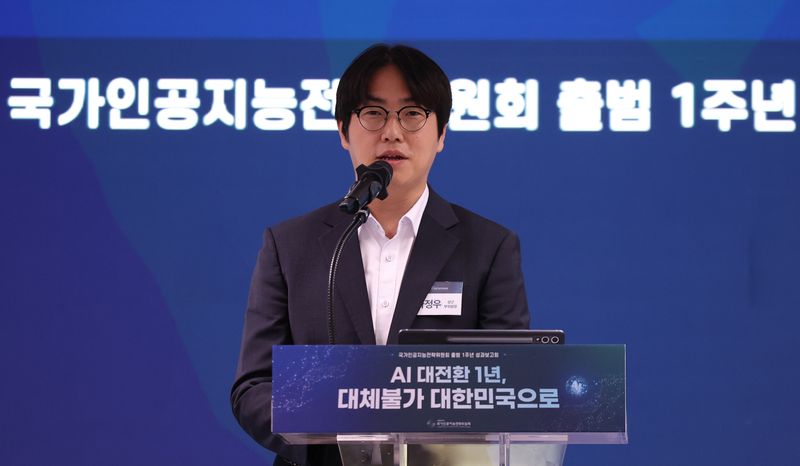
Marking the first anniversary of its launch, the National AI Strategy Committee presented a direction to concentrate its capabilities on full-scale implementation and the creation of results based on the AI policy foundation established so far.
The National AI Strategy Committee held a "1st Anniversary Performance Report Meeting" at Seoul Square on the 8th and announced its policy achievements over the past year and future activity plans. Since its launch last September, the Committee has served as the control tower for domestic AI policy, establishing the national AI strategy and supporting key policies.
Korea's AI ecosystem must create a structure that operates autonomously without government support
Ha Jung-woo, Executive Vice Chairman of the National AI Strategy Committee, emphasized, "If the past year was a time to lay the foundation for a great transformation of the Republic of Korea, now is the time to produce results that the public can feel firsthand," adding, "I will take the lead in making Korea leap forward as an irreplaceable global core AI supply chain nation."
In particular, Vice Chairman Ha emphasized the importance of a "one team" between the government and businesses, stating, "We must create a structure where the market operates on its own even after government support is reduced," and stressed that "the ultimate goal is for the ecosystem created domestically to continue overseas."
He added, "Our country possesses the potential to build a full-stack AI ecosystem based on its AI technology, infrastructure, and manufacturing competitiveness," stating, "We will connect necessary capabilities across ministries and sectors and resolve obstacles on the ground."
"Achievements over the past year laid the foundation for a major AI transformation"
Vice Chairman Ha assessed that the foundation for a major AI transformation had been laid over the past year, including the finalization of the 'Korea AI Action Plan' last February, which contains 99 implementation tasks and 326 policy recommendations under three major policy axes and 12 strategic fields.
Specifically, regarding the fields of technological innovation and infrastructure, it supported the establishment of a utilization system for national AI computing resources, such as graphics processing units (GPUs). It also presented directions for the localization and industrial internalization of AI data center (AIDC) equipment, such as domestically produced neural network processing units (NPUs), and reflected this in the national strategic industrialization plans for AIDCs under the three major mega-projects.
Vice Chairman Ha cited securing GPUs as the biggest achievement of the past year. He said, "Startup CEOs who struggled because GPUs were scarce and too expensive liked it," adding, "I think it provided a great sense of utility."
In the science and medical fields, it supported the establishment of the 'National Strategy for Science, Technology x AI' and the 'K-Moonshot Promotion Strategy,' and lent support to the launch of the National AI for Science Research Center (NAIS). In the field of Industrial AI Transformation (AX) and Ecosystem, it assisted in formulating strategies for the AI transformation of key industries, such as manufacturing, autonomous driving, and humanoid robots.
It also contributed to the social sector by devising measures to address changes in the labor market resulting from the transition to AI. In addition, it supported the proposal of six bills to amend laws aimed at improving the welfare application system to proactively provide necessary welfare services using AI.
In the public AX and data sectors, support was provided for the advancement of the government-wide AI common infrastructure and the establishment of an AI-based integrated civil complaint platform. A comprehensive evaluation system for AI policy performance by ministry was established, and initiatives were also pursued for the AI-friendly management of public data and the improvement of AI recognition efficiency for administrative documents. In the defense and security sector, a defense data catalog was built to expand private sector participation in defense AI development, and in the field of global cooperation, a government-wide global AI governance council was launched to embark on the establishment of national-level AI standardization governance.
"We will shift the focus of policy toward producing tangible results for the public"
The committee plans to shift the focus of future AI policy from laying the groundwork to generating tangible results. In particular, it will accelerate technological innovation by expanding the construction of AI computing infrastructure and enhancing its operations. To this end, it will establish a dashboard to monitor the operational status of real-time computing resources, such as GPUs. It also plans to secure physical AI data by industry and review environments for demonstrating domestic solutions.
To foster innovation in the science sector, we will support K-Moonshot initiatives and follow-up measures for the Research Data Act. We will also review the development status of specialized AI foundation models for various fields, including bio, materials, and healthcare.
In the public sector, a rapid development promotion system for Public AX and Public AX guidelines will be established. Measures for cooperation among national-level AI, data, and technology policies will be concretized, and support will be provided for the activation of 'data assetization' through linkages between finance and accounting. In the regional sector, it was decided to support the creation of an AI ecosystem by linking three major mega-projects and seven SEED projects with regional AX projects.
[email protected] Yoon Hong-jip Reporter