Jeju Haenyeo Demonstrate Sea Urchin Noodles at FAO in Rome, Bringing Their Culture to the Global Fisheries Stage
- Input
- 2026-09-08 16:59:35
- Updated
- 2026-09-08 16:59:35
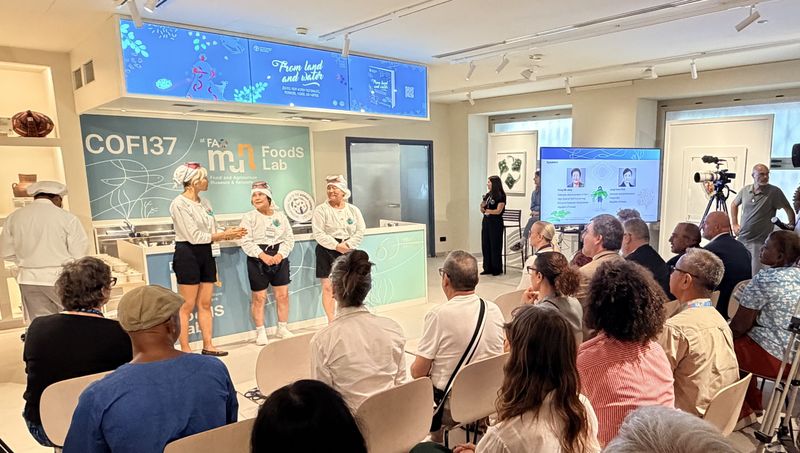
【Financial News Jeju = Reporter Yong-bok Jeong】 Jeju Haenyeo introduced their maritime community culture and cuisine directly on the United Nations stage, where global fisheries policies are discussed. Their lives, shaped by turning seafood harvested through muljil into dishes such as sea urchin noodles, were presented to fisheries officials from around the world.
According to Jeju Special Self-Governing Province and the Food and Agriculture Organization of the United Nations (FAO) on the 8th, six members of the Jeju Haenyeo Association participated the previous day in a special event at FAO headquarters in Rome, Italy, held as part of the 37th Session of the Committee on Fisheries (COFI37).
The event, titled “Blue Foods, Bold Stories,” was co-hosted by FAO, the Republic of Korea and Jeju. It took place for one hour from 12:15 p.m. on the 7th at the FAO MuNe Foods Lab, a food-culture space at FAO headquarters.
The Jeju Haenyeo prepared sea urchin noodles and other haenyeo dishes on site, explaining the muljil culture and community values reflected in the food. They also introduced haenyeo cuisine, including sea urchin and seaweed soup, and held a tasting program.
The event was linked to the unveiling of a cookbook produced to commemorate the UN-designated 2026 International Year of the Woman Farmer. FAO defines women farmers broadly, including not only those engaged in agriculture but also women working in fisheries, aquaculture, processing, distribution and other parts of the agrifood system. This is why Jeju Haenyeo were presented as an example from the fisheries sector representing the International Year of the Woman Farmer.
The cookbook for the International Year of the Woman Farmer, released by FAO, features dishes prepared by women producers from various regions, including Jeju Haenyeo’s sea urchin noodles, an Italian mussel dish, Swahili seaweed curry and Creole-style fish dishes. Rather than focusing solely on the food itself, the book highlights women’s labor and community roles in producing ingredients and managing resources.
The 37th Session of the FAO Committee on Fisheries, where the event was held, is taking place from the 7th to the 11th at FAO headquarters in Rome. The Committee on Fisheries is an intergovernmental forum where FAO member states discuss global fisheries and aquaculture issues and policy directions. Key agenda items at this meeting include illegal, unreported and unregulated (IUU) fishing, climate change, small-scale fisheries and food security.
The Culture of Jeju Haenyeo was inscribed on the Representative List of the UNESCO Intangible Cultural Heritage of Humanity in 2016. International recognition was given not only to the muljil techniques used to harvest seafood without oxygen-supply equipment, but also to the transmission of knowledge among haenyeo, community governance and the culture of jointly managing marine resources.
The significance of the Rome event lies in the way it expanded the international presentation of the Culture of Jeju Haenyeo, following its UNESCO inscription, from “cultural heritage” to women’s livelihoods, fisheries-resource management and food culture.
Kim Jong-su, director of Jeju’s Ocean and Fisheries Bureau, said, "It was an opportunity to directly share with the world the food culture of Jeju Haenyeo, their protection of fisheries resources and the values of their women’s community." He added, "We will continue sharing the sustainable Culture of Jeju Haenyeo with the international community."
[email protected] Yong-bok Jeong Reporter