How Will AI Change Jobs, Income and Welfare? Committee for Basic Society Launches Public Deliberation
- Input
- 2026-09-08 16:50:06
- Updated
- 2026-09-08 16:50:06
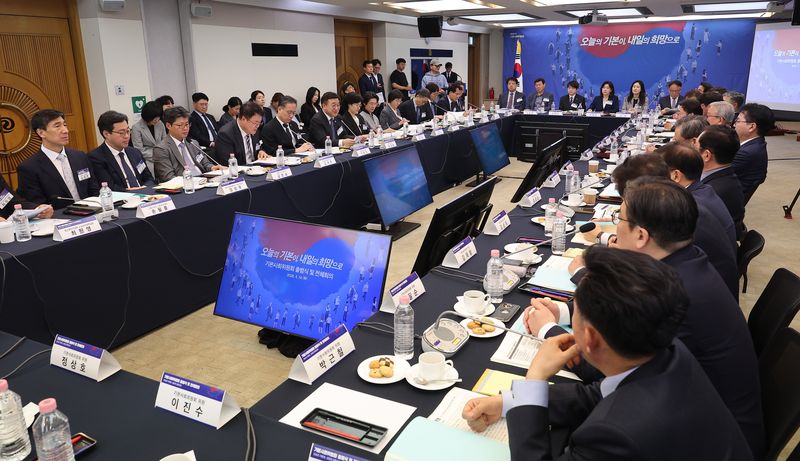
[Financial News] As the spread of artificial intelligence (AI) is expected to transform jobs, income, healthcare, welfare and other aspects of daily life, 200 citizens will directly discuss what a basic society should look like in the AI era. Following further discussions involving experts and citizen representatives, the deliberation results will lead to concrete policy proposals in November.
The presidential Committee for Basic Society said on the 8th that it would launch public deliberation on the basic society in the AI transition by holding the “National Participation Forum for Public Deliberation on a Basic Society” on the 9th.
The deliberation will examine social changes resulting from the AI transition and address income security, basic services, jobs, funding, and reinvestment as key agenda items.
The Citizen Deliberation Panel selected 200 people from among citizens aged 15 or older nationwide through random digit dialing (RDD), taking into account the proportional distribution of the population by gender, age and region. In particular, half of the panel, or 100 members, consists of adolescents and young adults aged 15 to 34, reflecting that this generation is likely to experience the social changes brought by the AI transition for a relatively longer period.
The panel will begin a 10-day preliminary deliberation period from the 9th through the 18th. Participants will study topics including the AI transformation, basic society, jobs, income security, basic services, funding and reinvestment through briefing materials and online lectures, while also asking questions of experts.
A two-day, one-night deliberative conference will then be held from the 19th to the 20th at the convention center of Seoul National University Siheung Campus. Based on the social changes AI is expected to bring, the panel will discuss “what a basic society should look like in the AI era.” The committee also plans to examine how participants’ views of a basic society are formed and change during the discussions.
This public deliberation will follow an “agenda-forming” approach that identifies policy issues through citizen discussions rather than dividing participants into opposing sides. Another distinctive feature is that the results will not end with a single discussion but will be connected to subsequent policy design.
In October, the committee will form a 40-member Policy Agenda Planning Group consisting of 20 experts and 20 representatives of the Citizen Deliberation Panel. The group will review the future vision and policy directions emerging from the deliberation process, prepare a proposal containing concrete policy agendas and strategic tasks, and submit it to the committee in November.
The committee plans to consult and coordinate with relevant ministries on the proposals, reflect them in new policies, and conduct follow-up public deliberation if necessary.
Citizens who are not part of the panel can also submit their opinions. From the 9th through November 30, the committee will operate the “National Participation Forum for Public Deliberation on a Basic Society,” publish briefing materials and presentation videos, and accept policy proposals from the general public. The submissions will also be used as reference material for future discussions on policy agendas.
Kang Nam-hoon, vice chair of the Committee for Basic Society, said, “A basic society in the era of the AI transition is a future that the government and citizens must build together,” expressing his intention to turn the public’s deliberation results into policy through this process.
[email protected] Lee Bo-mi Reporter