Symposium Held to Chart the Direction of Ulsan’s Flagship Festival... Future of Cheoyong Culture Festival Discussed
- Input
- 2026-09-08 18:13:00
- Updated
- 2026-09-08 18:13:00
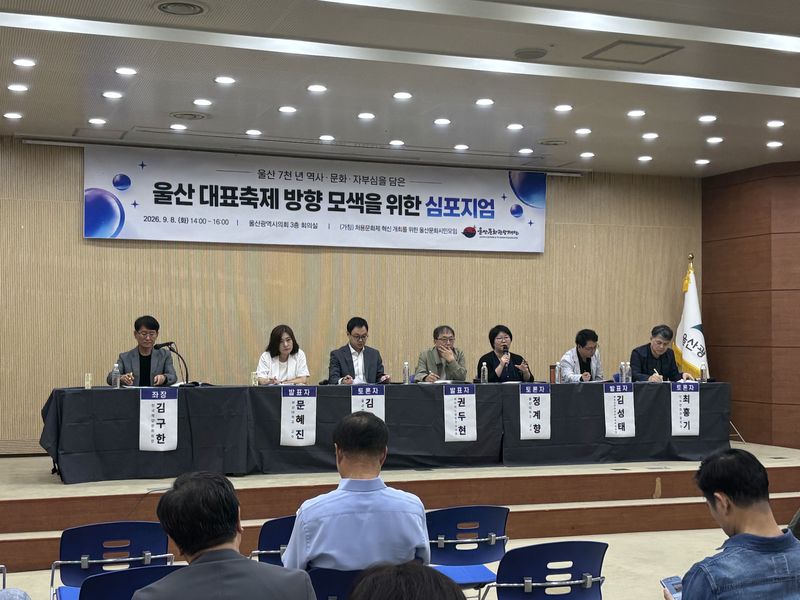
【Financial News Ulsan = Choi Su-sang, Reporter】With the revival of the Cheoyong Culture Festival anticipated, a symposium to explore the direction of Ulsan’s flagship festival was held at 2 p.m. on the 8th in the third-floor chamber of the Ulsan Metropolitan Council. The event was hosted by the Ulsan Cultural Citizens’ Association.
The symposium was organized to explore the direction of a new flagship festival that would embody Ulsan’s 7,000-year history and culture, extending from the Petroglyphs along the Bangucheon Stream, as well as the pride of its citizens. The event was particularly meaningful because it emphasized the importance of transforming Cheoyong, the symbol of the Cheoyong Culture Festival, not into an object of faith but into a shared urban asset for future generations. This would be achieved by embracing Ulsan’s 7,000-year history and culture through the spirit of Cheoyong—one of inclusion, harmony, coexistence, and convergence.
The Ulsan Cultural Citizens’ Association, which organized the symposium, assessed that the Ulsan Industrial Festival and the Cheoyong Culture Festival had served as the city’s flagship festivals. However, it has consistently maintained that the festivals must be transformed into a new flagship event that expands citizen participation and broadly incorporates Ulsan’s diverse historical and cultural resources, as well as the city’s identity, in response to changing times.
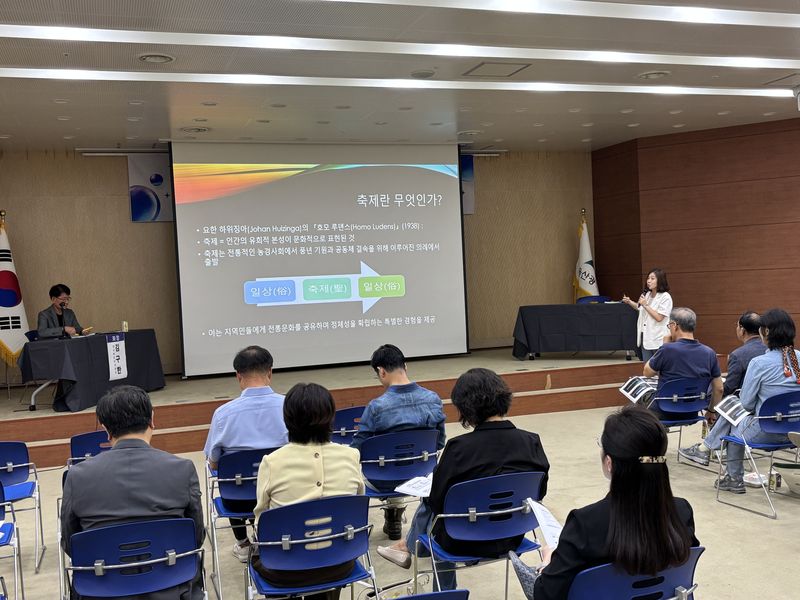
Hyejin Moon, a professor at Pusan National University, Doohyun Kwon, a professor at Andong National University, and Seongtae Kim, former head of the festival promotion team at the Ulsan Cultural Foundation, gave thematic presentations at the symposium.
In her keynote presentation, Professor Hyejin Moon explained the meaning and functions of local festivals and emphasized cultural, social, and economic benefits as conditions for their success. She also identified problems with Korean festivals through a comparison with festivals in Japan and South Korea, and presented the Cheoyong Culture Festival’s potential as a local intangible cultural heritage festival.
Professor Doohyun Kwon assessed the Ulsan Industrial Festival and the Cheoyong Culture Festival as local festivals. He called for restoring their character as festivals rather than mere events and carefully outlined the innovation challenges facing the Cheoyong Culture Festival. In particular, he suggested that a new paradigm was needed, saying, “A hammer is a musical instrument, and a horn is music.”
Seongtae Kim, former head of the festival promotion team at the Ulsan Cultural Foundation, called for a shift in the interpretation of Cheoyong toward coexistence and harmony in a presentation titled “The History of Ulsan Festivals and the Future of the Cheoyong Festival.” He emphasized that what the Cheoyong Culture Festival needs today is not a restoration of its past form, but a rediscovery of Cheoyong’s values.
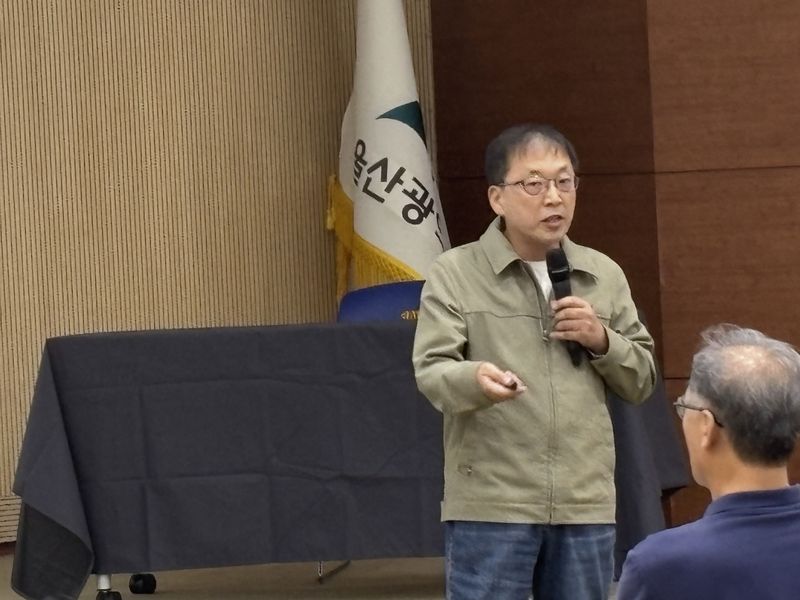
The ensuing discussion featured Gwangyong Kim, a researcher at the Ulsan Research Institute; Gyehyang Jeong, director of the Humanities Research Institute at the University of Ulsan; and Heunggi Choi, a doctor of folk performance and dance studies. Guhan Kim, president of the Korea Institute of Maritime Culture, moderated the session.
The discussion was distilled into three points. First, rather than simply restoring the former Cheoyong Culture Festival, Cheoyong’s values of inclusion and harmony should be newly interpreted to suit Ulsan today. Second, the festival should shift from one that is “shown” to one that is “created together by citizens,” making citizens and local cultural and artistic practitioners the main actors in planning and participating in the festival. Third, Ulsan’s diverse historical and cultural resources—including the Petroglyphs along the Bangucheon Stream—should be reinterpreted in contemporary ways and connected to new content and genres so that the festival can develop into a distinctive flagship event unique to Ulsan.
It was particularly emphasized that Ulsan’s flagship festival, which would replace the Ulsan Industrial Festival, should become both a festival and a platform for cultural imagination and the release of energy. Through coexistence and harmony, it should use Ulsan’s rich 7,000-year cultural heritage to open the way for the city’s next generation.
[email protected] Choi Su-sang Reporter