Jeju Open-Field Tangerine Production Forecast at 443,300 Tons; Sugar Content Hits Record 8.5 Brix
- Input
- 2026-09-08 16:53:18
- Updated
- 2026-09-08 16:53:18
【Financial News Jeju = Jung Yong-bok】 Jeju’s open-field tangerine production is expected to increase to approximately 443,300 tons this year. Average sugar content reached 8.5 Brix, up 1.1 Brix from last year, and the Jeju Special Self-Governing Province Agricultural Research and Extension Services assessed overall quality as the highest since observations began.
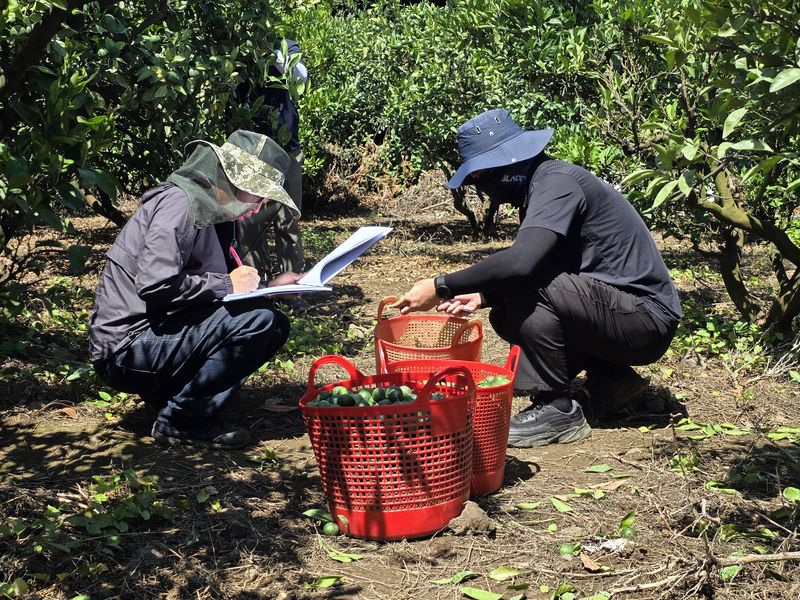
According to the Jeju Special Self-Governing Province Agricultural Research and Extension Services and the Citrus Observation Survey Committee on the 8th, estimated production was calculated at approximately 443,300 tons in the second 2026 fruit-set observation survey. The survey was conducted from August 19 to 25 at 320 sites involving 640 trees across the province.
The estimated range is 425,300 to 461,300 tons. This is 32,400 tons more than last year’s production of 410,900 tons, and the agricultural research and extension services forecast a 7.8% increase.
This figure is not the final production estimate. It is a second observation based on 13,524 hectares, excluding 448 hectares where trees are not bearing fruit because of mature-tree transplantation, variety and top-grafting renewal, and half-tree thinning, from the total cultivated area of 13,972 hectares. The agricultural research and extension services will conduct another survey of quality and the defective-fruit rate in November before issuing the final production estimate.
The increase in production was particularly evident in the number of fruit on each tree. The average was 909 fruit per tree, 109 more than last year’s 800 and 96 more than the five-year average of 813.
Regional differences were substantial. Jeju City recorded 813 fruit per tree, an increase of 301 from last year. This reflected the effects of alternate bearing following last year’s low fruit set. Alternate bearing refers to the recurring pattern in fruit trees of producing many fruit one year and few the next. The fruit set in the Hallim area increased more than sevenfold from last year.
Seogwipo City recorded 941 fruit per tree, 80 more than last year and 43 more than the five-year average. The number of fruit increased in every surveyed area except Namwon, while Daejeong recorded more than six times last year’s figure.
Fruit size in Jeju City averaged 41.9 millimeters, down 3.7 millimeters from last year, while Seogwipo City averaged 43.6 millimeters, unchanged from last year. Along with the increase in fruit set, fruit enlargement in the coming period remains a variable that could determine the final production volume.
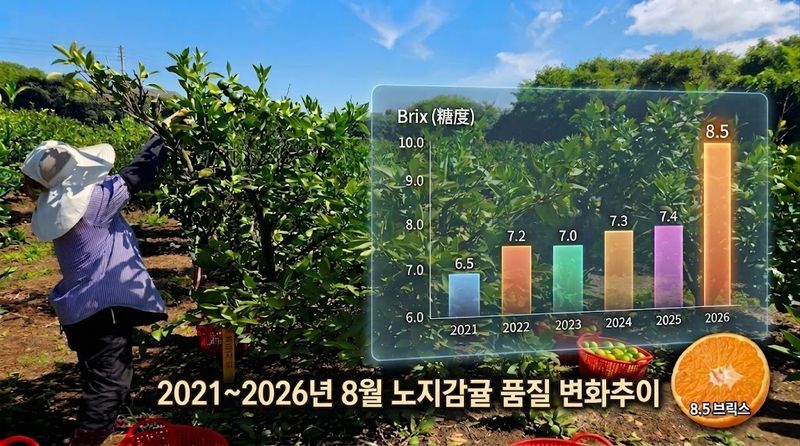
Sugar content was the most notable indicator in this year’s survey. The average was 8.5 Brix, 1.1 Brix higher than last year’s 7.4 Brix and 1.4 Brix above the five-year average. By region, Jeju City recorded 9.0 Brix and Seogwipo City 8.1 Brix. Brix measures the concentration of dissolved solids in fruit juice and is a key indicator used to assess the sweetness of tangerines.
Acid content was 3.14%, up 0.23 percentage points from last year but 0.15 percentage points below the five-year average. The results showed a quality trend of higher sugar content alongside acid content below the recent average.
The agricultural research and extension services analyzed that weather conditions during fruit enlargement were favorable for quality. Rainfall in July and August was 115.3 millimeters and 92.4 millimeters below normal, respectively, while sunshine duration was 36.5 hours and 16.9 hours above normal. Average temperatures during the same period were also 2.0 degrees Celsius higher than normal in July and 1.8 degrees higher in August.
Kim Tae-gyun, director of the Jeju Special Self-Governing Province Agricultural Research and Extension Services, said, "While production is expected to increase from last year, quality is also at its highest level since observations began. We will closely monitor growth conditions amid abnormal weather and provide observation data based on field information."
[email protected] Jung Yong-bok Reporter