Connecting 'Island Emergency Medical Services' by Helicopter... Two Jeju Safety Policies Designated as Nationwide Best Practices
- Input
- 2026-09-08 16:21:45
- Updated
- 2026-09-08 16:21:45
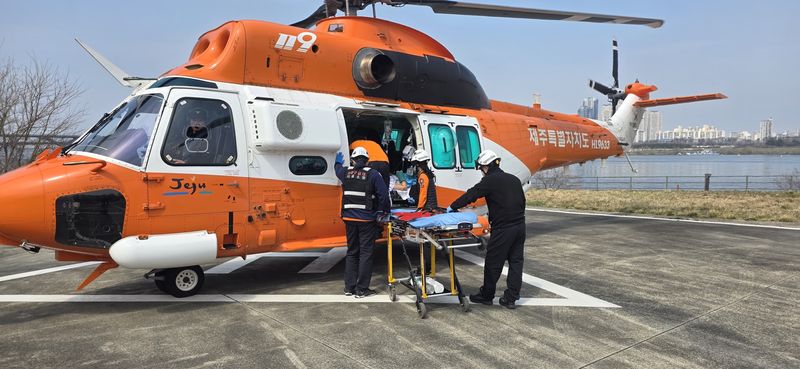
[Financial News Jeju = Reporter Jeong Yong-bok] Two safety policies from Jeju have been selected as national best practices: one involving the transport of critically ill patients requiring mainland treatment and pregnant women at risk of premature birth via fire department helicopters, and the other involving the institutional recognition of ordinary citizens and paramedics who saved cardiac arrest patients. Both the aerial ambulance service, which complemented the limitations of emergency medical access in island regions, and the institutionalization of measures to expand citizen participation in cardiopulmonary resuscitation were recognized.
According to the Jeju Special Self-Governing Province Fire Safety Headquarters on the 8th, the National Fire Agency (NFA) selected the Jeju 119 Air Unit’s “establishment of an ECMO transport system and reassuring care policy for pregnant women at risk of premature birth” and the ambulance team’s “enactment of the Heart Saver Day ordinance” as major special achievements and best practices to realize the value of “public safety first.”
The 119 Aviation Unit has strengthened its air ambulance system to transport critically ill patients who are difficult to treat within the province to specialized medical institutions outside the province using the fire department helicopter Hallamae. This decision was made based on the judgment that, given Jeju's separation from the mainland, securing a means to rapidly transport emergency patients out of the province is directly linked to saving lives.
Extracorporeal membrane oxygenation (ECMO) is a device that assists cardiopulmonary function by extracting blood from patients with significantly impaired heart or lung function, supplying oxygen, and then re-infusing it. Transporting a patient while the equipment is applied requires close cooperation between medical staff and air units, as well as a specialized transport system.
The Jeju Fire Department is operating a system to transfer ECMO patients to specialized medical institutions outside the province using Hallamae. On March 24, an ECMO patient was also transferred using Hallamae.
The scope of air ambulance services has been expanded to include pregnant women at risk of premature birth. The 119 Air Unit operates the '119 Safe Care Service' for pregnant women being urgently transported to mainland hospitals. It also provides supplies, such as diapers for premature babies, to help alleviate anxiety during the transport process.
The institutionalization of 'Heart Saver Day,' spearheaded by the Jeju Fire Department's ambulance team, was also recognized as an exemplary case. Jeju became the first in the nation to establish the 'Ordinance on the Designation and Operation of Jeju Special Self-Governing Province Heart Saver Day.' This provides the institutional basis to honor those who contribute to saving lives through emergency treatment in critical situations, such as cardiac arrest, and to spread the importance of cardiopulmonary resuscitation (CPR) throughout the community.
The Heart Saver program is a system that certifies ordinary citizens and paramedics who have contributed to the resuscitation of cardiac arrest patients by performing cardiopulmonary resuscitation (CPR) or using automated external defibrillators (AEDs). Jeju Province plans to use Heart Saver Day to raise awareness of the roles played by residents and paramedics who saved lives on the scene, and to expand participation in the initial response to emergencies.
This selection is also significant as it represents a case where Jeju overcame the geographical constraints of being an island through on-site safety policies. It addressed different gaps in emergency medical services by strengthening the air transport system for critically ill patients and institutionally incentivizing ordinary citizens who participated in the initial on-site response to cardiac arrests.
Park Jin-su, Head of the Jeju Special Self-Governing Province Fire Safety Headquarters, stated, "We will continuously identify safety policies that reflect Jeju's regional characteristics and on-site conditions to provide fire services that residents can tangibly experience."
[email protected] Jeong Yong-bok Reporter