"I'd rather buy stocks than put 100 million won in"... One year after the deposit insurance limit was raised, no 'money move' at savings banks
- Input
- 2026-09-08 17:37:14
- Updated
- 2026-09-08 17:37:14

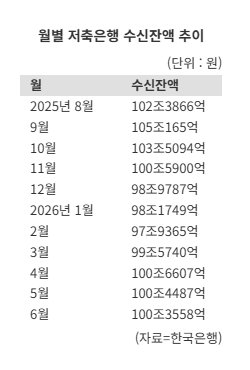
According to the Bank of Korea (BOK) on the 8th, the outstanding balance of deposits at savings banks stood at 100.3558 trillion won as of the end of June, an increase of 1.3772 trillion won (1.4%) from the end of last year (98.9786 trillion won). On the other hand, compared to the end of August last year (102.3866 trillion won), just before the increase in the deposit insurance limit, it decreased by 2.0308 trillion won (2.0%).
At the time the deposit insurance limit was raised, there was high expectation that funds would shift to savings banks. This is because even if more money is deposited into savings banks that offer relatively higher interest rates, the principal and interest can be protected.
Immediately after the actual implementation of the system, there was a temporary inflow of funds. As of the end of September last year, the outstanding deposit balance of savings banks stood at 105.0165 trillion won, an increase of 2.6299 trillion won in just one month. However, starting with a drop to 103.5094 trillion won at the end of October, it declined for five consecutive months. Subsequently, as savings banks raised deposit interest rates to defend their deposits, the balance increased slightly and recovered to over 100 trillion won last June.
The shift of funds to the stock market is cited as the reason why the money move to savings banks did not continue. As the KOSPI Composite Index rose sharply this year, funds that had been held in deposits and installment savings were seen moving into the stock market. The KOSPI Composite Index started at 4,224.53 on January 2, the first trading day of the year, and soared to 9,385.59 during trading on June 19. This represents a rise of 122.2% in just over six months.
Savings banks themselves did not have a strong incentive to expand deposits. With lending regulations and the resolution of non-performing real estate project financing (PF) loans making it difficult to aggressively increase loan assets, savings banks had little need to actively attract deposits by offering high interest rates. The average interest rate on one-year fixed deposits at savings banks remained in the 2% range during the second half of last year and has been fluctuating in the 3% range this year.
As such, with the effect of increased deposits following the raising of the deposit insurance limit not being significant, the burden of deposit insurance-related costs appears to be growing. The savings bank sector paid 387.3 billion won in deposit insurance premiums during the first half of this year. This amounts to 50.6% of the sector's net profit of 765.8 billion won during the same period. When the 94.4 billion won in special contributions to the Deposit Insurance Fund Bond Redemption Fund is added, the total amount paid for deposit insurance reaches 481.7 billion won.
Financial authorities are gathering opinions from the industry regarding the recalculation of deposit insurance premium rates. Savings banks are already subject to higher deposit insurance premium rates than other financial sectors. The current standard deposit insurance premium rate for savings banks is 0.40% per annum, which is five times that of commercial banks (0.08%).
"There were predictions that large amounts of capital would flow into savings banks due to the increase in the deposit insurance limit, but the impact of interest rates and fund management conditions was greater," said an official from the savings bank industry. "If the deposit insurance premium rate also rises, the cost burden on the sector will inevitably increase."
[email protected] Ye Byeong-jeong Reporter