Heavy Reliance on Patent Attorneys for Patent Advice...Companies Say “ACP Protection Gap Must Be Closed”
- Input
- 2026-09-08 15:54:00
- Updated
- 2026-09-08 15:54:00
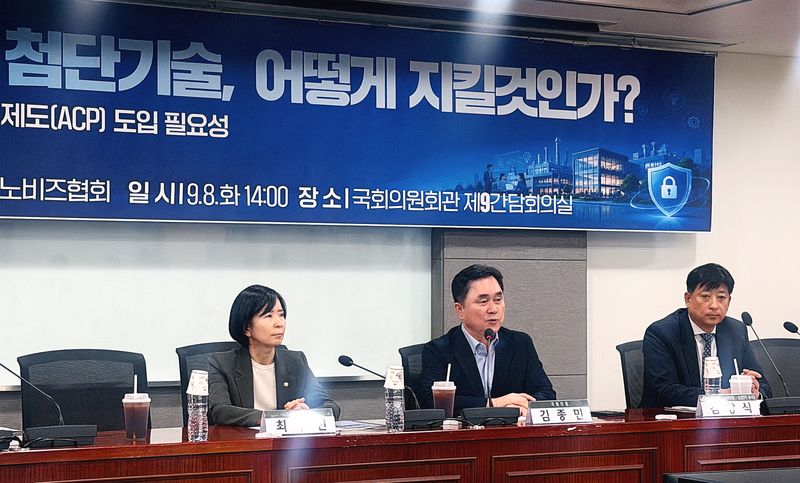
[Financial News] The need to introduce an attorney-client privilege system (ACP) to protect expert technical advice exchanged between Korean companies and patent attorneys in preparation for patent disputes has been raised. With attorney-client privilege for lawyers set to take effect in February next year, there are no explicit protection rules for advice from patent attorneys. This has prompted concerns that companies’ technology and patent strategies could be disclosed in overseas patent litigation and other proceedings.
A policy meeting was held on the 8th at the National Assembly Members’ Office Building in Yeouido, Seoul, hosted by Kim Jong-min of the National Assembly’s Trade, Industry, Energy, SMEs, and Startups Committee. Under the theme, “How Can Small and Venture Companies Protect Advanced Technologies?”, participants discussed measures to establish ACP protection for patent attorneys.
The key issue is a “gap in the right to mount a defense” created by the legal amendments. An amendment to the Attorney-at-Law Act passed in February codified attorney-client privilege between lawyers and their clients. It will take effect on February 20, 2027, but patent attorneys are excluded from its scope.
Yeo Woo-seok, chairman of KINPA’s policy committee and an executive at LG Energy Solution, cited the Astra case in a United States court. He noted that if only attorney-client privilege for lawyers is introduced, uncertainty could grow over how United States courts will treat documents containing advice from Korean patent attorneys in the future. He also warned that patent attorneys handle a substantial portion of infringement analyses and design-around work in advanced industries such as semiconductors and batteries. If related materials are disclosed during litigation, companies’ technology strategies could be exposed.
Companies were also found to rely heavily on patent attorneys. According to a survey of 76 INNOBIZ companies presented by Kim Se-jong, director of the Seongnam Innovation Support Center, 60.5% of respondents relied on external representatives without dedicated in-house intellectual property (IP) or legal personnel. When outsourcing IP-related work, 94.7% used patent attorneys, while 76.3% said patent attorneys were their first point of consultation when patent disputes arose.
Mico Ceramics, a mid-sized company specializing in components for semiconductor equipment, said it had received 772.5 hours of in-depth external IP advice through patent attorneys from 2021 through recently. Because analyses of competitors’ patent claims and design-around materials are directly linked to technical trade secrets, Mico Ceramics expressed concern that disclosure during litigation could be used against the company in disputes over whether infringement was willful.
The introduction of a Korean-style evidence-disclosure system is also linked to discussions on ACP. The amended Win-Win Cooperation Act, passed by the National Assembly in January, introduced expert fact-finding, examination of the parties, and orders to preserve evidence in lawsuits seeking damages for the misappropriation of small companies’ technologies. The amended law will take effect on February 20, 2028.
Kim Chang-sik, senior vice chairman of KINPA and a vice president at Samsung Electronics, said, “Attorney-client privilege for patent attorneys will enable communication between companies and their representatives and serve as a foundation for creating strong patents.” He urged the National Assembly to pass the amendment to the Patent Attorney Act promptly.
Kim Jong-min said, “Amid the rapidly changing global competition for technological supremacy, protecting the core intellectual property of Korean companies without any gaps is a national task. By listening to voices from the industrial sector, the National Assembly will do its utmost to provide the necessary policy and legislative support so that our companies’ right to defend their technologies can be effectively guaranteed.”
[email protected] Kim Mi-hee Reporter